
Editor's Note
This editor’s note highlights the key facts and market implications behind “Domus Antoniolupi: Where the Bathroom Becomes a “, with emphasis on sourcing, product fit, fabrication, logistics, or buyer impact.
At the Salone del Mobile, the Tuscan company presents a 900-square-meter stand inspired by the Roman house. Designed by Giorgio Rava, the space overturns the typical trade fair logic: architecture first, then products. A conversation with Andrea Lupi.
In the Roman domus, every room had a name, a function, and a precise rhythm. The spaces were organized along a continuous axis, from the atrium to the tablinum to the peristyle, in a sequence where the passage from one room to another was both architectural and social. The domus was an integrated system: each room dialogued with the others, and the quality of living was measured in the coherence of the whole. This idea of space is relevant again today in how we think about the home, and particularly the bathroom. For decades confined to a purely technical function, this room has acquired a new centrality: it has become the place for self-care, an intimate but no longer isolated environment, which opens up and blends with the rest of the house. The distinction between day zone, night zone, and bathroom has become an increasingly thin border, requiring not only technical expertise but a design vision capable of bringing together functionality, material, and emotion.
This is precisely the territory of investigation for Antoniolupi, a Tuscan company that for years has extended its research from the bathroom environment to the living area, bringing the same quality of materials, the same formal coherence, and the same sartorial attitude to design to both realms. For the Salone del Mobile 2026, the company will translate this vision into architecture with the Domus Antoniolupi: not a trade fair setup in the traditional sense, but a space to traverse and inhabit.
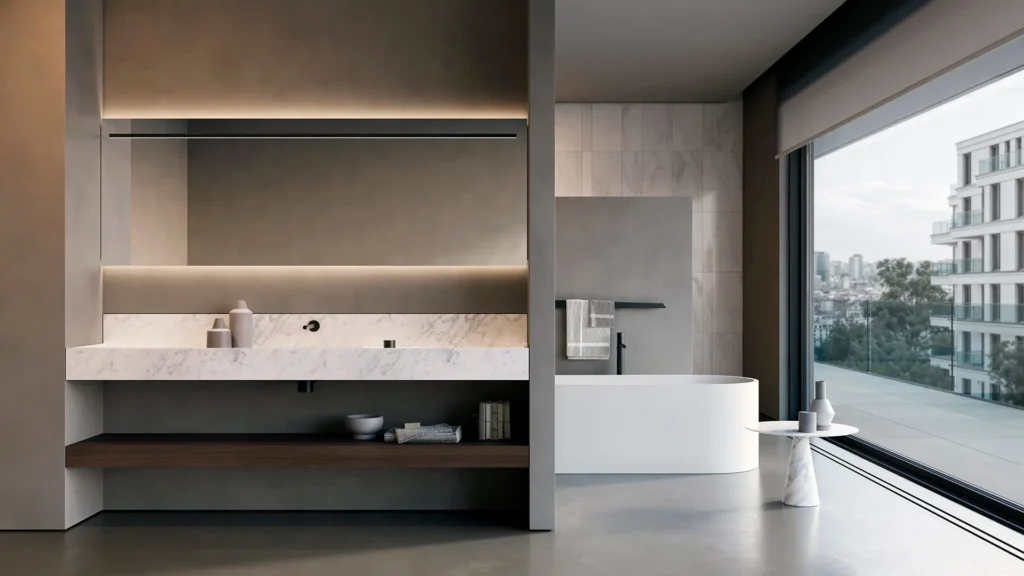
The project, signed by Giorgio Rava, will develop as a sequence of five rooms organized around a central space, following the layout of the atrium in the ancient Roman house. Each room will offer a different interpretation of the relationship between bathroom and living, creating environments where furnishings, surfaces, and water-related elements will coexist within a single domestic landscape.
This year Antoniolupi wants to reverse the usual order of things.
“Usually you have the products and then ask an architect to build a setup around them. We worked the opposite way,” recounts Andrea Lupi, CEO and art director of the company. “The Domus project was born first, and then the products were born. It’s as if we made them in function of the space, of the presentation.”
The stand – approximately 900 square meters in Pavilion 22 (A05–A07), accessible only through guided tours – will be configured as an installation where the fusion between bathroom and living takes concrete form.
“We want to tell the new image of Antoniolupi,” explains Lupi, “and make it felt that these two worlds can coexist in the same space.”
“Unlike many trade fair setups, where there is a tendency to show the greatest number of finishes possible, we chose only two materials: Evo oak and Botticino marble. Essentiality and coherence,” recounts the art director.
The Evo oak is a new natural and tactile finish; paired with Botticino, it will define a warm and uniform chromatic landscape where the products will emerge without competing with the context.
Within the Domus Antoniolupi, different design souls will coexist, united by the same root: research on material and interaction with water. On one hand, there is Carsico, the sink-sculpture signed by Paolo Ulian, born from a reflection on marble coring.
“It’s a poetic sink,” defines Andrea Lupi. “From the coring process came an object that I define as an organ. The CNC machine does a third of the work: the rest is craftsmanship, we return to the old artist who sculpted stone.”
On the other hand, there is Sensor technology, applied to the Lineadacqua collection by Giorgio Rava: a system that completely eliminates traditional faucetry.
“With sensors, you regulate the temperature and power of the water, just bring your hand close for it to come out. You don’t touch anything anymore,” recounts Lupi.
Presented last year for the sink, the technology will now be extended to bathtub and shower.
Among other novelties, Michele Vitaloni signs Nazionale, a line of faucetry with rigorous geometries; Brian Sironi presents Lilium, a sink inspired by the shape of the flower; Carlo Colombo designs Slide, a monolithic bathtub made from a single block of marble. The stand will also host the Batua horsehair rugs by Nevio Tellatin and a new capsule collection of porcelain stoneware coverings signed by Carlo Colombo, Gumdesign, Giorgio Rava, and Mario Trimarchi.
“There is innovation, research, design, project coherence. Those who come will perceive it,” concludes Andrea Lupi.
It is perhaps the best synthesis of what the Domus Antoniolupi will try to be: not a stand to visit, but a project to inhabit. Even just for the time of a frenetic visit to the Salone.
Source: Read the original article | Published: April 08, 2026