
Editor's Note
This editor’s note highlights the key facts and market implications behind “Global Expanded PVC Sheet Market Analysis: Size,”, with emphasis on sourcing, product fit, fabrication, logistics, or buyer impact.
Expanded PVC sheet is a lightweight, rigid or semi-rigid plastic sheet formed by expanding polyvinyl chloride (PVC) resin with chemical or physical foaming agents to create a uniform closed-cell foam structure. It features low density, excellent rigidity, moisture resistance, chemical resistance, flame retardancy, and high printability and workability. It is widely used in advertising, construction, furniture, and industrial manufacturing as a substitute for wood, MDF, and solid plastics. The expanded PVC sheet industry chain has a clear hierarchical structure. The upstream consists of PVC resin manufacturers, chlorine and ethylene suppliers, as well as various additive manufacturers for stabilizers, plasticizers, impact modifiers, lubricants, pigments, and foaming agents, plus extrusion equipment and mold suppliers. The midstream involves processors responsible for formulation design, high-torque twin-screw extrusion, calibration (cooling and shaping), surface treatment, lamination, and panelization via CNC cutting. Downstream, products are supplied through distribution networks to advertising contractors, building material distributors, furniture manufacturers, and transportation vehicle interior outfitters.
I. Industry Chain Vertical Integration and Recent Equipment Investment Trends
Ongoing or planned expanded PVC sheet-related projects are not limited to mere production capacity expansion. Specifically, they include: ① New additions of high-output twin-screw foamed sheet extrusion lines; ② Construction of new multi-layer co-extrusion board plants; ③ Automation enhancement via in-line density and thickness monitoring; ④ Establishment of regional manufacturing bases adjacent to construction and advertising industry clusters; ⑤ Strengthening cost competitiveness through backward integration into formulation lines; ⑥ Improvements in flame retardancy and low-VOC formulations; ⑦ Operation of pilot lines for foamed sheets using recycled PVC; and ⑧ Expansion of export facilities for wide-format sheets targeting Asia and the Middle East. These investments are driven by growing demand in markets for lightweight substrates for signage, prefabricated building materials, and lightweight furniture alternatives.
II. Technical Barriers and Unique Perspective: The Difficulty of Closed-Cell Structure Control
An often-overlooked perspective by industry stakeholders is that the quality of expanded PVC sheet is determined not just by "foam expansion ratio," but by "uniformity of cell diameter" and "smoothness of the surface skin layer." Ensuring high-definition UV printability, particularly as required for advertising and display applications, necessitates proprietary formulation technology that balances surface hardness and ink adhesion. Furthermore, in construction applications, requirements for high flame-retardant grades (self-extinguishing) to comply with recent building code amendments have become stricter, making the matching of decomposition temperatures between phosphorus-based flame retardants and foaming agents a technical challenge. Major manufacturers have built market entry barriers by keeping this formulation know-how as a black box.
III. Competitive Environment and Regional Market Disparities
The key companies covered in this report include global players such as SIMONA, Palram, 3A Composites, VEKA, Plaskolite, Kömmerling, and Inteplast Group, as well as high-growth Asian-based companies like China's Xiaodan New Material, Zibo Dingtian Plastics, Jinbao Group, and Hangzhou Jianguan Plastic. By product segment, rigid PVC foam boards hold the majority of the market for structural materials and advertising signage, while flexible PVC foam sheets are specialized for cushioning and automotive interior skins.

By application, the advertising and display sector maintains a high growth rate as a substrate for digital signage, while demand in the construction sector remains stable for interior/exterior substrates and formwork alternatives. Regionally, it is estimated that last year, the Japanese market accounted for a certain share of the global market, with its share performing steadily. Domestically in Japan, the solid remodeling market and the characteristics of expanded PVC sheets—being lightweight and offering excellent workability—are valued, leading to ongoing substitution from wood-based materials. Meanwhile, the US market, while influenced by fluctuations in housing starts, is underpinned by demand for interior materials in commercial facilities.
IV. Future Outlook: The Dual Drivers of Sustainability and Lightweighting
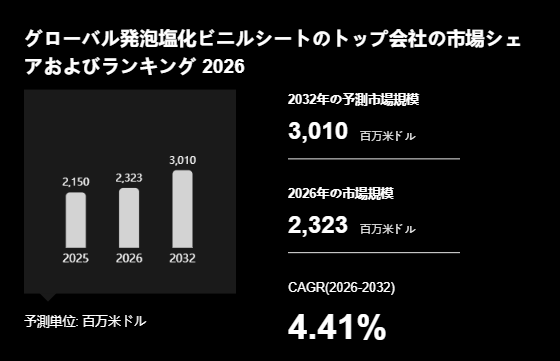
From 2026 to 2032, the global expanded PVC sheet market is forecast to maintain a stable compound annual growth rate (CAGR), centered on the advertising and construction sectors. In particular, lightweighting needs accompanying automotive electrification and suitability for labor-saving construction on-site are expected to create new demand segments. In future market competition, moving beyond mere price competition, development capabilities for "environmentally responsive expanded PVC sheets," such as recycled material formulation technology and VOC emission reduction, will become decisive factors separating winners from losers.
Source: Read the original article | Published: April 10, 2026