
Editor's Note
This editor’s note highlights the key facts and market implications behind “Trends in M&A and Business Succession in the Foo”, with emphasis on sourcing, product fit, fabrication, logistics, or buyer impact.
The food wholesale industry, which supports Japan's food supply, has faced various headwinds in recent years, necessitating a re-evaluation of its business model. Strategies such as expanding product assortments through M&A and strengthening regionally-focused transactions are emerging to enhance competitiveness. This article focuses on the challenges and M&A trends in the food wholesale industry, introducing specific case studies.
Overview of the Food Wholesale Industry
The food wholesale industry includes companies involved in the intermediate distribution or trade of food and beverages such as seafood, meat, and agricultural products. Food wholesalers purchase goods from food manufacturers and producers, sell them, and provide delivery services to destinations. Food wholesalers act as intermediaries between food manufacturers and retailers, streamlining aspects like inventory management, logistics, and procurement to ensure a stable food supply. The main business model involves sourcing from food and beverage manufacturers and selling to retailers and food service establishments. It is said there are approximately 30,000 food manufacturing establishments and about 1 million retail establishments. If retailers attempted direct logistics from manufacturers without wholesalers, the high number of suppliers and product lines would create immense operational burdens for both parties with each delivery and receipt. Therefore, wholesalers act as agents, consolidating operations to achieve efficient distribution. Furthermore, given the nature of handling food products, they also manage quality control aspects like shelf-life and temperature management. The industry has a multi-layered structure, including primary wholesalers, local secondary wholesalers (intermediate wholesalers), and tertiary wholesalers (final wholesalers), due to the wide range of participants from SMEs to individually operated stores.
Benefits of Utilizing M&A in the Food Wholesale Industry
The benefits of utilizing M&A in the food wholesale industry include the following points. Benefits for the Transferor (Seller): Expected improvement in negotiating power and profitability through scale expansion. Strengthening of sales capabilities through expanded sales channels. Strengthening of management systems. Cost reduction and financial strengthening (procurement costs, administrative costs, logistics costs, etc.). Potential for mutual development through collaboration with highly motivated companies. If transferred to a suitable company, employee employment can be secured, and growth opportunities can increase. Resolution of succession issues.
Owner-presidents can be freed from personal guarantees and collateral provision, achieve a happy retirement, and if necessary, continue involvement as directors, etc. Benefits for the Transferee (Buyer): Expansion of products/services and development of new market areas. Expected expansion of sales scale and market share. Expected improvement in negotiating power and profitability through scale expansion. Potential for cross-selling by acquiring new distribution channels. Business diversification and entry into new business areas. Acquisition of human resources. Cost reduction and financial strengthening (procurement costs, administrative costs, logistics costs, etc.). Vertical integration, enabling consolidation from manufacturing to distribution. Complementing the value chain and expanding related business areas. Risk diversification.
Key Points When Executing M&A in the Food Wholesale Industry
Key points to note when executing M&A in the food wholesale industry are as follows. Whether hygiene and quality control are thoroughly implemented.
Relationships with business partners, etc. Human resource management. Financial issues. Labor issues. Compliance. Governance and management systems. While general points are introduced here, actual considerations can vary significantly based on individual circumstances. Furthermore, as different industries may have unique regulations and business practices, correctly understanding the characteristics of each industry/sector is crucial when facilitating M&A. Japan M&A Center, with offices nationwide, has consultants well-versed in various industries, enabling us to provide highly specialized services. We offer free individual consultations under strict confidentiality. If you have any questions regarding M&A procedures or key points, please feel free to contact us.
Market Size of the Food Wholesale Industry
According to a Ministry of Economy, Trade and Industry (METI) report, the nominal business scale of the entire food business in the 2021 survey was approximately 198 trillion yen. The breakdown is: "Restaurants and Food Service Industry" at about 24 trillion yen, "Food Manufacturing Industry" at about 39 trillion yen, and "Food Distribution Industry" including wholesale and retail at about 135 trillion yen. Among these, food-related wholesale trade is the largest at 88.2 trillion yen, accounting for 44.4% of the entire food business. On the other hand, looking at the profit and loss structure of the food wholesale industry, the cost of sales ratio is high, and logistics costs constitute a large portion of selling, general and administrative expenses. Furthermore, against a backdrop of intensifying competition and rising logistics costs, the ordinary profit margin for food wholesalers has been trending below 1%, making profitability improvement an industry-wide challenge.
Recovery from the COVID-19 Pandemic
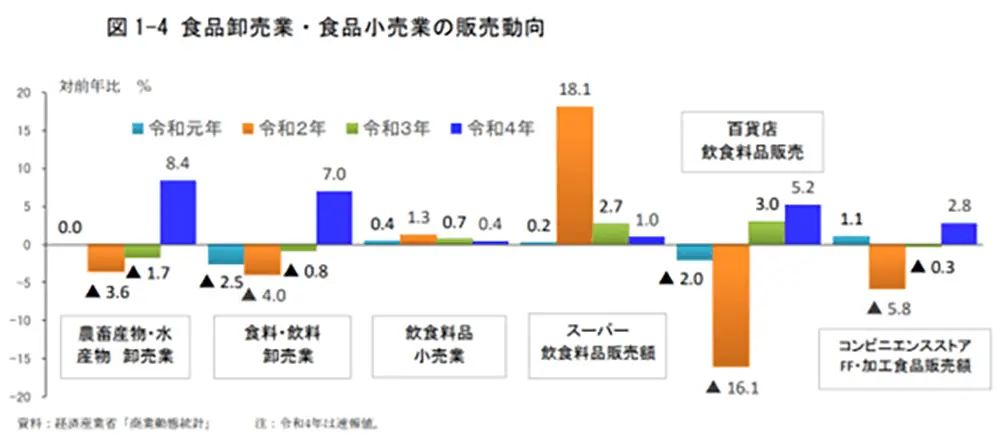
Japan's nominal GDP in 2022 was 556.5 trillion yen, showing a slight increase of 1.3% year-on-year. Household consumption expenditure increased moderately by 5.1% year-on-year. Exports of goods and services saw a significant increase of 19.8%. The Japanese economy is gradually recovering from the economic stagnation caused by the COVID-19 pandemic in 2020. In the food industry, with the easing of infection control regulations and the effects of various policies, a recovery in business conditions is expected. However, besides the pandemic, the industry faces various challenges such as price pass-through of production costs due to rising energy and commodity prices, and sluggish consumption due to rising food prices. In 2022, sales in the agricultural/livestock products & seafood wholesale trade and food & beverage wholesale trade increased significantly by 8.4% and 7.0% year-on-year, respectively, recovering to near pre-pandemic 2019 levels. Sales in the food and beverage retail trade in the same year were flat year-on-year at 0.4%, showing a slight increase compared to 2019. Among these, supermarkets, which performed well due to stay-at-home demand, saw a significant increase compared to 2019, while department stores and convenience stores increased slightly from the previous year but have not fully recovered to pre-pandemic levels.
Environmental Changes in the Food Wholesale Industry
In the retail industry, which directly impacts food wholesaling, as competition intensifies, companies are expanding their handled product ranges and entering business areas of different industries. Particularly, there is a growing trend to focus on selling high-frequency purchase items like food to enhance customer attraction, with not only food supermarkets (SM) and general merchandise stores (GMS) but also drugstores and discount stores strengthening their food offerings. Especially among major drugstore chains, active expansion of store networks beyond their traditional strongholds is notable.
The food wholesale industry faces changes in the external environment. Major factors include the impact of industry realignment centered on retail, declining profits due to the strengthening of private brand (PB) products by retailers, and sales declines accompanying population decrease. This reality means even listed companies struggle with profitability. On the other hand, while the overall market size of the food wholesale industry showed a recovery trend in 2020 due to inbound demand and increased domestic demand during the pandemic, improving profitability remains challenging.
Major food wholesalers are promoting "full-functionality" to confront this harsh situation. Specific initiatives include full-line product offerings and supply chain integration. Full-line product offerings, in particular, are a difficult challenge for SMEs but are a strength for major food wholesalers. They are advancing product diversification and integration while demonstrating a stronger presence than competitors even in non-core product assortments.
To solve the challenges of food wholesaling, strengthening product procurement capabilities is essential. Solving this requires building strong relationships with producers and manufacturers nationwide, a process demanding significant time and effort. M&A strategy is gaining attention as a means to overcome this challenge. Particularly, SMEs are choosing to join the groups of major or local mid-sized companies to solve these challenges and achieve performance improvement. The food wholesale industry is now required to transform. To overcome the harsh competitive environment and improve profitability, leveraging full-functionality and M&A strategies will be indispensable. It is expected that major food wholesalers leading this charge and advancing the creation of new business models will change the future of the entire industry.
Market Environment and Challenges in the Food Wholesale Industry
The market size of the food wholesale industry is expanding due to price increases by food manufacturers and increased demand for prepared foods (side dishes) and frozen foods. However, due to the impact of population decline, domestic demand is expected to remain flat or shrink in the future. In this industry, while the performance of major food wholesalers is growing due to rising food prices and increased transactions from industry realignment, ordinary profit margins remain low at less than 1% due to intensifying competition and rising logistics costs. Due to the characteristics of food products (unit price, need for temperature control, high delivery frequency, etc.), logistics costs tend to be higher compared to other wholesale trades. Furthermore, labor shortages and high crude oil prices are pushing up transportation and storage costs, and efforts for cost reduction and profit improvement are underway. Moreover, competition is intensifying due to entry by companies from other industries. Particularly in the retail industry, expansion of handled products and entry into new business areas are occurring, increasing food offerings. Drugstores are a notable example, increasing not only pharmaceutical sales but also food offerings, enhancing their competitiveness. This cross-industry entry is a factor intensifying competition between local wholesalers and national wholesalers.
Price Range for M&A in Food Wholesaling
We explain the prices and market sense for M&A in the food wholesale industry. First, there is no clear market price for SME M&A, and the final price is typically determined through negotiation between seller and buyer. M&A prices fluctuate based on a wide range of factors including industry, company size, quality of human resources, financial condition, brand strength, future potential, and market environment. Therefore, prices are calculated considering individual circumstances. There are several valuation methods for M&A pricing, one of which is the "Transaction Multiples Method." This method evaluates value based on past M&A transaction records of companies with similar business content, region, and financial metrics. The key in this method is referencing similar transactions, but finding comparable cases requires accumulating a considerable number of examples. As many M&A deals for unlisted companies involve non-public information, referencing other companies' records can be challenging. In this regard, Japan M&A Center has a wealth of experience, with over 10,000 successful M&A deals and being recognized for five consecutive years in the Guinness World Records™ for the highest number of M&A transactions completed*. It is possible to select buy/sell cases of similar companies based on business content, region, and financial metrics and perform fair valuation according to certain rules. You can experience our share price calculation simulation from here. *Guinness World Records™: 2024 Most deals handled in M&A financial advisory business. Recognized in Guinness World Records™ for 5 consecutive years from 2020. Finally, to succeed in M&A, comprehensive efforts to enhance corporate appeal are essential. This not only impacts valuation but also deeply influences the negotiation flow.
Source: Read the original article | Published: October 09, 2025