
Editor's Note
This editor’s note highlights the key facts and market implications behind “Market Size, Share, Growth, and Forecast for Sus”, with emphasis on sourcing, product fit, fabrication, logistics, or buyer impact.
The sustainable construction market is undergoing transformation, driven by rising regulatory standards, corporate sustainability goals, and growing consumer awareness and expectations for sustainable buildings. Faced with increasingly stringent regulatory frameworks worldwide, market participants are increasingly focusing on innovative solutions and environmentally friendly building materials to remain competitive. In October 2024, the European Bank for Reconstruction and Development (EBRD) granted a loan of 5 million euros to Shunkhlai Holding for the renovation of its headquarters in Mongolia to create more sustainable office spaces. The initiative also contributes to decarbonizing Mongolia's construction sector and serves as a best-practice model for comprehensive commercial building renovation. These developments align with the global trend toward climate neutrality in emerging and industrialized countries.
Sustainable Construction Market Outlook
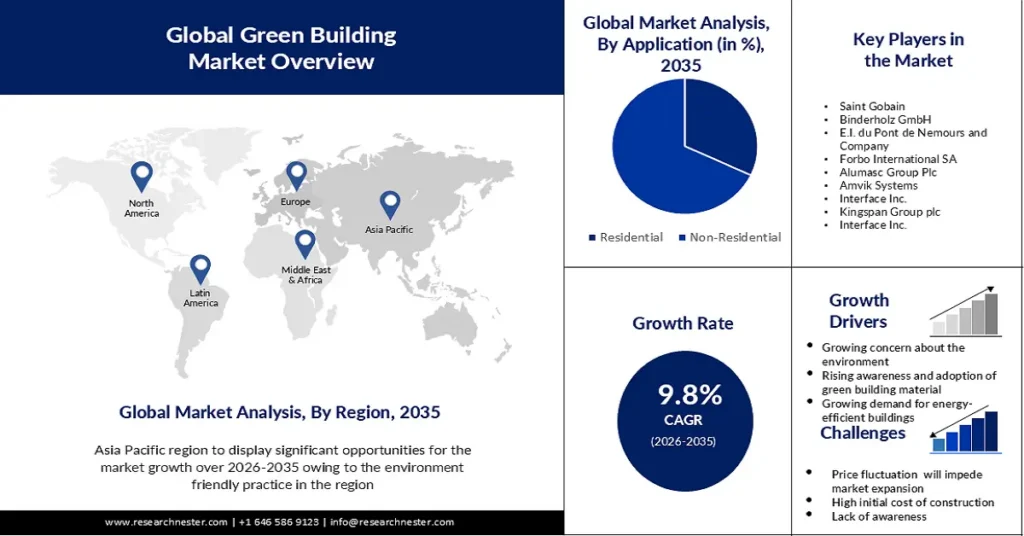
The sustainable construction market was valued at USD 700.96 billion in 2025 and is projected to grow to USD 1.79 trillion by 2035, representing a compound annual growth rate (CAGR) of approximately 9.8% during the forecast period 2026–2035. In 2026, the sustainable construction market volume is estimated to be USD 762.78 billion. Additional momentum is being created by integrated material efficiency standards, digital building intelligence, and lifecycle-oriented emission control measures. The London Energy Transformation Initiative has set a carbon budget of 600 kg CO₂e/m² for 2024, which has become a benchmark for sustainable construction in most cities worldwide. By promoting low-emission materials and resource-efficient renovation solutions, the initiative contributes to the dissemination of circular construction principles. This step aligns with EU-wide decarbonization initiatives and makes material innovation a competitive advantage in the construction supply chain. Green buildings are increasingly coming into focus—not only as sustainable investments but also as essential drivers of climate protection strategies.
Key Green Building Market Insights Summary
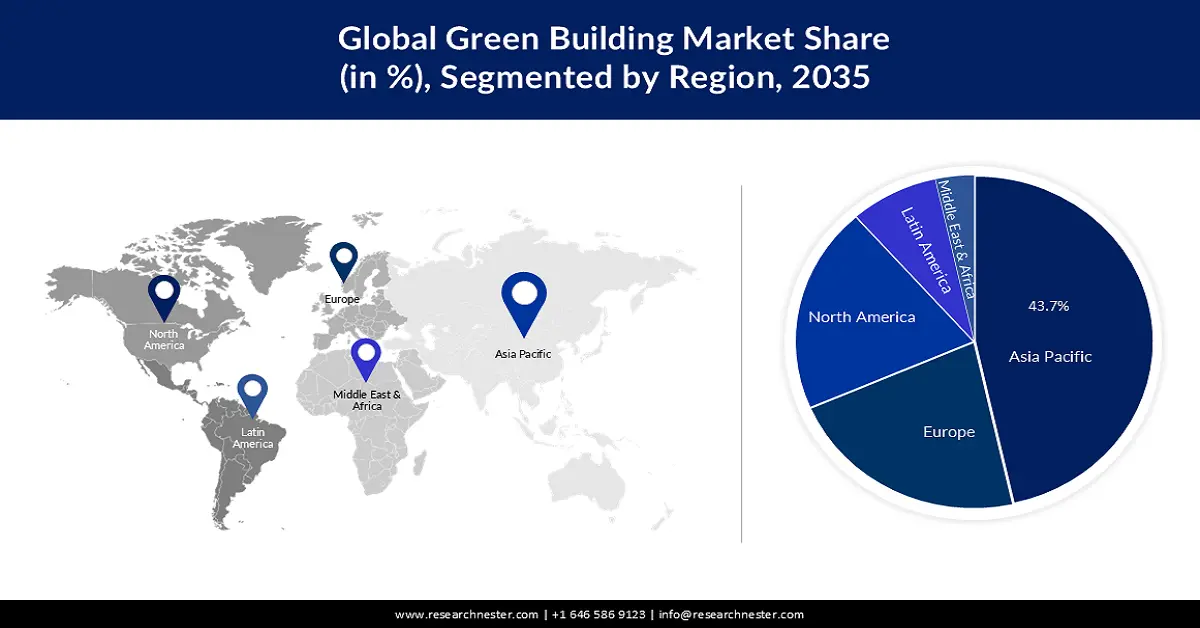
Regional Highlights The Asia-Pacific sustainable construction market is projected to account for approximately 43.70% of the share by 2035. Drivers of this development include increasing urbanization, favorable frameworks, and growing investments in sustainable construction. The North American market is expected to register significant CAGR during the period 2026-2035, driven by federal energy efficiency policies, infrastructure spending, and consumer sustainability trends. Segment Insights The non-residential buildings segment in the sustainable construction market is forecast to account for a 68% share by 2035, driven by urbanization and growing demand for sustainable construction solutions. The solar products segment in the sustainable construction market is projected to achieve a 52% market share by 2035, attributed to cost efficiency, energy access, and reduction of carbon footprint. Key Growth Trends Regulatory frameworks and policy incentives; Integration of renewable energy systems into building planning. Major Challenges Regulatory frameworks and policy incentives; Integration of renewable energy systems into building planning. Key Players
Alumasc Group plc, Amvic Inc., BASF, Bauder Ltd, Forbo Group, Interface, Inc., Kingspan Group, Owens Corning, Panasonic Holdings Corporation, Wienerberger AG.
Global Green Building Market Forecast and Regional Outlook
Market Size and Growth Forecasts Market Size 2025: USD 700.96 billion Market Size 2026: USD 762.78 billion Projected Market Size: USD 1.79 trillion by 2035 Growth Forecast: 9.8% annual growth (2026–2035) Key Regional Dynamics Largest Region: Asia-Pacific (43.7% share by 2035) Fastest-Growing Region: Asia-Pacific Dominant Countries: USA, China, Canada, India, Germany Emerging Countries: China, India, Japan, Singapore, South Korea
Growth Drivers and Challenges of the Sustainable Construction Market
Growth Drivers Regulatory Frameworks and Policy Incentives: Government regulations remain the most important driver of the sustainable construction market. Legislation such as the EU Energy Performance of Buildings Directive (EPBD) and US Building Performance Standards (BPS) mandate compulsory renovations and energy modernizations by 2030. In April 2024, the World Green Building Council published the European Manifesto for a Sustainable Built Environment, outlining policy goals for reducing energy consumption and fossil fuel use. The program, supported by 24 national bodies, focuses on employment, economic stability and sustainability, and green cities. Such frameworks are not only transforming the public sector but also opening new avenues for action for the private sector. Integration of Renewable Energy Systems into Building Planning:
Source: Read the original article | Published: September 09, 2025