
Editor's Note
This editor’s note highlights the key facts and market implications behind “Material Trends: 9 Surfaces Defining Interiors i”, with emphasis on sourcing, product fit, fabrication, logistics, or buyer impact.
Interiors are moving beyond the bland and the brittle. Designers are embracing surfaces with history, depth and above all, narrative. It’s a shift that reflects a renewed preference for subtle craft at a moment when machines and artificial intelligence feel increasingly foreboding, and a natural evolution of design towards spaces that value the human hand and lived experience. From honed oak floors to jewel-bright epoxy, materials in 2026 explore how texture and tone enrich space and encourage a more personal way of living.
Flat, painted drywall is insipid when you compare it to the resurgence of limewash, plaster and microcement. These ancient finishes, whose roots lie in ancient Rome, Greece and the Middle East, imbue walls with movement. Limewash layers softly, revealing tonal variation and a velvety matte sheen, while clay and raw plaster invite touch and temper hard surfaces with warmth. Of all the material trends we anticipate this year, this one is part of a broader embrace of authentic textures: visible wood grain, natural stone veining, woven rattan and handcrafted ceramics, all adding sensory appeal without the overwhelming drama of say colour-drenching or pattern clashing.
Chrome hasn’t disappeared altogether, but designers are rediscovering the warmth of aged metals. Bronze is poised to lead 2026’s metal palette with its earthy patina, offering a sophisticated alternative to high‑shine finishes. Meanwhile, aged brass, burnished nickel and matte pewter channel the Arts and Crafts ethos by celebrating hand‑finished surfaces. Together, these metals have the feeling of being collected rather than coordinated, which is crucial in achieving the subtle approach to craftsmanship which is being advocated over amplified artisanship.
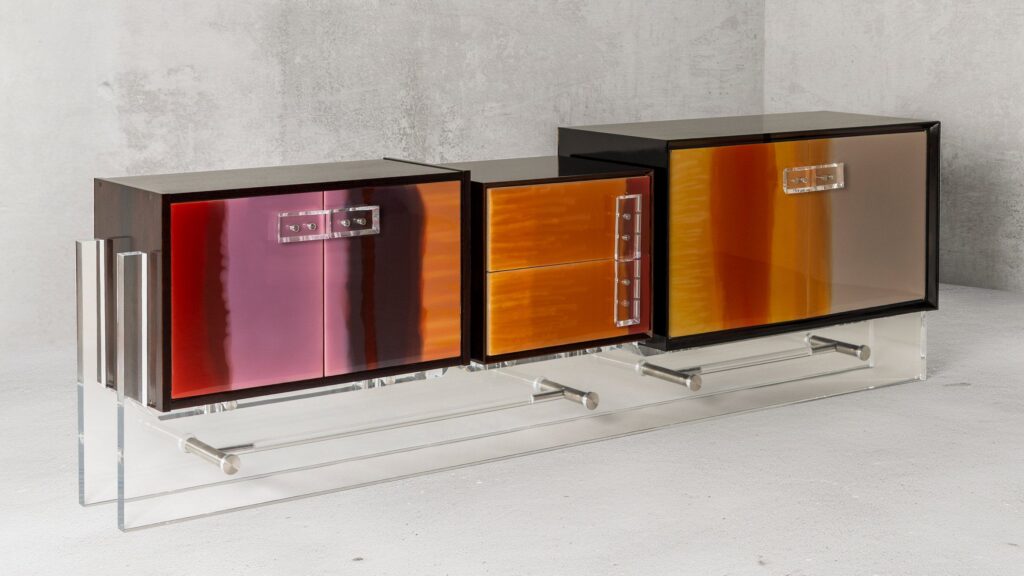
Resin is popping up in unexpected ways across the home, not only as a surface treatment but as an architectural gesture, like a monolithic bathtub or a translucent shower screen. In furniture, epoxy-wood pieces have become fixtures in luxury homes and boutique hotels, with demand for resin furniture continuing to grow, reflected in the work of studios such as Lake Como–based Draga & Aurel. Even flooring is changing: epoxy coatings once reserved for garages now appear in living spaces, offering seamless, UV-stable, slip-resistant finishes in soft neutrals.
Concrete has quietly shed its industrial severity. In 2026, designers are embracing coloured and pigmented concrete in warmer, softer tones that feel more architectural than brutalist. Used for floors, kitchen islands, basins and even furniture, coloured concrete offers a sense of permanence without heaviness. Its matte surface absorbs light rather than reflecting it, grounding spaces and allowing more expressive materials to sit comfortably alongside. Subtle pigment variations and natural mottling prevent it from feeling flat or uniform, giving each surface a gentle sense of movement.
The Return of Warm Wood
The revival of honey‑toned wood is more than nostalgia. It’s a reaction against years of cool grey floors. Designers favour natural oak arranged in geometric layouts like herringbone or checkerboard, evoking mid‑century design. The light, airy colour of untreated oak brings a Scandinavian or Japandi sensibility to rooms, making them appear brighter and larger, while wide planks showcase the grain and pair seamlessly with neutral palettes. For 2026, expect oak flooring finished in matte or low‑sheen coatings to emphasise texture and warmth rather than gloss.
Carpet, But Make It Colour
Wall‑to‑wall carpet is back, and despite Pantone’s prediction that 2026 will belong to pale, cloud-like neutrals, it’s anything but beige. Designers are turning to deep blues, emerald greens and terracotta rusts, colours once reserved for accent rugs, but are now drenching entire rooms. Plush textures recall the cozy rooms of the 1920s and 1970s, but modern fibres ensure durability and stain resistance. When paired with minimal furniture, coloured carpeting becomes a sculptural element, turning the floor into a lounge‑friendly landscape. It’s nostalgia without kitsch, a way to add all the colour you need in one big fat dose.
Relaxed Linen, Elevated
Etsy’s announcement of its first-ever ‘Texture of the Year’, washed linen, reflects a craving for authenticity in 2026. Unlike crisp hotel sheeting, washed linen is pre‑treated to soften its fibres, giving it a gently rumpled, lived‑in appearance. The fabric’s natural slubs and folds add dimension and tactility, preventing a space from feeling over‑styled. Linen’s eco‑credentials further its appeal, while its durability means upholstery and drapery age gracefully. Layered in neutral tones, relaxed linen turns sofas into cosy retreats and bedrooms into sanctuaries, a reminder that luxury need not be overly-styled or polished.
More Murano Glass
Obviously, Murano glass isn’t new, but it is newly relevant. Designers are reworking Venetian and Murano traditions into sculptural pendants and table lamps that feel more like jewellery than lighting. And across studios and retailers, a wave of Murano-inspired pieces is translating the language of coloured, hand-worked glass into forms that suit modern interiors, which doesn’t always necessarily mean bold colours. The appeal lies in their ability to introduce tactility and a sense of quiet theatre, and not exclusively through fixtures and fittings. Murano glassware, vases, bowls, stemware and sculptural centrepieces can be used to dress spaces with just as much impact.
These are the material trends we look forward to seeing in the coming year.
Source: Read the original article | Published: January 10, 2026