
Editor's Note
This editor’s note highlights the key facts and market implications behind “3D-Printed Ceramic Tile Facade! Dutch Architectu”, with emphasis on sourcing, product fit, fabrication, logistics, or buyer impact.
Design Architecture By Shen Peizhen In recent years, 3D printing technology has become increasingly mature, and its visibility in the architecture field has grown rapidly over the past year or two. Although it is still difficult to use printers to construct skyscrapers due to scale limitations, architects can now use this technology to generate complex textures in a more environmentally friendly, precise, fast, and labor-saving way, freeing up all creative ideas to be carved onto building facades, bringing a rich variety of expressions.
P.C. Hooftstraat ("straat" means "street" in Dutch), named after the Dutch historian, playwright, and poet Pieter Corneliszoon Hooft, is a historic and iconic high-end shopping district in Amsterdam. In one part of the neighborhood, Dutch architecture studio Studio RAP has created the "Ceramic House" for a boutique store using algorithms and a 3D-printed ceramic tile facade. The silhouette is simple, but the details are far from ordinary.
Ceramic House. (Photo Credit: Riccardo De Vecchi) As modern architectural vocabulary becomes mainstream, cityscapes around the world are becoming homogenized. Maintaining a balance between traditional urban character and innovative design, using novel technologies and materials as tools, has become one of the active pursuits of international architects.
For example, in 2023, a tea house called "Tsuginote Tea House" was built at the Kanazawa Shrine in Japan. Kei Atsumi and Nicholas Préaud used 3D printing technology and recycled waste wood PLA filament to print over 900 hyperbolic parts to construct it, aiming to explore and redefine traditional Japanese joinery techniques that do not require nails or adhesives.
Tsuginote Tea House. (Photo Credit: Eiichi Yoshioka) Tsuginote Tea House. (Photo Credit: Eiichi Yoshioka) Tsuginote Tea House. (Photo Credit: Eiichi Yoshioka) Similarly, at the end of last year, the Museum of the Future in Dubai exhibited "Nadarra," a 6-meter-long sand wall generated by algorithms and manufactured using 3D printing technology by architect Barry Wark, showcasing organic and complex natural textures. According to Barry Wark, this wall can be ground down and reprinted up to 8 times without affecting its structural integrity. This technology is particularly suitable for Middle Eastern countries and holds great potential for combining different sands and stones to form new architectural elements in the future. Nadarra Project. (Photo Credit: Barry Wark) Nadarra Project. (Photo Credit: Barry Wark) Returning to the "Ceramic House" on P.C. Hooftstraat, Studio RAP combined internally developed algorithms with 3D printing technology to create the complex ceramic facade. When architects choose building materials, they often carry certain symbolic meanings. The protagonist here, "ceramics," represents an important local culture, inspired by the precious collections of the Rijksmuseum. The Rijksmuseum is not only famous for its collection of works from the Dutch Golden Age but also has a rich ceramic collection symbolizing the important culture of ceramic production and related trade since the 17th century.
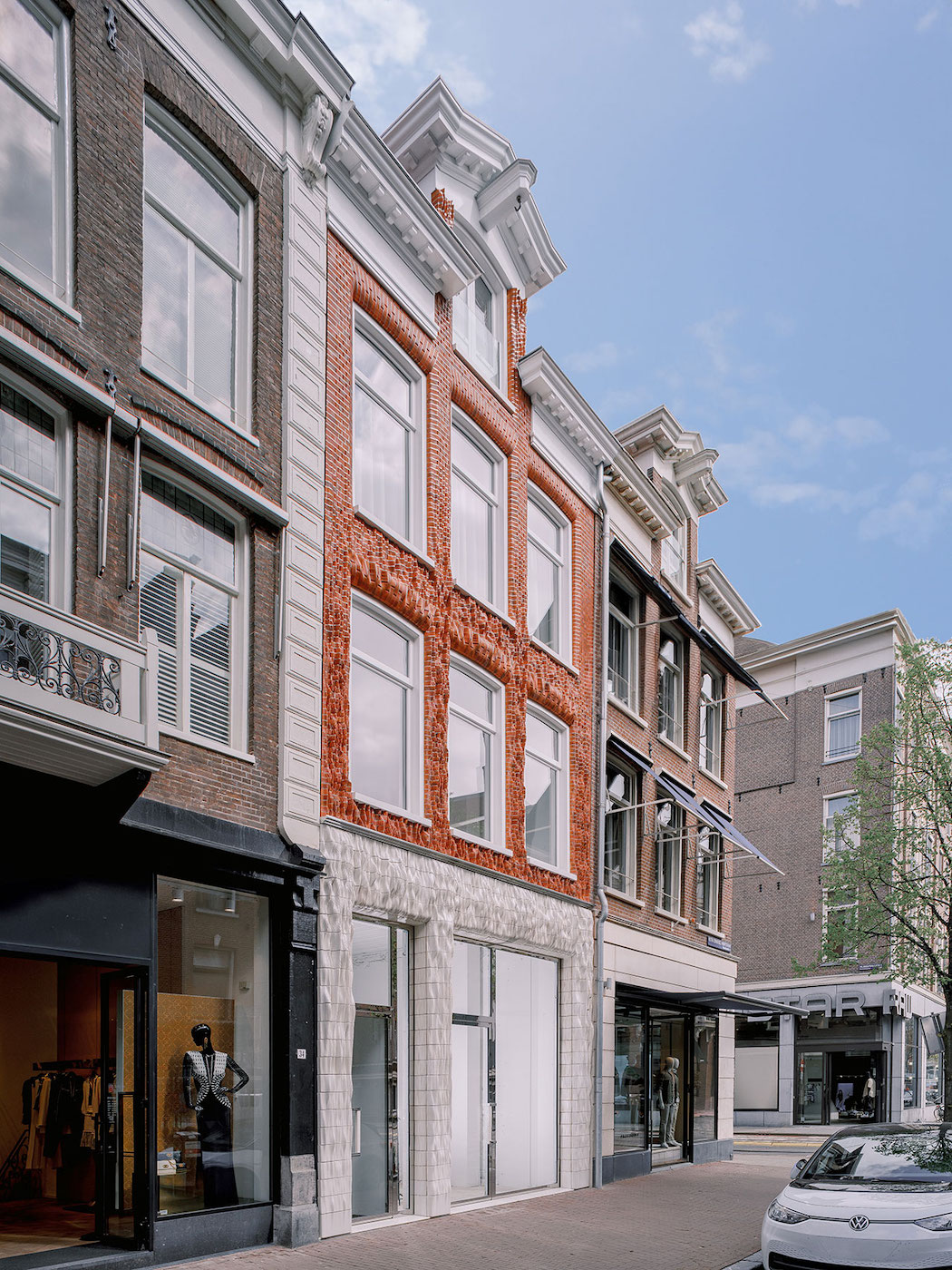
Ceramic House. (Photo Credit: Riccardo De Vecchi) 3D Printing Process. (Photo Credit: Riccardo De Vecchi) 3D Printed Building Materials. (Photo Credit: Riccardo De Vecchi) The ceramic layers of the "Ceramic House" are arranged like red bricks and white bricks, seamlessly blending into the surrounding historic buildings. While preserving the original typical three-part facade structure of the building, the ground floor uses large ceramic tiles measuring approximately 40 x 20 cm each. Koninklijke Tichelaar Makkum (Royal Tichelaar Makkum), a Dutch ceramics and glaze company established over 450 years ago, was invited to apply the glaze, resulting in a pearly white tone with a hint of light yellow. This responds to the typical storefront design of the street, seamlessly connecting with the ground, showcasing a delicate and harmonious aesthetic. Ceramic House. (Photo Credit: Riccardo De Vecchi) Ceramic House. (Photo Credit: Riccardo De Vecchi) Ceramic House Detail. (Photo Credit: Riccardo De Vecchi) Ground Floor Pearl White Ceramic Tiles Unglazed. (Photo Credit: Riccardo De Vecchi) Moving up one floor, the building facade features 3D-printed bricks with three different red glaze finishes. These bricks cross-fuse with the original brickwork and have a decorative design that fades with height. These bricks are embedded in laser-cut stainless steel panels, mimicking the flat, layered feel of the original red bricks stacked one on top of another. Ceramic House. (Photo Credit: Riccardo De Vecchi) Ceramic House Detail. (Photo Credit: Riccardo De Vecchi) 3D-Printed Bricks Embedded in Laser-Cut Stainless Steel Panels. (Photo Credit: Riccardo De Vecchi) Ceramic House Detail. (Photo Credit: Riccardo De Vecchi) The texture, characteristics, and complex forms of the ceramic tiles reference the folds of knitted fabric and the interlocking rhythm of yarn. As people approach and view from different angles, the organic, wave-like texture changes, offering a highly performative quality. The facade silhouette is simple, but the details are boldly sculptural, representing significant innovation in building facades. However, what makes this design stand out is how Studio RAP uses a novel design language to echo the city's architectural heritage, skillfully blending tradition and innovation, reshaping architectural expression, and enriching the existing historic building. Ceramic House. (Photo Credit: Riccardo De Vecchi) Ceramic House. (Photo Credit: Riccardo De Vecchi)
Source: Read the original article | Published: May 14, 2024