
Editor's Note
This editor’s note highlights the key facts and market implications behind “Polymer Concrete Market Size, Share, and Growth “, with emphasis on sourcing, product fit, fabrication, logistics, or buyer impact.
Polymer Concrete Market Size, Share, and Trend Analysis Report
Forecast by Material Type (Polyester, Vinyl Ester, Epoxy-based, Others), by Binder (Natural Resin, Synthetic Resin), by Application (Solid Surface Countertops, Outdoor Seating & Benches, Waste Containers, Pump Bases, Floor Blocks, Chemical Storage Tanks, Trench Drains, Others), and by Region (North America, Europe, Asia Pacific, Middle East & Africa, Latin America), 2025-2033.
Solid Surface Countertops
Polymer concrete can be used to create sleek and long-lasting solid surface countertops. These countertops are resistant to stains, heat, and moisture.
Overview
Polymer concrete is a type of concrete modified by adding polymers to the concrete composition. These polymers, which include epoxy, vinyl ester resins, and other synthetic binders, replace or supplement part of the conventional cement content in the concrete mix. This alteration improves the properties of concrete, making it more suitable for specific applications. The polymer concrete market is expected to expand its share as its use in drainage applications increases. Polymer concrete allows for precise molding and polishing, promoting efficient hydraulic flow and ensuring excellent drainage rates in pipes. These benefits are expected to drive demand for polymer concrete in urban infrastructure. Consequently, market growth is anticipated to be fueled by the increasing application of polymer concrete in the construction industry.
Market Summary
Market Metrics
Detailed Data (2024-2033)
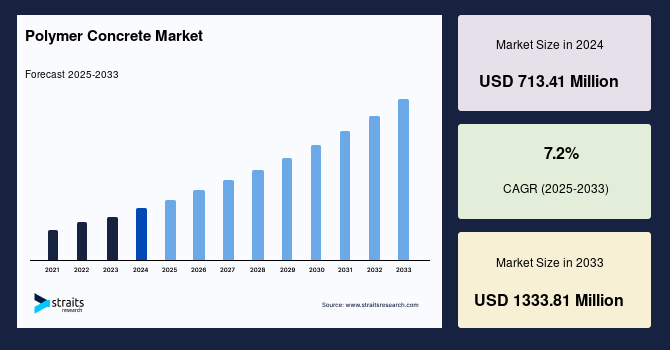
2024 Market Value: USD 713.41 Million
Estimated 2025 Value: USD 764.78 Million
2033 Projected Value: USD 1333.81 Million
CAGR (2025-2033): 7.2%
Key Region: North America
Fastest Growing Region: Asia Pacific
Key Market Players: BASF, Sika, Mapei, Fosroc, Dow Chemical
Polymer Concrete Market Growth Drivers
Exceptional Durability and Lifespan
Polymer concrete is well-known for its excellent resilience and long lifespan, making it widely used in construction projects requiring resistance to environmental pressures and durability. One of the most representative applications of polymer concrete is in the production of bridge deck overlays. Bridge decks are exposed to various environmental stresses, including severe traffic loads, freeze-thaw cycles, deicing salts, and moisture. Polymer concrete overlays were developed to meet the demand for long-term solutions to maintain and extend the lifespan of bridge decks.
According to an American Concrete Institute (ACI) report, polymer concrete overlays have been successfully used to restore and protect bridge decks in several countries.
These overlays have demonstrated excellent long-term performance, with some projects proving a lifespan of over 20 years.
Furthermore, polymer concrete is widely used in wastewater treatment facilities requiring corrosion resistance due to its long lifespan. Real-world use cases in these facilities demonstrate the reliability of polymer concrete even in harsh environments. Therefore, the polymer concrete market is expected to show positive prospects during the forecast period.
Market Constraints
Environmental Concerns
Environmental concerns pose a significant obstacle to the widespread use of polymer concrete. While polymer concrete offers advantages such as enhanced durability and reduced maintenance, the production and use of polymers and resins have environmental impacts. This raises concerns about sustainability and environmental footprint, especially in regions with stringent environmental regulations and heightened awareness of environmental issues.
The manufacturing of polymer resins, an essential component of polymer concrete, is associated with VOC emissions that can cause air pollution. Regulations limiting VOC emissions are being strengthened in many regions, making environmental concerns even more critical.
Market Opportunities
Green Building Practices
Green building strategies emphasize environmental friendliness and sustainability. From this perspective, polymer concrete can be a promising alternative, especially when produced with recycled materials and custom-designed to minimize environmental impact. Using environmentally friendly polymer concrete can meet green building requirements and sustainability goals.
Some polymer concrete formulations incorporate recycled materials, such as consumer or industrial waste. These recycled materials can include aggregates, reducing the demand for virgin resources. For example, polymer concrete mixtures can use recycled glass or plastic aggregates to lessen the environmental impact of raw material extraction.
According to the U.S. Green Building Council (USGBC), green building practices are gaining popularity worldwide.
The USGBC’s LEED (Leadership in Energy and Environmental Design) certification program encourages the use of environmentally friendly and sustainable building materials. Additionally, the European Union’s Circular Economy Action Plan emphasizes the recycling of building materials and reducing environmental impact. This focus opens prospects for green building materials like polymer concrete, especially when using recycled materials to reduce carbon footprint.
Regional Analysis
North America Leads the Global Market
North America holds the largest share of the global polymer concrete market. The construction industry contributes significantly to the U.S. economy, employing over 7 million people and comprising more than 680,000 firms. It produces approximately $1.3 trillion worth of structures annually and is one of the most important consumer markets in manufacturing, mining, and various service sectors. New bridge construction in locations like Clinton, Beaver, and Clearfield, along with increased road construction activity, are primary drivers of industrial expansion in this region. As of January 2021, industrial building construction in the region increased by about 4.7% compared to December 2020, and hospital construction grew by 1.1%.
Furthermore, healthcare facility construction in the region is forecast to grow by about 5%.
Commercial construction is predicted to increase by 2%, with office construction expected to rise by about 6% and retail construction by 1%. Additionally, in the U.S., single-family home development has increased in Florida, Georgia, North Carolina, Washington, Utah, Tennessee, Ohio, California, Idaho, and South Carolina. The Southern U.S. region is projected to have the highest growth rate, over 6%, followed by the West, Midwest, and Northeast.
Asia Pacific
Analysis of the Asia Pacific polymer concrete market indicates the region is experiencing significant infrastructure development, urbanization, and growing demand for durable and sustainable building materials. Polymer concrete overlays extend the lifespan of highways and bridge decks in countries like China and India. For example, India's Yamuna Expressway uses polymer concrete overlays to protect the road from wear due to increased traffic. China is the world's largest producer of consumer goods and retail products, particularly in the automotive sector.
China is also a major consumer of polymer concrete. Demand growth from industrial end-use sectors is driving rapid expansion of China's polymer concrete market. China's ongoing economic development relies heavily on the construction industry.
Moreover, Asia Pacific countries have been increasing the capacity of sewage treatment facilities. Polymer concrete is used to construct water-retaining structures and sewer system linings, ensuring long-term functionality. For instance, Singapore is developing innovative sewage treatment systems.
Europe
The European market has grown steadily during the forecast period. The region's focus on infrastructure development and sustainable construction standards has significantly contributed to regional growth. Polymer concrete is well-known for its durability, resilience to environmental variables, and versatility, making it suitable for various applications. Europe was a major consumer of polymer concrete in 2022, thanks to strong product demand from advanced economies like Germany, the UK, Russia, Italy, and France. The European market is expected to grow further, buoyed by the recent recovery in residential and commercial construction. High consumer spending power and stringent government regulations on the construction industry in Europe are expected to stimulate market growth.
Middle East & Africa
The construction sector in the Middle East & Africa is projected to grow rapidly during the forecast period due to increased investment, rising oil production, and improved climatic conditions. Increased government investment in infrastructure development projects in Saudi Arabia, the UAE, and Qatar is expected to strengthen the construction industry, which is anticipated to boost demand for polymer concrete during the forecast period.
Segment Analysis
Analysis by Type
Vinyl ester is generating the most revenue in the market.
Vinyl ester polymer concrete products combine the strength of epoxy with excellent resistance to chemical and environmental stress. They are highly robust and can withstand harsh environments. Vinyl esters are cost-effective to manufacture and offer superior resistance to corrosive and chemical solutions. Vinyl esters are often more brittle than epoxy, leading to higher shrinkage rates in polymer concrete. They exhibit high resistance to vibrational stress, are heat-resistant, and harder than polyester, minimizing the risk of breakage under impact loads.
Polyester
Polyester polymer concrete is well-known for its excellent strength and chemical resistance. It is frequently used in applications where corrosion resistance is critical.
Chemical containment structures, industrial flooring, and sewer pipe linings are common applications requiring chemical resistance.
Binder Information
Synthetic resins are the most commonly used construction material in the market.
Primarily derived from petrochemical feedstocks, synthetic resins offer excellent adhesion, durability, and resistance to various environmental variables. They are also known for their high adaptability and long lifespan. Synthetic resin-based polymer concrete is widely used in various fields, including industrial flooring, bridge deck overlays, chemical containment structures, and sewer system linings. Their high adaptability makes them suitable for a wide range of construction and infrastructure projects.
Natural Resins
Derived from plant-based sources like soy, corn, and flaxseed, natural resins are environmentally friendly and highly biodegradable. Polymer concrete using them is known for long-term durability and minimal environmental impact.
Application
Flooring has influenced market growth.
Polymer concrete flooring is renowned for its durability, wear resistance, and easy maintenance. It can be customized to meet various aesthetic and functional requirements. Growing demand for polymer concrete flooring in industrial, commercial, institutional, and residential sectors is driving growth in this segment.
Key Player List: Polymer Concrete Market
BASF
Sika
Mapei
Fosroc
Dow Chemical
SAUEREISEN
Kwik Bond Polymers
Dudick
ErgonArmor
Crown Polymers.
Recent Trends
May 2025:
In early 2025, BASF launched Pluriol® A 2400 I, a reactive polyethylene glycol (isoprenol-PEG or iPEG) designed for manufacturing third-generation polycarboxylate ether (PCE) high-performance superplasticizers. This product represents a significant advancement in concrete admixture technology, offering improved workability, strength development, and excellent long-term durability.
June 2025:
Source: Read the original article | Published: September 01, 2025