
Editor's Note
This editor’s note highlights the key facts and market implications behind “Electric kiln displaces hydrogen as the alternat”, with emphasis on sourcing, product fit, fabrication, logistics, or buyer impact.
The new war in the Middle East has raised alarms in one of Spain's most export-oriented industries, which is also one of the country's largest gas consumers: tile manufacturers. The sector, Europe's largest manufacturer by volume, consumes 7% of the natural gas burned by Spanish industry, with nearly 12.3 TWh per year. This fuel has so far been essential for firing ceramics at over a thousand degrees Celsius in their kilns. However, something seems to be shifting in the tile industry, a sector with high geographical concentration (90% of companies are located in the province of Castellón) and a strong presence of family-owned businesses. After suffering firsthand the effects of the exorbitant price increases due to the war in Ukraine, which led to cutting almost a third of Spanish production in two years, for many business owners replacing gas is a priority on which their own future depends, beyond decarbonization goals or environmental policies. Both the manufacturers' association, Ascer, and the association of their coating suppliers, Anffecc, have always been very critical of the deadlines imposed for ending CO2 emissions. But at the same time, they have promoted projects to seek alternatives that offer a way out for the sector. These initiatives are fundamentally based on two technologies: green hydrogen as a fuel, on one hand, and the electric kiln, on the other.
Pros and cons
In recent years, driven precisely by decarbonization and European Next Generation funds, associations, companies, and energy groups have promoted projects to develop these alternatives on an industrial scale. Initially, hydrogen appeared better positioned, because its calorific power guarantees reaching the high temperatures required for firing tiles and glazes. Many companies have been wary of electrification for years due to doubts about whether they could reach and maintain the necessary heat. A technical obstacle that has led the sector's major machinery manufacturers, mostly Italian, to rule out investing in this technology. Another advantage of hydrogen is that, as it is also a gas, it opens the door to not having to renew the kilns. Also in its favor were the plans for large green hydrogen hubs in the tile triangle, such as bp's project at its Castellón refinery with Iberdrola or the Orange Bat project, promoted by Swiss Smartenergy in Onda. These electrolyzer projects have accumulated delays compared to initially planned timelines, but they remain active.

This cannot be said for other initiatives, such as Porcelanosa's, which in 2021 presented a project with Iberdrola to generate green hydrogen and replace up to 50% of the gas in its kilns. The project even had public aid allocated, but the Castellón-based group ultimately abandoned it.
Costs and efficiency
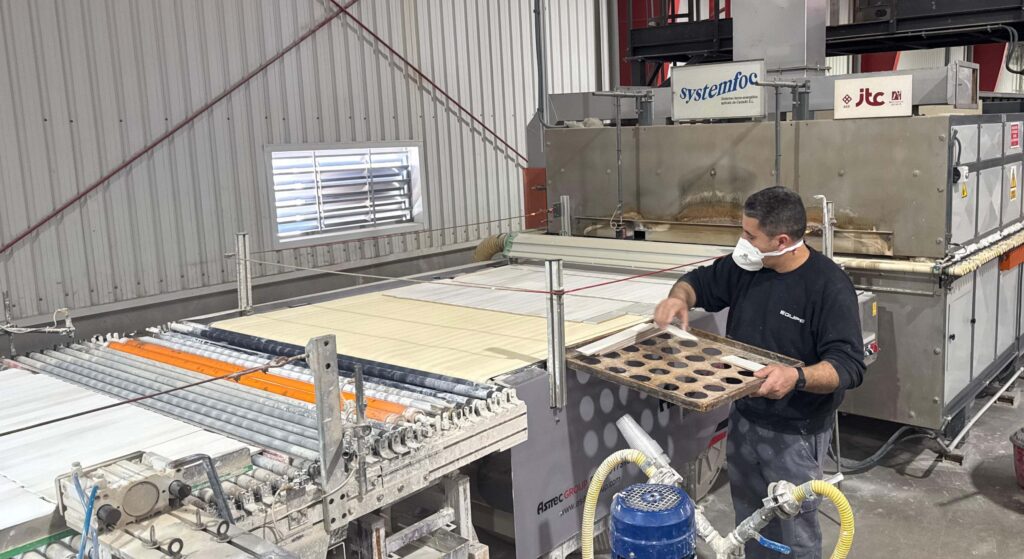
The reason is the same one that has now made kiln electrification the clear bet for part of the tile industry and its own reference center, the Instituto Tecnológico de Cerámica (ITC): the cost of green hydrogen. With a price of 158 euros per MWh, it triples that of natural gas, which after soaring due to the crisis in the Strait of Hormuz is around 53 euros per MWh and exceeded the average electricity price in March, around 42 euros per MWh. So far, forecasts that investment in new technology would reduce the production costs of that fuel have not been met, according to the ITC to explain its lack of competitiveness. The Ascer association itself also does not foresee it being competitive at least until 2050 and warns of another underlying problem. Hydrogen production is based on renewable electricity, and to transform it, the sector's current energy consumption would have to triple. Precisely one of the advantages of the electric kiln is its greater efficiency by using electricity directly without that conversion, which implies higher consumption. In fact, the first electric line, which has been operating for almost two years at the tile manufacturer Equipe in Onda, has already certified that it more than doubles the efficiency of natural gas itself. By using resistors to generate heat, the combustion gases from burners are eliminated, which allows reducing the size of the firing chambers and improves insulation. Its owner is already installing a second, higher-capacity and higher-power electric kiln, after having developed the equipment from scratch together with the local manufacturer Systemfoc and the ITC. However, it maintains one of the handicaps of its predecessor: the equipment cost is 25% higher than gas kilns. In total, the tile company plans an investment of 10 million euros, including complementary machines such as presses and conveyor belts. As a cost advantage over traditional gas, the electric kiln avoids paying emission allowances, whose prices will rise in the coming years. Furthermore, it can benefit from Energy Saving Certificates (CAE).
Source: Read the original article | Published: April 06, 2026