
Editor's Note
This editor’s note highlights the key facts and market implications behind “Tile Industry Rules Out Relocation Despite CO2 ‘”, with emphasis on sourcing, product fit, fabrication, logistics, or buyer impact.
The leak of a draft confirming a 34% cut in free CO2 emission allowances has set off alarm bells in the Spanish ceramic sector. "Producing outside the EU is not viable," industry sources insist.
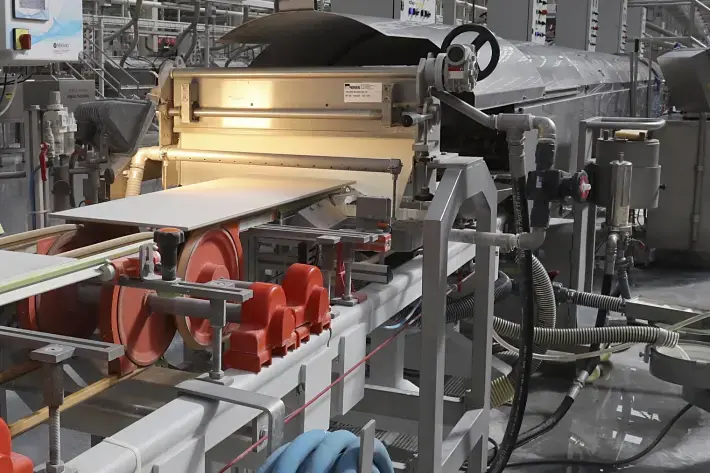
Tile production is a highly gas-intensive process.
The leak of the draft detailing the new revision of the reference criteria – benchmarks – which are decisive for granting free CO2 emission allowances for the 2026-2030 period, undertaken by the European Commission and still pending official publication, has set off alarm bells in the Spanish ceramic sector. The draft reflects, as was foreseen in the initial proposal, a 34% cut in allowances compared to the previous period (2021-2025). The sector still holds out hope that the European Commission will publish a text different from the leaked draft, but companies are beginning to warn of the serious risk posed by the measure, which would leave the sector with a bill of between €109 and €163 million per year just in direct emission costs.
From the Spanish tile sector, they insist that manufacturing outside Europe – an alternative the industry would be forced into as the production process becomes excessively expensive – is not viable. Sources from the employers' association Ascer emphasize that "relocation is not an easy or generalizable way out for a tile company. The threat of carbon leakage exists, but in our case, it translates more into the sector losing investment, margin, and industrial capacity to competitors from outside if Europe makes producing here too expensive and does not correct competitive asymmetries. Therefore, there is a danger more of companies disappearing than of relocation."
“It is complex for a company, especially if it is an SME, to choose to move its production outside the EU,” clarify sources from Ascer.
Precisely, the tile sector is considered 'at risk of carbon leakage,' meaning the European Commission, theoretically, tries to prevent production from moving outside the EU. But in practice, a new cut in free emission allowances leads to a greater need for companies to resort to the private market, regulated by the EU Emissions Trading System (EU-ETS), and consequently, the cost of manufacturing in Europe increases.
It is worth remembering that the European ceramic manufacturers' association Cerame-Unie already warned that, if the 34% adjustment is approved, manufacturing ceramics would be unviable in the EU by 2030.
Sector sources explain that if a company's profitability disappears to pay for CO2, it must ultimately assess how much of what it produces is sold in Europe and how much outside, and what sense it would make to relocate production.
“If a company moves abroad to produce, which is very complicated due to how heavy our structures are and how anchored we are to the territory, it is because it has a pool of clients outside the EU that will justify that investment. That is, the company will increase its margins by not having to pay for CO2 or European wages, which are the bulk of the cost. But if that guarantee is not there, what will end up happening is that companies decide to simply close down,” point out expert sources in the sector.
RAISING PRICES IS NOT VIABLE
Nor does the ceramic sector consider the option of passing on the energy cost overrun to the product price as viable. Such a measure could price Spanish products out of the market as they already compete with countries subject to lower costs and regulations and, therefore, with products at a lower price.
“It is not realistic to think that the sector can fully pass on that overrun in prices without losing market share. Precisely for this reason, ceramics are recognized in the EU ETS as a sector at risk of carbon leakage. The logic of that recognition is clear: it competes internationally with producers that do not bear the same level of regulatory costs, and if the European cost overrun cannot be passed on to the final price, the margin is eroded and local production is put at risk,” add sources from the employers’ association Ascer.
The publication of the new reference criteria framed within the ETS seems imminent. After this step, there will be a four-week public consultation process before member states vote on the measure for it to move forward.
The sector will fight until the end to prevent the draft already circulating from becoming a definitive document, and for this, it also places its trust in the member states, whose vote will be key to demonstrating their defense of the industry.
Source: Read the original article | Published: April 09, 2026