
Editor's Note
This editor’s note highlights the key facts and market implications behind “Eloisa Gobbo: How Ceramics Ceases to Be ‘Decorat”, with emphasis on sourcing, product fit, fabrication, logistics, or buyer impact.
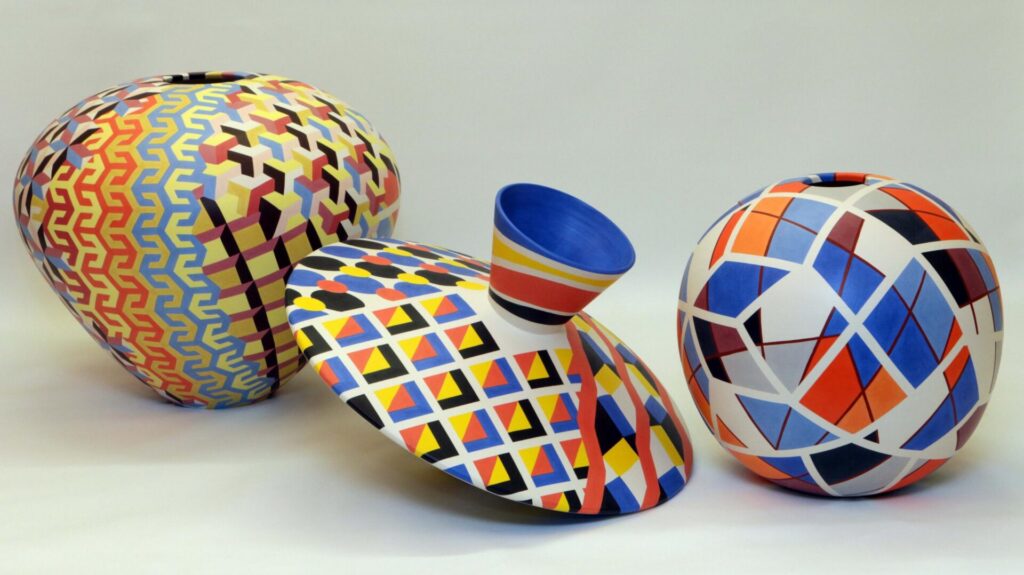
There is a vertical table at the center of the exhibition. No one can sit at it, but everything refers to that gesture: gathering to share, occupying a common space. The installation, composed of more than a hundred ceramic pieces, seems to celebrate something—a meal, a family, a tradition—though it takes only a few more seconds for the scene to begin shifting. It is not exactly celebration; there is something more uncomfortable, more contemporary: a reflection on what remains and what breaks. That is the territory in which Eloisa Gobbo works, whose exhibition Cromática can be seen in Madrid until May 22. Her work, traversed by color and the accumulation of visual references, does not seek to beautify the surface but to strain it. On the plates appear echoes of Vesalius's anatomy, Dürer's engravings, or Goya's scenes, not as erudite quotes but as layers superimposed on the same image. The result is a visual field where art history, material culture, and the contradictions of the present coexist. Some of Eloisa Gobbo's ceramic pieces Eloisa Gobbo trained at the Brera Academy of Fine Arts in Milan, where she now teaches Chromatology. She lives between Padua and Milan, and her work has moved in recent years through various international contexts, always in dialogue with that diffuse border between the pictorial and the sculptural. In her case, ceramics are not a support but a language. A language that gathers Eastern and Western traditions, ornament and structure, repetition and variation, to build dense, almost saturated surfaces that force a close look.
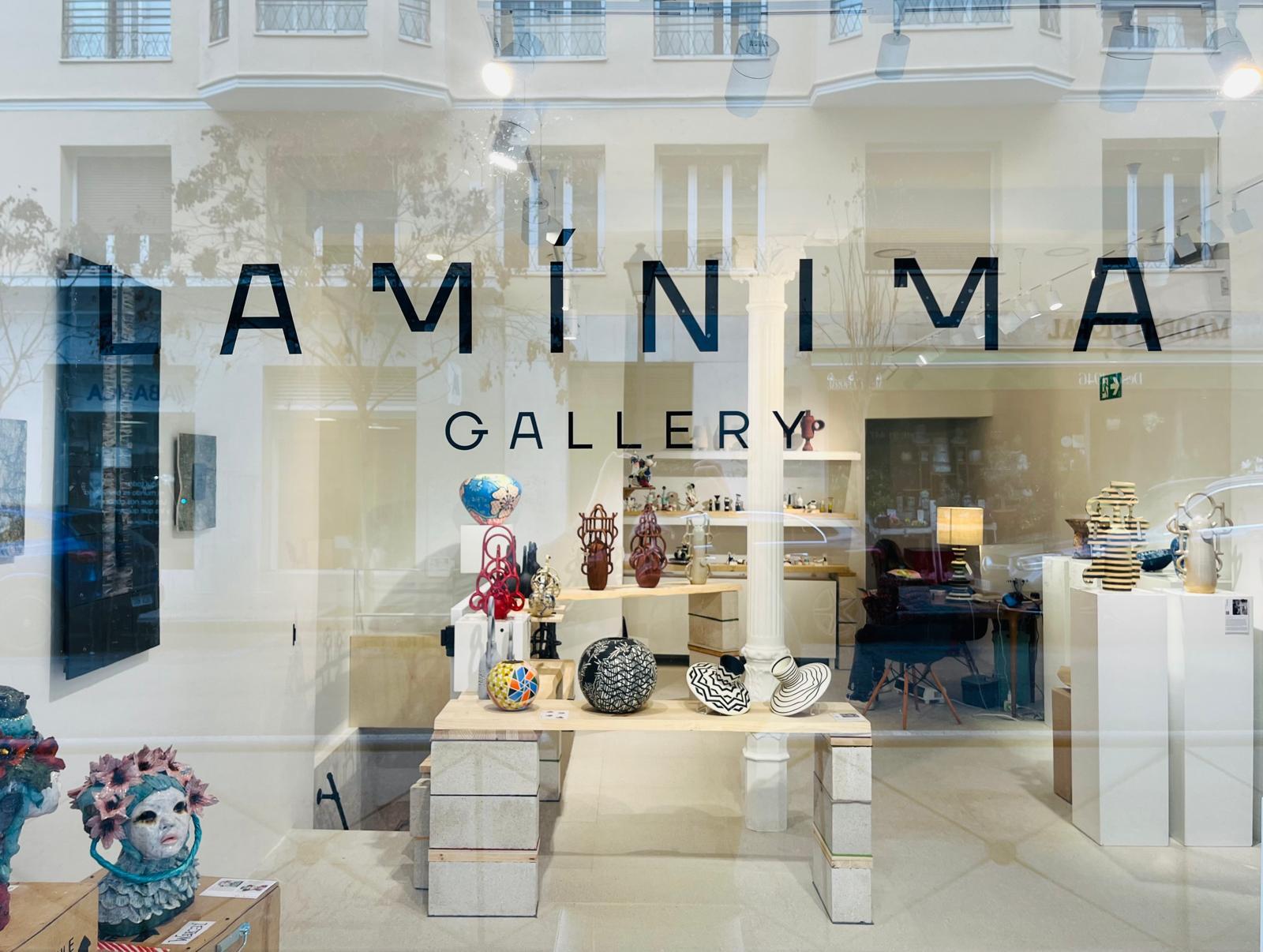
But what is truly significant about her presence in Madrid is not only the work itself, but the place where it is shown. La Mínima Gallery, opened in 2026, is the first space in the city dedicated exclusively to contemporary ceramics. And that fact, in a capital with one of the highest concentrations of museums in Europe, is not anecdotal. It speaks of a historical absence. Of a discipline that has been systematically relegated to the category of "minor art," associated with the domestic, the utilitarian, and, by extension, the feminine. The gallery's inaugural exhibition, in fact, already raised that tension by bringing together exclusively female ceramists. It was not an isolated curatorial gesture; indeed, it is a deeply feminized practice in its production, but scarcely recognized in the circuits of artistic legitimation. For centuries, ceramics have been a territory inhabited by women and at the same time rendered invisible by art history. Showcase of La Mínima Gallery, the first gallery dedicated to contemporary ceramic art in Madrid In this context, Gobbo's work takes on another dimension. Her pieces, although they refer to everyday objects—like plates, bowls, vases, and recognizable forms—are not situated in the realm of the decorative. They displace that imaginary toward a critical reading. The table, that space traditionally associated with care and invisible work, appears here elevated, literally, to the wall and turned into image and discourse. Color plays a central role in that operation. The tones overlap, repeat, and generate rhythms that organize the gaze and, at the same time, destabilize it. Eloisa Gobbo has a will to intensity that avoids any temptation of neutrality. There is also a reflection on fragmentation. The pieces that make up the installation can be purchased separately, as if the work admitted its decomposition. That gesture dialogues with the content itself: the idea of community, of bond, of shared structure that, however, can break, disperse, disappear. There is no idealization of the collective, but a conscious look at its fragility.
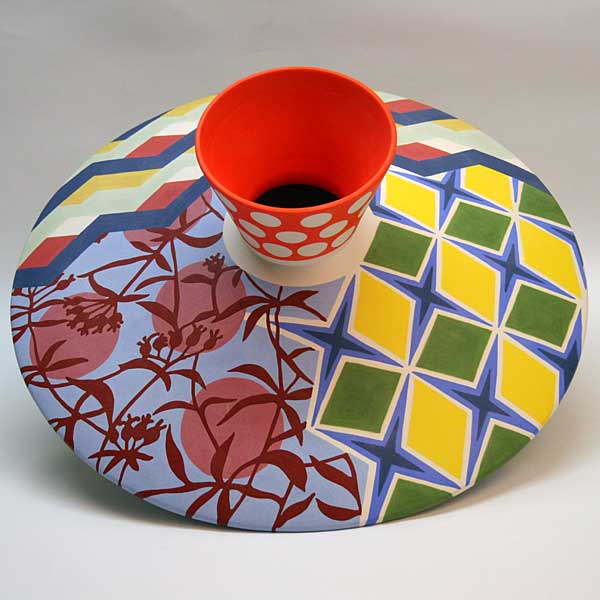
In just three months, La Mínima Gallery has become a reference for its selection of contemporary ceramic pieces The presence of Eloisa Gobbo in Madrid also coincides with a moment of broader revision within the art market. Traditionally relegated materials—ceramics, textiles—are beginning to occupy a central place in fairs, galleries, and collections. In part, as a reaction to a context saturated by the digital and the reproducible. The handmade, the material, regains value. But also because the canon itself is beginning to be questioned.
In that shift, the work of artists like Gobbo not only expands the limits of a discipline. It also forces a review of the categories from which art history has been constructed. What is considered art and what is not. What is exhibited and what is stored. What is valued and what is reduced to "pretty."
In that sense, ceramics cease to be a margin to occupy the center. And they do so, to a large extent, hand in hand with women who have worked for years in that territory without equivalent recognition. The exhibition at La Mínima does not correct that history, but it does highlight it. And in that evidence, perhaps, change begins.
Source: Read the original article | Published: April 27, 2026