
Editor's Note
This editor’s note highlights the key facts and market implications behind “Iris Ceramica Group Transforms Historic Chapel f”, with emphasis on sourcing, product fit, fabrication, logistics, or buyer impact.
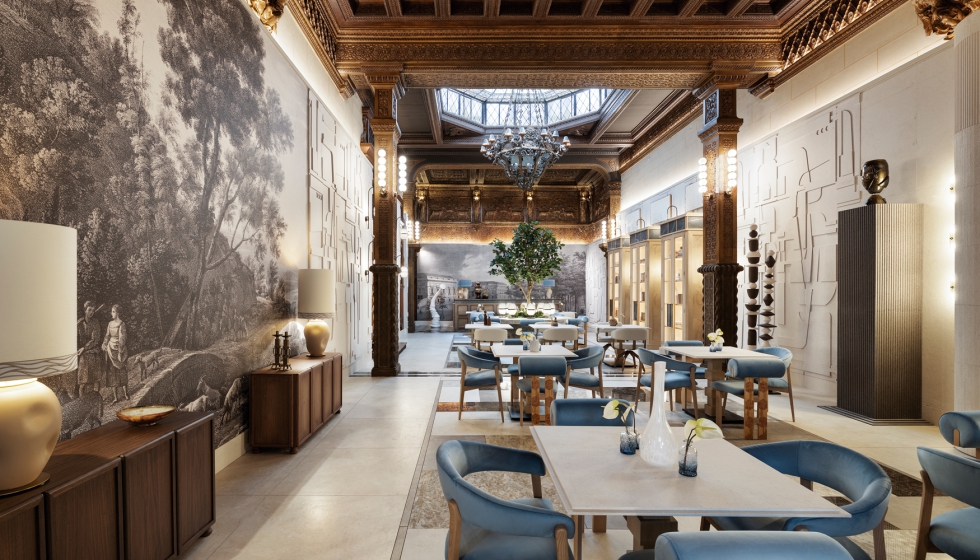
Iris Ceramica Group is participating in Casa Decor 2026 with an intervention that highlights the expressive potential of ceramics in the architectural and interior design fields. From April 9 to May 24, the company is dressing the deconsecrated former chapel of the palace hosting the exhibition, located in the Barrio de las Letras, transforming the space into a contemporary aesthetic restaurant that dialogues with the historical context. The project, signed by Raúl Martins, articulates a balance between tradition and modernity, integrating ceramic surfaces into the original architectural framework and extending their presence to other spaces along the exhibition route. For this edition of Casa Decor 2026, Iris Ceramica Group presents an architectural project that highlights the expressive capacity of ceramics, a material where history and innovation coexist, and which generates a dialogue between architecture and interior design, as well as between tradition and contemporary taste. The contribution of Sapienstone surfaces, an Iris Ceramica Group brand distributed in Spain by Cupa Stone, is also notable. They are used in the furniture elements intended for visitor service. The bar area desk and the kitchen desk have been made with Jatoba Brown 4D Lapped surfaces in 20 mm and Calacatta Aureo 4D with Cashmere finish in 12 mm, respectively.
Other Surfaces Along the Exhibition Route
Beyond the 'The Silent Chapel' space, the Group's surfaces are present in other environments along the Casa Decor 2026 exhibition route, configuring an extended narrative through different contexts and design languages. In the 'Órbita y Materia' space, Sapienstone's Fior di Viola surfaces are used on the nightstands and the flooring, defining the project's material palette. The composition is completed with Alpi Chiaro Venato Polished from the brand. For the Bauhaus space, two Sapienstone surfaces structure the chromatic proposal: Fior di Viola 4D with Cashmere finish on the countertop and Marsala Red Natural on the sink, elevating the kitchen from its practical function towards a reading as an architectural element of the space. For Mapei, Sapienstone's Breccia Imperiale Natural is used on the central table surface and interior claddings, establishing material continuity between horizontal and vertical planes. The full-height decorative panels in Patagonia from the brand are also featured.
Application of Iris Ceramica Group and Sapienstone Surfaces
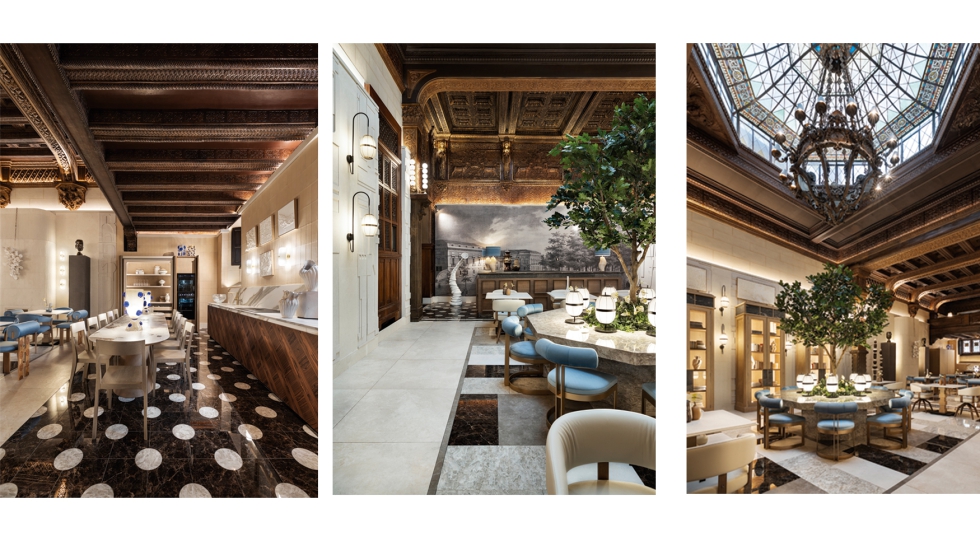
THE SILENT CHAPEL – IRIS CERAMICA GROUP SPACE Sapienstone – Jatoba Brown 4D Lapped 20mm Sapienstone – Calacatta Aureo 4D Cashmere 12mm The firm's participation highlights the role of ceramics in the dialogue between architecture and interior design. Interior designer Raúl Martins, author of the project, has transformed the deconsecrated former chapel of the historic palace on Calle San Agustín into a restaurant dining room, with an approach that respects the identity of the space while proposing a contemporary and traditional reading simultaneously. Ceramics are integrated as a 'custom' element, both in the design of architectural claddings and in the furniture specifically made for the project, in combination with wood worked artisanally by the technical partner Mogno Woods, a Galician cabinetmaker who integrates the natural material in dialogue with ceramics.
‘The Silent Chapel’
The palace hosting the new edition of Casa Decor was built between 1892 and 1895 as the residence of the Marquises of Vélez and Counts of Niebla, following the architectural language typical of urban residences of the time. In 1926, after a change of ownership, the building was adapted for use as a school-convent, at which time the former coach houses were transformed into a place of worship. The chapel, now deconsecrated, is one of the most unique spaces in the complex, both for its Spanish Neo-Renaissance style and for the large glazed skylight that allows natural light to enter and creates an intimate and welcoming atmosphere. With a rectangular floor plan of 164 square meters and particularly enveloping spatial conditions, the enclosure is conceived as an ideal environment to house a restaurant dining room. In this context, the use of the company's ceramic surfaces, selected in their most classic aesthetics, provides a new reading of the space, which does not alter or replace the original architecture, but integrates respectfully, establishing a dialogue between the history of the place and the contemporary intervention. Raúl Martins's project proposes a refined language that allows the pre-existing architecture to maintain its prominence. Historical elements are preserved, while contemporary materials are incorporated as an additional layer over the original structure, redefining the space without modifying its essence. In the proposal, the past and present coexist through the firm's ceramic surfaces, of classic and natural inspiration, which articulate a combination of forms and patterns, including mosaic-type flooring, perspective games, mix & match compositions, and geometric designs.
Source: Read the original article | Published: April 22, 2026