
Editor's Note
This editor’s note highlights the key facts and market implications behind “Sustainable Building Materials: Wood Enhanced wi”, with emphasis on sourcing, product fit, fabrication, logistics, or buyer impact.
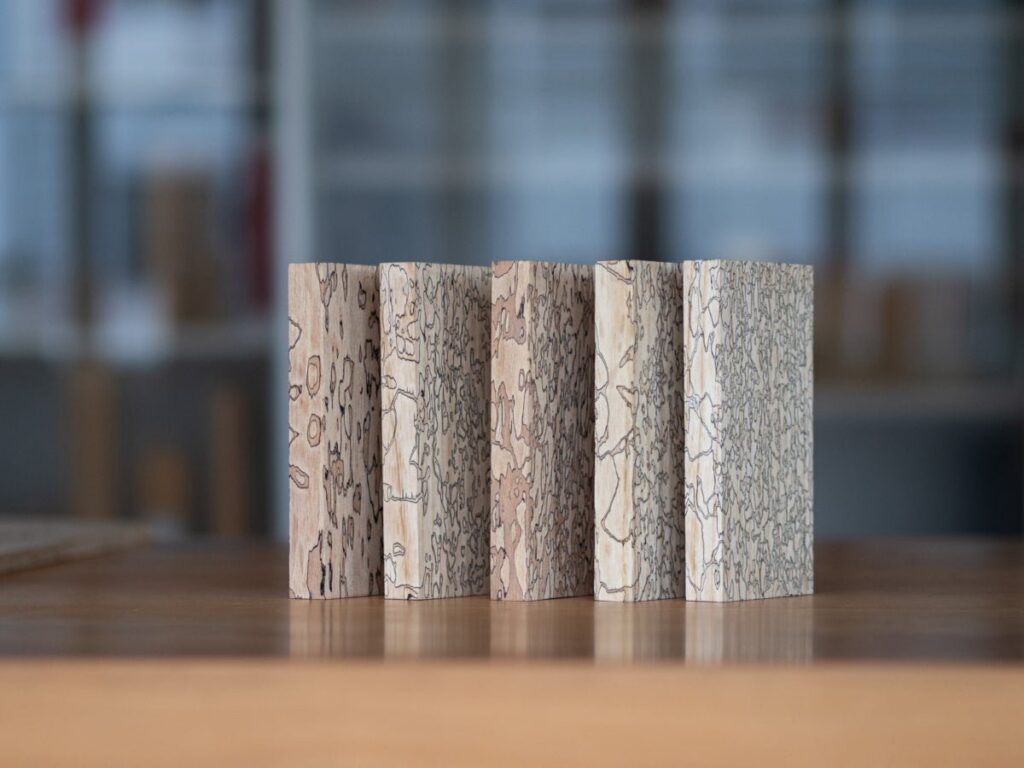
Anyone can observe it in the forest or garden: tree fungi decompose wood into unsightly remnants. However, if the process is deliberately controlled and the right fungus is selected, a noble-looking material can be created: wood with a marble look. That, in short, is the business idea of Swiss entrepreneur Jakob Koster. Under the name Myrai, the product should be available for purchase soon.
Local deciduous wood species, which according to Koster are usually burned for fuel, serve as the basis. He says the product is also suitable as a sustainable alternative to exotic imported woods.
The idea came about by chance. Koster, then head of the carpentry workshop Koster Holzwelten in Arnegg near St. Gallen, discovered unusual black lines on a piece of wood. He inquired at the Swiss Federal Laboratories for Materials Science and Technology (EMPA) and learned it was a very special tree pest.
The ascomycete fungus produces the black pigment melanin. When colonizing the wood, it creates a marble-like pattern. Koster was lucky to find it, as it is rare. "In the past, tree trunks were placed in the forest for several months in the hope that they would be colonized by the right fungus," EMPA researcher Francis Schwarze told him.
Koster and Schwarze teamed up to deliberately control the fungus's "wood painting." Stainless steel containers with laboratories and climate and vacuum chambers moved into the airy carpentry hall near St. Gallen. The Swiss innovation promotion agency Innosuisse supported the project.
Marble Patterns from the Climate Chamber
By now, the men have found a functional procedure. They bring boards up to two and a half meters long to a suitable humidity level in a climate chamber. Subsequently, the boards are sterilized and then inoculated with spores of the ascomycete fungus.
It takes several weeks for the fungus to draw the desired patterns into the wood. Among other factors, the choice of wood and changes in production conditions influence the appearance of the marbling. At the end of the process, the wood is dried in a chamber. The fungus dies.
For Construction Panels, Furniture, and Musical Instruments
"The special thing about this ascomycete is that it does not break down the heavily lignified areas of the cell wall, and the wood retains high bending stiffness," reports Francis.
The marbled wood is suitable for interior finishing, furniture, musical instruments, and jewelry. When exactly it will be available for purchase is not yet certain.
The new wood enhancement expands the potential of fungi for producing sustainable building materials. Mycelia, for example, thread-like networks of fungal cells, are suitable among other things as insulation material and for construction panels. Furniture has also already been made from it. Whether the melanin painting of the ascomycete can also provide beautification here is unknown.
Source: Read the original article | Published: February 13, 2026