
Editor's Note
This editor’s note highlights the key facts and market implications behind “Green Building Materials Market Anticipated to R”, with emphasis on sourcing, product fit, fabrication, logistics, or buyer impact.
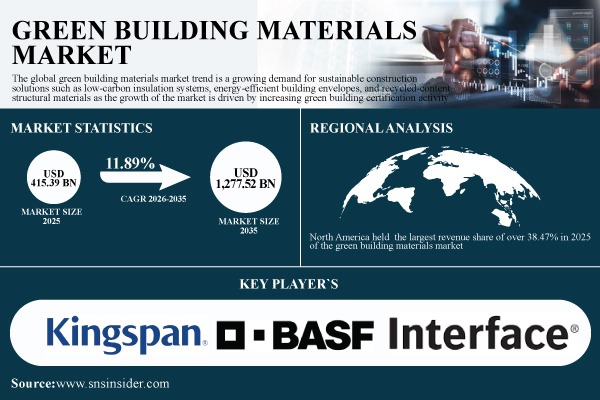
The Green Building Materials Market is expanding as demand rises for low-carbon, energy-efficient construction solutions. The global market size was estimated at USD 415.39 billion in 2025 and is expected to reach USD 1,277.52 billion by 2035, growing at a CAGR of 11.89% from 2026 to 2035. The growth is driven by increasing green building certification activity, government-mandated building energy codes, and developer preference for materials that reduce lifecycle carbon emissions in residential and non-residential construction. U.S. Market Growth The U.S. Green Building Materials Market was estimated at USD 163.85 billion in 2025 and is expected to reach USD 503.58 billion by 2035, growing at a CAGR of 11.93%. This is largely due to widespread LEED certification adoption, state and federal building energy code requirements, and established green construction supply chain infrastructure. Segment Analysis By Building Type: The non-residential buildings segment accounted for the largest share (57.36%) due to mandatory green certification requirements for commercial, healthcare, and government buildings globally. The residential segment is slated to grow at the fastest rate (CAGR ~12.61% from 2026–2035) as homeowners and developers seek certified green insulation, solar roofing, and energy-efficient building envelope products. By Product Type: The interior products segment held the highest revenue share (~34.62% in 2025) due to broad adoption of low-VOC paints and recycled-content flooring. The solar products segment is anticipated to achieve the highest CAGR (~13.47%) driven by building-integrated photovoltaics and falling solar module costs. By Application: The insulation segment contributed the largest revenue share (28.74% in 2025) due to its direct impact on building energy performance and thermal resistance mandates. The roofing segment is projected to grow at the highest CAGR (~12.83%) due to demand for cool roofs, green roofs, and solar-integrated roofing in urban environments. Regional Insights North America held the largest revenue share (over 38.47% in 2025) due to a well-established green certification ecosystem, strict energy codes, and growing developer awareness of ESG benefits. Asia Pacific is the fastest-growing region (CAGR 13.72%) due to rising awareness of sustainable practices, government-backed green building rating systems, and industry modernization in China, India, Japan, and Southeast Asia. Key Market Drivers The implementation of IECC energy code updates, LEED v4.1 material credit requirements, and EPA indoor air quality standards are main factors driving growth. These solutions help developers align with ESG goals and meet sustainable construction compliance. Key Players Saint-Gobain S.A., Kingspan Group plc, Owens Corning, BASF SE, Armstrong World Industries, Rockwool International A/S, Johns Manville, Knauf Insulation GmbH, Interface, Inc., Forbo Holding AG, USG Corporation, LafargeHolcim Ltd., GAF Materials LLC, CertainTeed LLC, Ecological Building Systems, Nucor Corporation, Trex Company, Inc., Fiberon LLC, SolarCity Corporation (Tesla Energy), GreenMan Technologies, Inc. Recent Developments In February 2025, Saint-Gobain S.A. launched its next-generation ISOVER bio-based glass wool insulation line with a 35% reduced embodied carbon profile and full EPD certification, targeting LEED v4.1 and BREEAM Outstanding rated projects in North America and Europe. In October 2024, Kingspan Group plc expanded its QuadCore insulated panel range with a new ultra-low embodied carbon formulation achieving LEED Material & Resources credits compliance, targeting large-scale logistics, data center, and commercial office projects across North America and Asia Pacific.
Source: Read the original article | Published: March 23, 2026