
Editor's Note
This editor’s note highlights the key facts and market implications behind “Energy Security Problem Becomes Increasingly Urg”, with emphasis on sourcing, product fit, fabrication, logistics, or buyer impact.
Geopolitical fluctuations in the Middle East have caused the energy market to become volatile, leading to increased production and logistics costs and creating significant pressure on businesses.
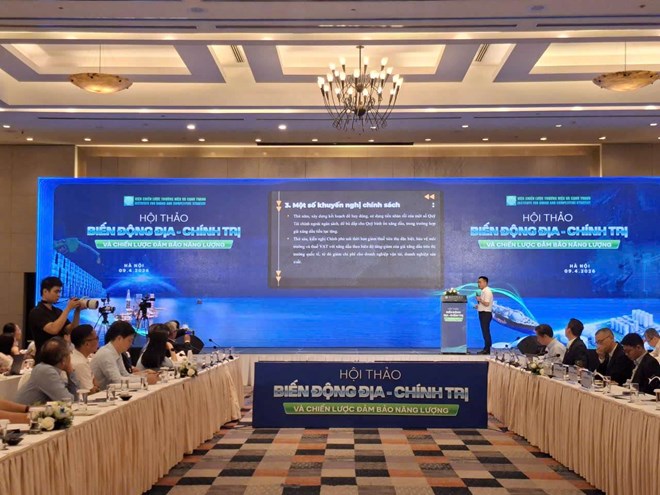
On April 9, the Institute of Brand Strategy and Competition, in coordination with relevant units, organized a workshop titled "Geo-political and Energy Assurance Strategy."
According to experts, in the context of increasing geopolitical conflicts and tensions in many regions around the world, especially in the Middle East, the global energy market is witnessing strong fluctuations in prices, supply, and transportation costs.
Energy fluctuations also have a chain reaction effect on business production activities. Industries that use a lot of energy or are heavily dependent on logistics and input materials—such as transportation, processing, building materials, agriculture, and fertilizers—are under significant cost pressure.
From a business perspective, Ms. Phan Thi Thanh Xuan, Vice President of the Vietnam Leather and Footwear – Handbag Association, said that Vietnam's leather and footwear industry currently holds an important position in the global supply chain, ranking second in the world after China. The leather and footwear and textile and garment industries currently create jobs for about 5 million workers.
However, due to about 90% of the output serving exports, the industry is strongly affected by geopolitical and international market fluctuations. According to Ms. Xuan, recent tensions in the Middle East have caused logistics costs to increase by about 15%, while many oil-related raw materials have increased in price by up to 30%.
In that context, businesses are forced to share costs throughout the supply chain while promoting automation, digital transformation, and optimizing production management to reduce costs. In addition, businesses also face increasingly strict requirements for green transformation and the goal of net zero emissions from major markets.
In the context of fluctuating input costs due to geopolitical conflicts, increasing the proactiveness, flexibility, and resilience of the economy is very necessary. Dr. Ha Huy Ngoc, Director of the Center for Strategy and Policy at the Vietnam and World Institute of Economics, proposed eight groups of solutions to improve energy security and reduce the negative impacts of energy price fluctuations.
First, the Government needs to develop a response scenario, ensure sufficient gasoline and oil supply, and diversify import sources of gas and crude oil.
Second, accelerate the construction of total crude oil and strategic oil reserves. Although current oil resources are limited, building long-term reserves is necessary to proactively respond to future shocks.
Third, strengthen international cooperation, diversify supply sources, and ensure national energy security.
Fourth, quickly deploy E5 and E10 bio-gasoline. It is necessary to accelerate the widespread use of E5 and E10 bio-gasoline to compensate for the shortage of traditional fuel sources.
Fifth, reduce taxes on gasoline and oil. Relax the application time of taxes, such as environmental protection tax and VAT, according to oil price fluctuations in the international market, in order to reduce input costs for transport and manufacturing enterprises.
Sixth, maintain macroeconomic stability and flexible growth. Accordingly, build growth and inflation scenarios and combine different management measures to maintain economic stability.
Source: Read the original article | Published: April 09, 2026