
Editor's Note
This editor’s note highlights the key facts and market implications behind “How to Install and Renovate Floors for Functiona”, with emphasis on sourcing, product fit, fabrication, logistics, or buyer impact.
Interior floors are a central part of the home ecosystem. Beyond being functional for use, they must withstand the traffic of inhabitants and support the weight of furniture and appliances. At the same time, they should coordinate with walls and other areas to provide a pleasant view. Since the pandemic began, many people have undertaken renovations that included replacing floors that were worn, broken, or old; similarly, those building from scratch paid close attention to this material.
Bárbara Berson, head of Berson Arquitectura, told Infobae that the first steps are to remove the old floor and be careful not to create excessive dust or damage anything in the house: "To reach the subfloor, level it to properly accommodate the tiles later, and also consider a proper waterproof barrier (using asphalt mortar or 200-micron polyethylene), especially in wet areas like bathrooms and kitchens. The important thing is that it is well-leveled so the tiles are not uneven."
Experts advise that once the existing floor is removed, check for cracks, seal them if any, and only begin installation after the material used has dried completely, so the tiles settle well.
“When installing a floor at home, it is essential to know the type of surface, whether it is a cementitious subfloor or an existing floor, to then define what type of covering will be used. The size and weight of the piece must be considered, whether ceramic or porcelain, and the traffic in that area, whether interior or exterior, exposed to temperatures like radiant heating, for example. After analyzing all variables, you can define what type of adhesive to use, as the surface absorption will determine if it should be with resins or not.”
Julio Pereyra, head of training at Weber Megaflex (Saint-Gobain), explained this.
To install ceramic or porcelain tile over any type of floor, it is important that the surface is flat and clean, so the tile is fully supported, dry, firm, and consistent. The ambient temperature at the time of installation is a factor to consider and should be between 10°C and 30°C.
The style of the house must also be considered.
“It is key to follow that style. For example, for industrial or country style, wood-look porcelain planks work very well; for minimalist or classic, large-format polished tiles instead.”
María del Mar Danuzzo, commercial architecture manager at Familia Bercomat, explained.
Danuzzo indicated that "it must be considered that the bedroom is a medium-traffic space, which allows for ceramic tile as well, not just porcelain. For the kitchen or living room, which are higher-circulation areas, we suggest porcelain; wood-look planks are very functional. For garages, galleries, or exteriors, we recommend installing cementitious tiles, and it is ideal for them to be anti-slip. In bathrooms, ceramic or porcelain can be used interchangeably, depending on the aesthetics or taste of the chooser. For this environment, wall panel coverings also work."
Professionals treat floors as a tactile and visual surface of great importance.
“In general, we work with noble materials like stone and wood. To make the joints less visible, we use rectified joint materials for a neat finish.”
Berson said.
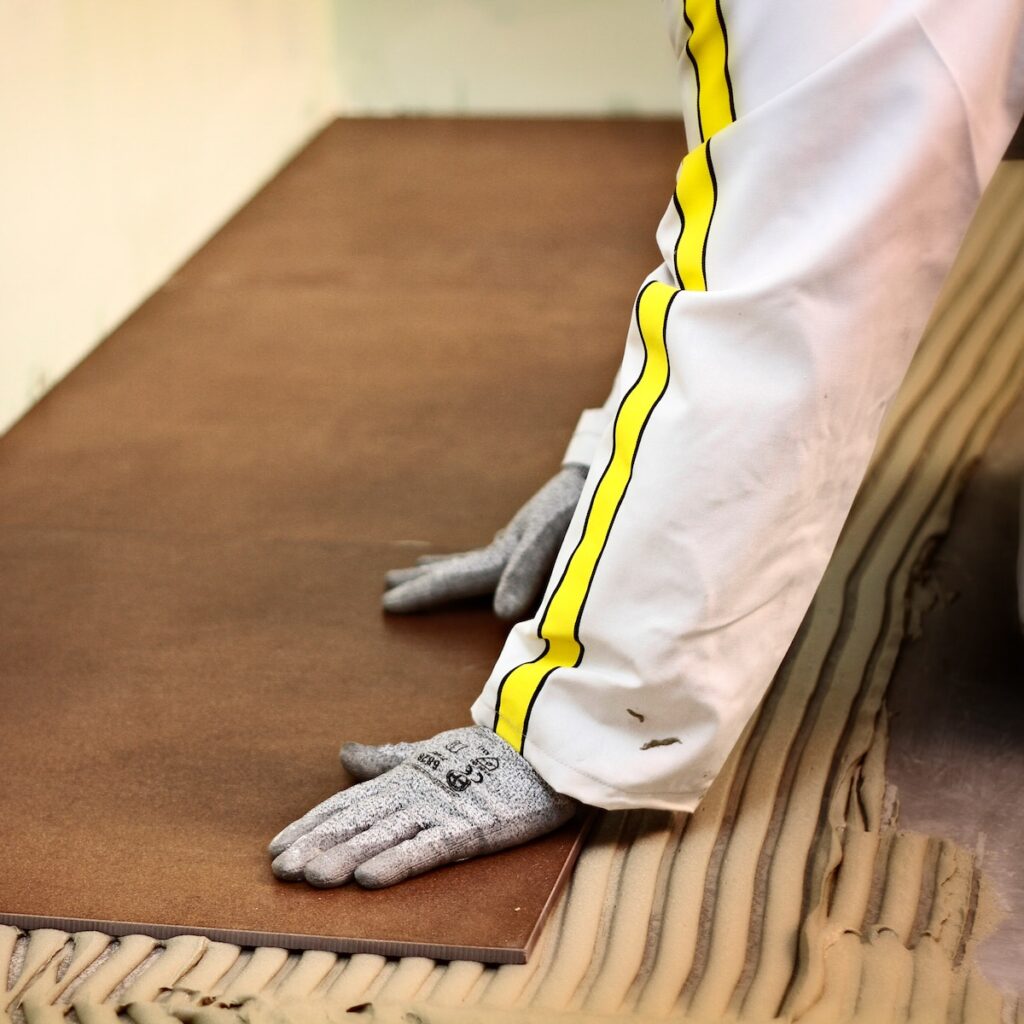
Typically, for larger and heavier slabs, two people work on the installation. For smaller tiles, one person can do the job. It is important to consider if the spaces are small, as there is no room to move around, making individual work more comfortable.
Domestically, many people resort to installing tile over tile. To avoid mistakes, experts warned Infobae that without prior preparation, gluing the new floor over the old one will eventually cause detachment. Therefore, it is necessary to chip the floor to install tile; if the existing floor is vinyl or laminate, it must always be removed. If the base is mosaic, tile, cement, or other ceramic, it should not be chipped.
Liliana Silva, marketing manager at Cerámica Alberdi, highlighted that "another essential aspect is the aesthetic quality related to typology (there is a wide variety of products that emulate stone, marble, wood, cement, and fantasy designs, among others). They come in various textures that perfectly imitate the materials. Hence the possibility of having the desired floor, on a ceramic base."
The size of the pieces must be considered. It is not practical to install large-format tiles in very small bathrooms.
“Instead, for spacious environments, the most accurate decision is to opt for larger-dimension floors.”
She added.
What About Joints?
Those preparing to renovate or install floors in their new home must also pay attention to the joints, which play a key role because they allow for minimal movement of the slab. They undergo displacement, expand with heat, and contract with cold. If they lack a joint, they can crack, even injure someone passing by, or simply pop up from the floor.
In ceramic tile, the anchorage is mechanical, requiring the adhesive to penetrate the pores to fix to the floor. This happens because ceramic has water absorption.
“Joints are small spaces between tiles that allow the pieces to move freely due to contraction and expansion, resulting from structural stresses caused by movement, wind action, or thermal differences. These allow the pieces to move freely and prevent popping, which causes them to detach. This is why ceramic and porcelain tiles, even if they are rectified pieces, never…”
Pereyra argued.
Source: Read the original article | Published: May 06, 2021