
Editor's Note
This editor’s note highlights the key facts and market implications behind “Sèvres, a Rothschild Passion at the Villa Ephrus”, with emphasis on sourcing, product fit, fabrication, logistics, or buyer impact.
When porcelain tells the story of a great European dynasty.
Over the centuries, certain works of art transcend their status as objects to become privileged witnesses of history. Sèvres porcelain belongs to this rare category: fragile by nature, yet of astonishing permanence in the collective memory.
Through this immersive retrospective, porcelain becomes language, heritage, and memory. It tells the story of the genius of 18th-century artisans, the enlightened taste of the Rothschilds, and the upheavals of European history.
Each piece is the result of a subtle dialogue between painting, sculpture, and ornamentation. Mythological scenes, floral patterns, or allegories unfold with extreme precision, making Sèvres porcelain a total art form. From the 18th century onwards, these works circulated throughout Europe, captivating sovereigns, aristocrats, and great collecting families.
Installed in Paris, London, Vienna, or Naples, they patiently assembled some of the finest porcelains from the Sèvres Manufactory, favoring masterpieces from the 18th century. These acquisitions took place in the context of a booming art market: the great public sales of the 19th century became social events where a true aesthetic competition played out.
Displayed in refined cabinets or integrated into sumptuous décors, Sèvres porcelains contributed to an art of living where taste, knowledge, and transmission held a central place.
The Sèvres Manufactory, a pinnacle of French refinement
Founded in the 18th century under the impetus of the royal court, the Sèvres National Manufactory quickly established itself as an absolute symbol of French refinement. At a time when the decorative arts fully contributed to the political and cultural prestige of the kingdom, Sèvres embodied technical excellence and artistic audacity.
The fineness of the paste, the perfection of the firings, and the chromatic richness distinguished its productions. The colors, which became legendary: rose Pompadour , bleu céleste , vert pomme , rivaled in intensity and depth. The shapes were surprising: monumental vases, delicate cups, hybrid objects inspired by nature, architecture, or the fantastic bestiary.
The Rothschilds, visionary aesthetes and collectors
In the 19th century, the Rothschild Family established itself as one of the greatest dynasties of European collecting. Influential bankers, enlightened patrons, passionate art lovers, the Rothschilds developed a true culture of beauty, nurtured by a pronounced taste for French decorative arts.
But for the Rothschilds, the collection went beyond mere social prestige. The works were conceived as a heritage , carefully passed down from generation to generation. They circulated among the different family branches, traveling from a Parisian townhouse to an English castle, from Ferrières to Waddesdon Manor.
Béatrice Ephrussi de Rothschild, a woman at the heart of the narrative
Within this European dynasty, Béatrice Ephrussi de Rothschild emblematically embodies the spirit of great collecting. A passionate heiress, she devoted her life and fortune to acquiring works of excellence, animated by a motto that became famous:
“Ars patriae decus” (Art is the honor of the homeland).
To house her treasures, Béatrice had the spectacular Villa Ephrussi de Rothschild built on the heights of Saint-Jean-Cap-Ferrat . Overlooking the Mediterranean, this residence became a showcase for her collections and an aesthetic manifesto in its own right.
A visionary, deeply attached to the transmission of heritage, she decided in 1934 to bequeath the villa and its collections to the Académie des Beaux-Arts , offering the public an exceptional testimony of the taste and refinement of a great aesthete.
Fascinated by French decorative arts and the virtuosity of the Sèvres Manufactory, she assembled at the beginning of the 20th century a remarkable collection of porcelains, chosen with rare exigence. Each piece bears witness to a discerning eye, sensitive to the balance of forms, the quality of the decorations, and technical perfection.
An immersive exhibition between art, memory, and history
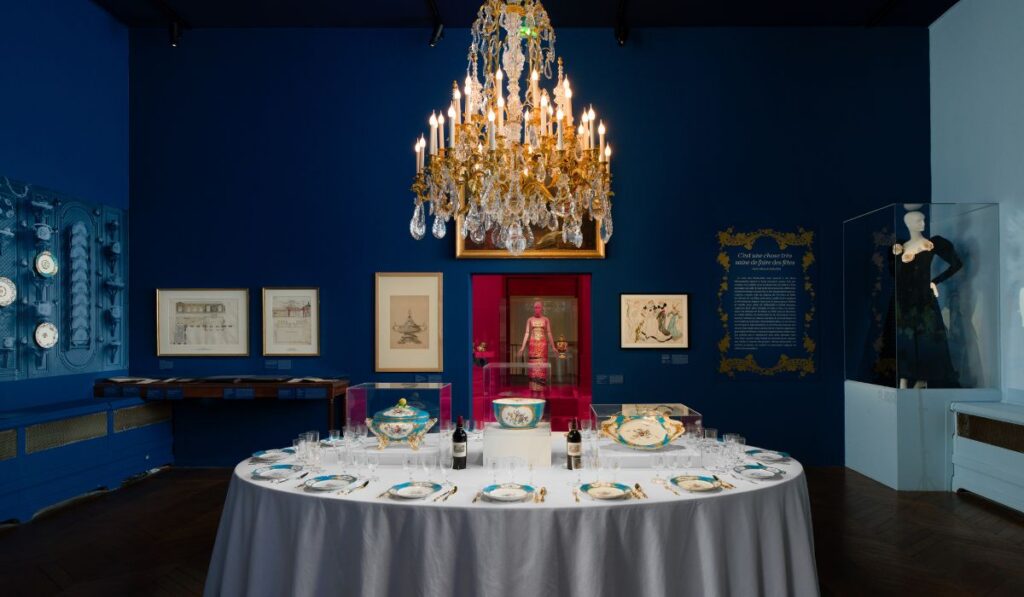
The exhibition proposes an immersive journey that traces this unique artistic and family adventure. Visitors discover porcelains with brilliant colors and virtuoso forms, staged in décors evoking the atmosphere of the great Rothschild residences.
For the exhibition does not shy away from the darker episodes of the 20th century. During the Second World War, Rothschild properties in France, Germany, and Austria were looted. Many works were dispersed: some disappeared, others reappeared decades later.
Today, the exhibition reconstructs a unique panorama of this turbulent history.
When porcelain becomes memory
Beyond their brilliance and virtuosity, Sèvres porcelains tell a profoundly human story. Each vase, each cup, each object bears the trace of an artisan, a collector, an era.
The exhibition reminds us that art objects are not only symbols of beauty or prestige. They are also vectors of memory .
With this exhibition, Paris once again confirms its major role in promoting French heritage and decorative arts, offering the public an experience where luxury dialogues with memory, and where porcelain becomes a narrative in its own right.
The exhibition "Sèvres, a Rothschild Passion. From Paris to the Villa Ephrussi" is presented from April 17 to July 26, 2026 in Paris, inviting visitors to rediscover the extraordinary dialogue between a great European dynasty and one of the jewels of French decorative arts.
Source: Read the original article | Published: April 17, 2026