
Editor's Note
This editor’s note highlights the key facts and market implications behind “Housekeeper King: Hot Coffee Pot Leaves Stains o”, with emphasis on sourcing, product fit, fabrication, logistics, or buyer impact.
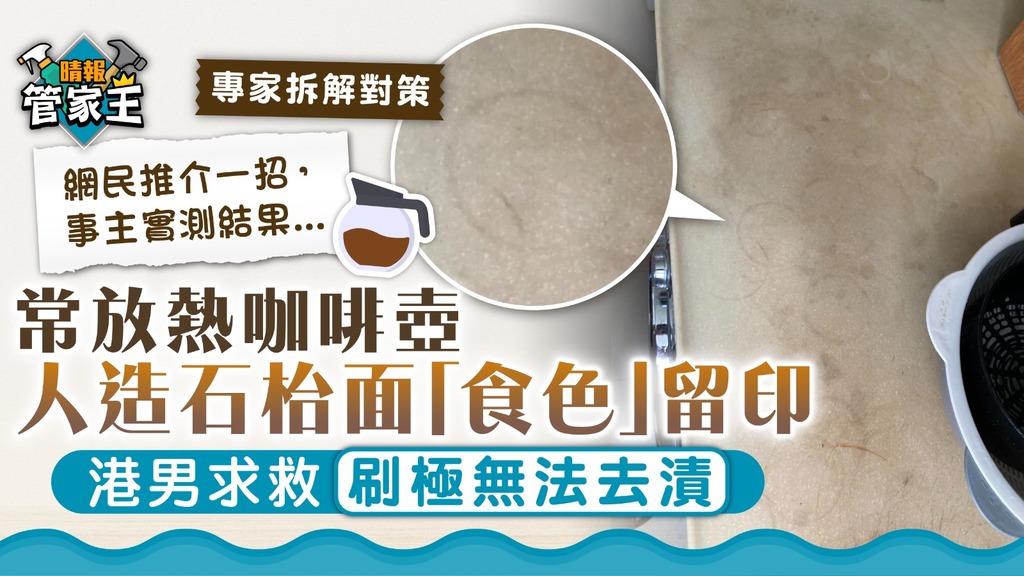
Many homeowners choose artificial stone for kitchen countertops, but improper use can damage the surface. A Hong Kong man recently shared online that frequent coffee brewing on his stone countertop left large cup marks, some deeply stained, which he could not remove despite repeated cleaning. Experts note that artificial stone is relatively soft and prone to cracking under frequent temperature changes, and placing hot items can leave marks that are difficult to clean with detergents alone.
Additional Case: Common Mistakes with Heater Fans
In a related segment, a maintenance expert warned that using heater fans with two common mistakes can lead to early failure, advising against always running them at maximum heat and speed.
Netizen’s Dilemma
A netizen posted on the Facebook group "Oh yes 有得整" saying that after recently getting into pour-over coffee, the hot coffee pot left ring-shaped stains on the artificial stone countertop. The coffee stains had penetrated the surface, and even cleaning agents failed to remove them. The user wrote, "Even 'Jie X Liang Dian' scrub didn't work… Is there any way to clean it myself?" Photos showed dark brown and black rings on the light-colored stone, with some areas showing larger black marks.
Netizens Say It’s Hard to Fix
Many commenters suggested using a cleaning sponge from a 12-dollar store or applying bleach, but others said the stains were irreversible without professional grinding. One user noted, "A master told me that after 8-10 years, you can have it polished to remove the top layer and restore whiteness, but that costs a few thousand dollars."
The original poster later tried electrolyzed water and a cleaning sponge, which improved the situation slightly but did not fully remove the coffee stains. He said, "It helped a bit, but my hands got sore from scrubbing."
Expert Advice: Avoid Hot Items on Artificial Stone
Winnie Cheung, a senior housekeeping instructor, told Sky Post that artificial stone is soft and prone to cracking and losing luster under frequent temperature changes. Placing hot cookware directly on the surface can leave marks.
She advised always using a trivet under hot pots to prevent stains. For severe cases like this, she recommended soaking a white cloth in a 1:4 bleach solution, placing it on the stone for 20 minutes, then wiping with clean water to try to improve the appearance.
Professional Polishing for Deep Stains
Simon Tang, head of an online renovation platform, explained that dark liquids like coffee or soy sauce can penetrate deep into artificial stone if not cleaned promptly, causing stubborn stains. Additionally, artificial stone is not heat-resistant, so the marks in the photos are likely a combination of coffee stains and burn marks from the hot coffee pot.
He noted that electrolyzed water only removes surface dirt, while the remaining stains are deep-set, making it ineffective. A cleaning sponge with friction can help but cannot fully remove stains that have penetrated deeply. The only complete solution is professional polishing to remove the top layer and eliminate deep stains.
Artificial Stone vs. Quartz Stone
According to the renovation platform "Good Master," seamless stone (artificial stone) is the most popular countertop material in Hong Kong. It is made by compressing mineral fillers (usually aluminum hydroxide) with acrylic resin or polyester. Originally a luxury alternative to natural stone, it is now mid-range and affordable, costing about HK$300–1,000 per linear foot.
Its advantages include easy shaping, high plasticity, and many design options. It can be joined seamlessly and used to create integrated sinks or curved backsplashes. However, quality varies greatly between brands, with higher-priced versions generally resisting stains better. Due to its low hardness, it is easily scratched by sharp objects and can be marked by hot cookware.
Popular brands in Hong Kong include Corian (US), LG, and Staron (formerly Samsung, now under Lotte). Corian is about 50% more expensive than the Korean brands. Formica, known for laminate, also produces seamless stone. Cheaper Chinese-made options are available but vary widely in quality.
For those concerned about staining, quartz stone is a harder, more durable alternative. It is resistant to scratches and heat, easy to clean with water, and can even have surface stains scraped off with a blade. It maintains a smooth finish over time without special maintenance. However, it is more limited in shape (cannot be curved or seamless) and costs more, around HK$700–1,400 per linear foot.
Source: Read the original article | Published: April 28, 2023