
Editor's Note
This editor’s note highlights the key facts and market implications behind “Europe Between Tariffs and Missiles”, with emphasis on sourcing, product fit, fabrication, logistics, or buyer impact.
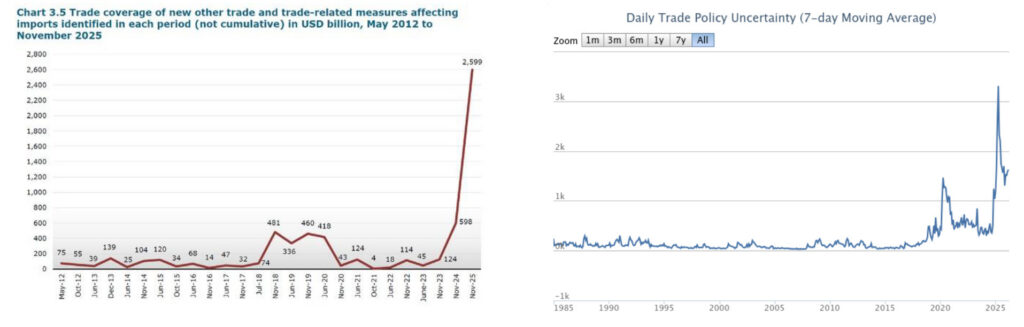
The Israeli-American attack on Iran follows a generalized increase in military conflicts, albeit in various forms—from the "old-style" invasion of Ukraine by the Russian Federation to the kidnapping of President Maduro by American armed forces. Political-military conflict grows in step with economic and commercial clashes and has the same causes: the United States, and the West as a whole, are no longer able to curb the rise of their competitors by ordinary means. They must therefore resort to trade wars and actual wars. The following two charts illustrate this parallel escalation well. Sanctions, for instance, primarily aim to target Russia's war effort but in reality serve to attack the entire enemy bloc, especially China. With Trump, Europe is also in the crosshairs, and precisely at its most difficult moment. After all, Europe has a significant trade surplus with the United States (around €200 billion in 2025). Indeed, if at the peak of the hyper-globalization phase, the weight of world trade in China had assumed a dynamic similar to Europe's, after 2008, while China charted a course change with greater emphasis on the domestic component, Europe, with austerity, crushed domestic demand, amplifying the export-led nature of its growth model. Now the European economy overwhelmingly depends on world trade, just as we have entered the era of trade wars. The threat to invade Greenland and to punish European countries that opposed annexation moves in the same unprecedented direction. The United States finds itself having to curb the rise of an economic rival with currency agreements. In the 1980s, with the Plaza Accord, Japan was forced to revalue the yen, which only delayed a further increase in the trade deficit by a few years. Similar agreements were concluded, also in the mid-1980s, with Germany. Even earlier, Nixon, when he ended the Bretton Woods system of fixed exchange rates, which prevented the convertibility of the dollar, also announced the introduction of a general 10% tariff; however, with victory in the Cold War, globalizing tendencies prevailed, as seen with the 1991 NAFTA agreement with Mexico and Canada and other negotiations in the GATT and later WTO. The Trump administration's disjointed response to these trends does not constitute an industrial policy that could even come close to the long-term lines of Chinese five-year plans. It therefore does not involve incremental changes in the country's productive composition. Thus, the effort to imitate where possible, or more frequently to destroy the efforts of others, prevails. The idea of developing a trade corridor from India to the Mediterranean, which to function requires the liquidation of Iran and the Palestinians (the so-called IMEC), is precisely an example.

Europe Between Tariffs and Missiles
The trade war waged by the declining United States on the global stage preludes large-scale armed conflict. And what is the EU doing?
In the life of peoples, great problems are solved only by force.
– Lenin

In this sense, we live in a transitional era: for the first time in many centuries, the West does not benefit from world trade and must therefore resort to protectionism, not to defend nascent industries, as Western countries have always done against each other, but mature industries against new competitors. For its part, China systematically increases its production capacity because it uses its lower production costs to expand the market share of its companies. This strategy, which Western analysts reduce to "over-investing" resulting in excess production capacity, has allowed China to conquer one sector after another, leaving the West, to save its own companies, with no choice but to resort to tariffs or direct bans, like the American one to close its market to those using Chinese software.
Why Tariffs?
Already with the first Trump administration, the issue of tariffs was placed at the center of American economic policy, reversing thirty years of consensus towards globalization and free trade. Certainly, the US trade balance worsened during the era of globalization. The first Trump administration undertook a complex series of initiatives to try to reduce this dynamic, especially in an anti-China key. The most immediate aspect of the strategy, and also the most discussed in the media, was, as also from 2024, that of tariffs. Breaking a post-war trend towards their reduction, Trump decided to use tariffs not only to reduce the trade deficit but also to increase tax revenue in order to be able to cut taxes for the wealthier classes, thereby determining an enormous shift of the tax burden from the rich to workers, and to bring manufacturing production back to the country (so-called reshoring). This last objective was not achieved in the slightest. Nations hit by tariffs used tariff circumvention methods that were paid for the most part by American companies and consumers. Overall, American industry did not see a significant recovery in production volumes in key sectors. Just to take the example of automotive, production remains well below the level of 2008 or 2000, despite reshoring and incentives.
Source: Read the original article | Published: April 17, 2026