
Editor's Note
This editor’s note highlights the key facts and market implications behind “In Faenza, the Italian Ceramic System Discusses “, with emphasis on sourcing, product fit, fabrication, logistics, or buyer impact.
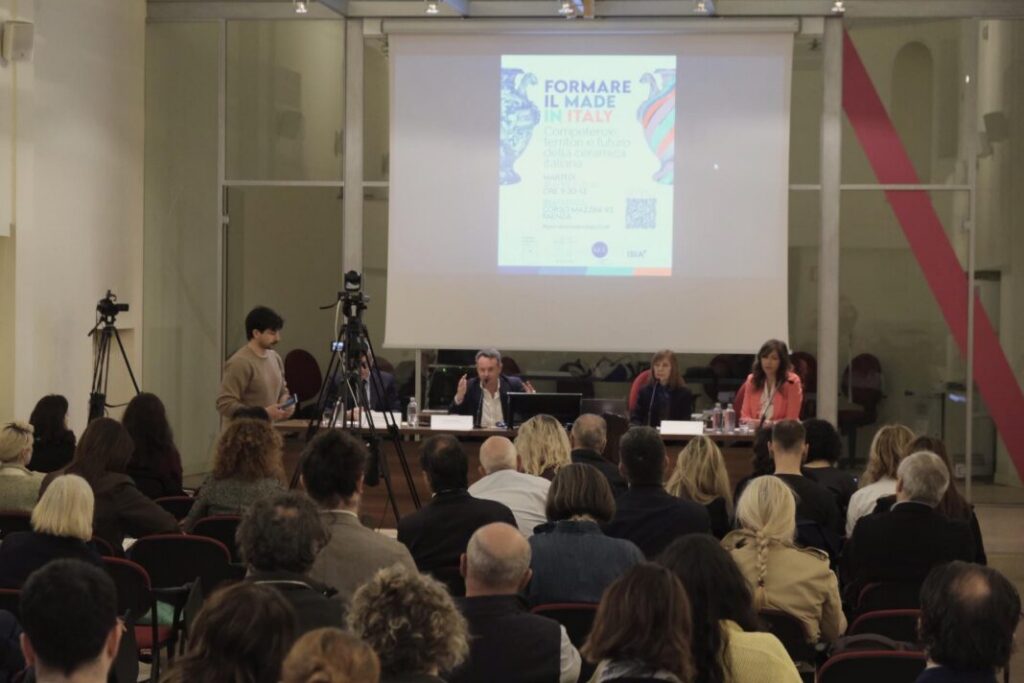
A broad and articulated debate to reflect on the future of Italian ceramics, starting from training: this emerged from the conference hosted in Faenza as part of the National Day of Made in Italy.
Critical Issues in Training for the Ceramic Sector
The conference "Forming Made in Italy. Skills, Territories, and the Future of Italian Ceramics," promoted by AiCC – Italian Association of Ceramic Cities, brought together institutional representatives, training experts, artisans, designers, and industry operators. The aim was to initiate a shared reflection on the transformations underway in educational pathways and the transmission of knowledge in the ceramic sector.
Nadia Carboni, director of AiCC; Patrizia Maggia, expert in artistic crafts and high craftsmanship; and Elisa Guidi, coordinator of Artex – Center for Artistic and Traditional Crafts of Tuscany, highlighted the richness of widespread skills and experiences, but also the fragmentation and lack of unified coordination.
The progressive loss of the integrated model between school and workshop, together with the reduction of laboratory activities, has weakened the transmission of artisanal knowledge, making the transition between training and work more complex. In this context, training was interpreted not only as a technical lever but also as a cultural and social element, closely linked to issues of identity, cohesion, and development.
The Role of Institutions and Advanced Training
During the proceedings, the strategic value of Made in Italy was repeatedly emphasized, recognized as one of the country's most important assets internationally. The institutional message from Mimit, delivered by Minister Adolfo Urso via video link and by Angelo Berluti, representative of the Casa del Made in Italy for Emilia-Romagna, Umbria, and Marche, reaffirmed this centrality.
In particular, the role of advanced training institutions emerged as decisive in redefining educational models. As highlighted by Maria Concetta Cossa, director of ISIA Faenza, the institute now represents a laboratory where tradition and innovation dialogue through research on materials, attention to sustainability, and integration with new technologies, in close relationship with the production system and national and international networks.
At the same time, Vincenzo Colla, vice president of the Emilia-Romagna Region with delegations for economic development, green economy, energy, vocational training, and research, emphasized the need to strengthen the link between training, research, and development to support competitiveness without losing the connection with material culture.
Concrete Experiences Between Training and Work
Alongside the national framework, the conference gave space to concrete experiences that represent significant attempts to build a bridge between education and work. In this context, Federica Cavriana, project manager for Training and Orientation at the Cologni Foundation for Artistic Crafts, illustrated the project "A School, a Job," emphasizing the value of apprenticeships in workshops as tools for professional accompaniment and skills transmission.
Particularly relevant were the territorial case studies, which demonstrate how it is often the territories that experiment with innovative solutions. Viola Emaldi, educational coordinator of the Ifts and Its courses for ceramic product technician at the Fondazione Ceramica Montelupo Onlus and the Ceramics School of Faenza, highlighted the importance of territorial networks and awareness-raising activities aimed at young people.
Benedetta Falteri, director of the Montelupo Fiorentino Municipal Ceramics School, presented a model based on the integration between art high school, Its and Ifts pathways, businesses, and cultural institutions.
Gabriele Resmini, president of the Ceramists Association of Albisola and Albisola Superiore, recounted an experience where training intertwines with tools such as business incubators.
Finally, Valter Luca De Bartolomeis, head of the Caselli Palizzi Arts Hub in Naples, the Industrial Art Museum, and the Royal Factory of Capodimonte, as well as director of Its Ma.De. and curator of the Correale Museum in Sorrento, illustrated a model capable of integrating training, production, and cultural heritage, overcoming the separation between craftsmanship and design.
A Mapping Between Opportunities and Critical Issues
A comprehensive reading of the system was provided by the mapping of training in ceramic cities, presented by AiCC. "We are faced with a void in national policy, which has never built a real training space for Made in Italy and which, after the suppression of art institutes, has left municipalities with ancient ceramic traditions to manage specialized training on their own." Starting from ceramics, AiCC makes ten significant case studies available, capable of activating connections between existing communities of practice and building bridges between different training systems. The challenge, as emerged from the conference, is not so much to create new isolated models, but rather to strengthen and connect existing ones, giving continuity to pathways and enhancing widespread experiences in the territories, in a shared perspective of development for the Italian ceramic sector.
Source: Read the original article | Published: April 23, 2026