This editor’s note highlights the key facts and market implications behind “48 Hours in Canavese: Castles, Ceramics, and Cul”, with emphasis on sourcing, product fit, fabrication, logistics, or buyer impact.
Nestled in the hills between Turin and the Aosta Valley, embraced to the west by the Graian Alps, the green Canavese region blends castles that bear witness to history with industrial vocation, craftsmanship with Piedmontese cuisine. This is a territory that, after the loss of the industrial and social heritage of Olivetti (the legendary Lettera 22 typewriter was produced in Agliè), is seeking a new calling in culture with theaters and museums, in food and wine among Erbaluce wineries and rustic mountain flavors, and in its historical and architectural heritage with the castles of San Giorgio, Agliè, and Castellamonte (the "Red Land" of ceramic art).
Municipalities are united by the "Tre Terre Canavesane" project—a synergy to enhance products, knowledge, historical heritage, and landscape—which sees tourism as the natural outlet for its resources, a new development opportunity fueled by a packed calendar of gastronomic, historical, and craft-themed events. This is further supported by its location at the foot of Val Soana, Valchiusella, and Gran Paradiso National Park.
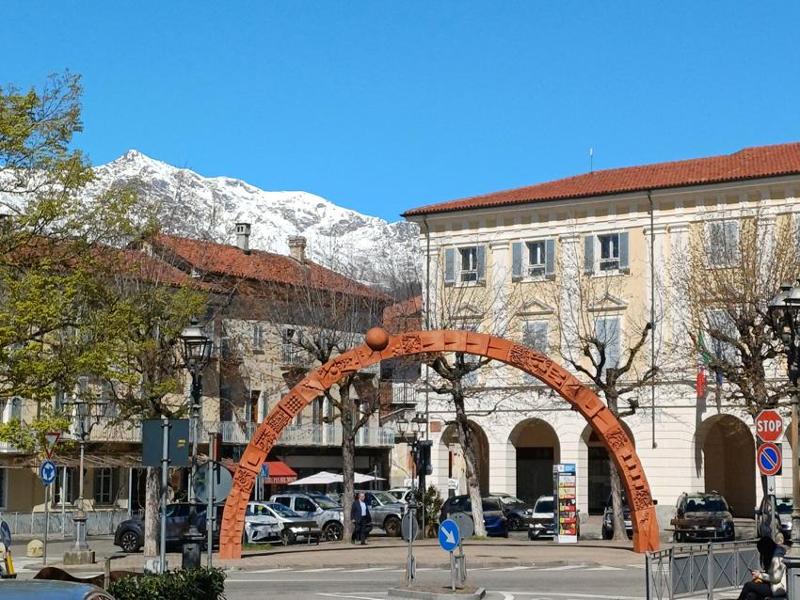
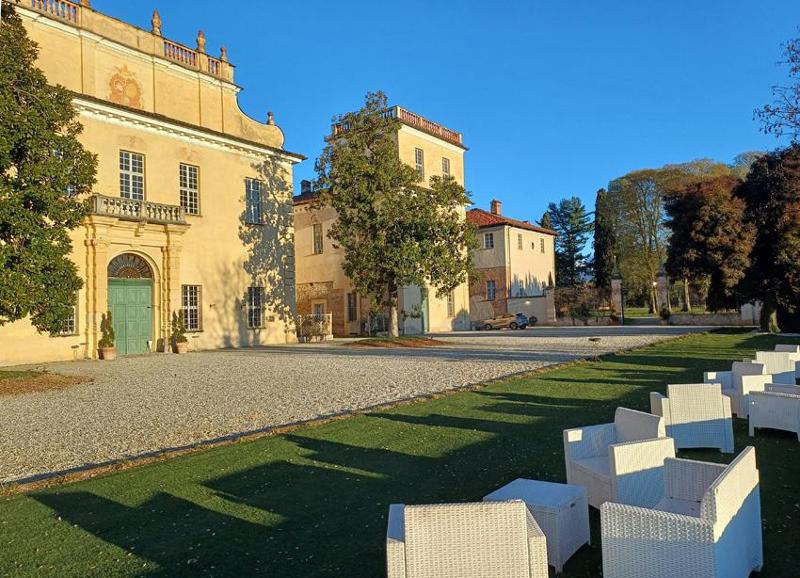
The view ranges from the Cottian Alps, dominated by Monviso, to the Graian Alps. The medieval manor, perched on the village, was expanded in Baroque style between the 17th and 18th centuries and endowed with elegant gardens, recently restored with PNRR funds. It includes an 8-room guesthouse with terracotta floors and period furniture, a restaurant, and halls for hosting cultural, corporate, conference, and wedding events. The interiors can be visited on guided tours. Just 8 km separate Agliè from Castellamonte, the city of ceramics, famous for its eponymous stoves. The Ceramic Museum in Palazzo Botton illustrates the history of an activity that once, between clay quarries and kilns, involved 2000 workers: it spans from industrial archaeology to modern design. Two companies producing stoves and 10 artisan workshops remain. But ceramics have spread into urban furnishings: from ceramic street and shop signs to the arch by Arnaldo Pomodoro that stands in front of the Town Hall with its façade designed by Alessandro Antonelli, who is also responsible for the unfinished Rotonda Antonelliana on the opposite side of the square. This extends to the Monument to the Stove by Ugo Nespolo, in front of the Congress Center which houses the unique Museum of Ceramic Whistles with 300 pieces displayed in rotation from a collection of 3000.
Castellamonte hosts the "Buongiorno Ceramica!" event on May 23 and 24, with artists and artisans from 60 Italian municipalities. And, from August 22 to September 13, the Ceramics Exhibition, a widespread museum on 360° terracotta production.
FIRST DAY
The guardian of San Giorgio's identity is the "Nòssi Ràis" (Our Roots) Museum, an ethnographic hub with 4000 artifacts of rural civilization and ancient trades. A place of collective memory: wooden plows, hemp looms (from which the term "Canavese" derives), blacksmith forges, and carpentry workshops tell the story of the hardship of living in these valleys. The museum also illustrates the works of its most illustrious sons. The Jacobin Carlo Botta, a forerunner of Risorgimento values. Antonio Michela Zucco, inventor in the mid-19th century of the phono-stenographic machine (displayed here) used to transcribe parliamentary sessions across half the world. Carlo Vigna, the naval engineer director of the maritime arsenals of La Spezia, Naples, and Venice, to whom a monument is dedicated in the town's central square. And the contralto Teresa Belloc-Giorgi, a key interpreter in Rossini's operas, also rumored to have been the composer's lover, to whom the restored Belloc Theater is dedicated, a hub of cultural and educational activities for the area, with 15 shows scheduled. San Giorgio is the production center of Erbaluce di Caluso, the first white DOC wine in Piedmont (1967), the main wine of Canavese (1800 hectares of vineyards) with 1.5 million bottles of dry sparkling wines, still whites, and passito wines, the result of pergola-trained vines on morainic soil with a rainy microclimate and high acidity. To a lesser extent, red and rosé DOC wines are also produced from blends of Nebbiolo, Barbera, Bonarda, Freisa, and Neretto grapes. Cantina Ciek and Orsolani are the main local winemakers, open to the public.
Pasticceria Roletti, on the other hand, has been the guardian of culinary sins since 1896: for five generations, it has served its own white vermouth with "Duchessa" biscuits, the sharp cocoa meringues with which the noblewoman justified her escapes to meet her lover.
San Giorgio boasts the Slow Food Presidium of the 'Piattella di Cortereggio,' the white bean cultivated on the banks of the Orco stream, cooked in a wood-fired oven for 12 hours with pork rinds, lard, and aromatics in Castellamonte terracotta pots. It also hosts the "Mercato della Terra e della Biodiversità": heir to the historic San Giorgio fair, with 80 producers of sweets, legumes, vegetables, cured meats, cheeses; with sales, tastings, and street food; next edition May 9 and 10.