
Editor's Note
This editor’s note highlights the key facts and market implications behind “Episode 06: Self-Renovation _ Tiles / Bathroom F”, with emphasis on sourcing, product fit, fabrication, logistics, or buyer impact.
Once the carpentry was finished, it was time for the tile team to come in.
The tile team had a meeting around the time the demolition was completed. We confirmed the height of the plumbing and discussed the number and shape of the drains.
I didn't have much to interfere with during the tile team's work, so I just checked periodically to make sure the work was progressing well.
The important thing was choosing the fixtures.
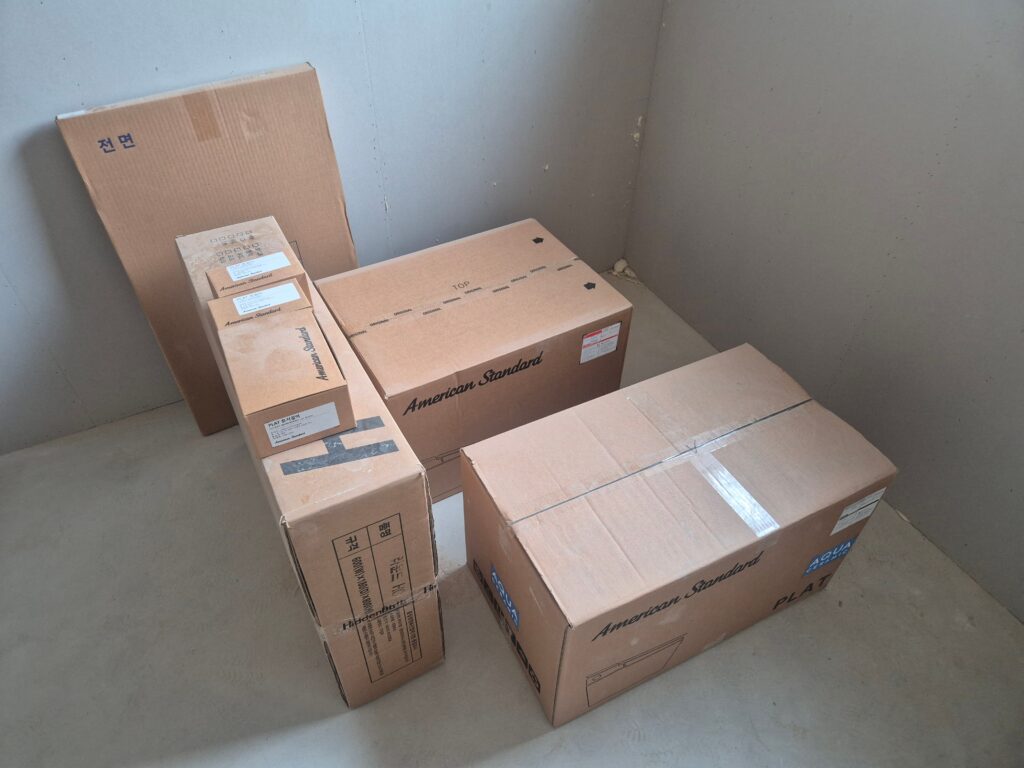
Since the tile team handles the installation of all fixtures, ceilings, and lighting, the fixtures needed to arrive on-site while the tile work was in progress.
Major fixtures include: toilet, sink, shower stall and sink faucet, towel rack, clothes hanger, mirror cabinet or wall cabinet. And the currently trendy Hygenic ventilation fan.
I purchased everything from wholesale shops in Euljiro and from IKEA.
I also saved costs by purchasing the tiles myself and arranging for their hoisting.
I visited two tile shops: Yong Tile in Incheon and Hash Sourcing in Hanam.
Below are tiles photographed at Yong Tile. First of all, all the tiles were hung on the wall, which made viewing them very convenient. Since it was my first visit, I didn't realize at the time what a big advantage this was.
After looking for a while, they all started to look similar and my eyes began to spin.
Yong Tile mosaic tile. Yong Tile 600*600. Yong Tile 1200 * 600. Beautiful.
The second shop was Hash Sourcing. Hash Sourcing seemed to have a higher price range, but since I visited Yong Tile first and then Hash Sourcing, it was difficult to go back to Yong Tile, so I just made my selection at the second shop. At Hash, tiles with low remaining stock are sold at sale prices. I also bought the Hygenic fan there as it was said to be cheaper than in Euljiro. (If I were to do it again… I'd want to buy from a closer shop. For returning leftover materials later, closer is better.)
Judging just by the tile patterns, I didn't feel there was a significant quality difference from Yong Tile. Most are made in China.
Choosing the tiles was the most agonizing moment. They dictate the mood of the house, but after looking for a while, my eyes spun and I couldn't tell what was what.
Hash Sourcing tiles. Mosaic tile 1 that I agonized over, and balcony tile 2 that I bought cheaply. Entrance tile 3, unified with the kitchen.
The areas where tiles go are: 1. Entrance, 2. Kitchen, 3. Bathroom, 4. Balcony. You just need to choose tiles for these four places.
I wanted to lay mosaic tile in the entrance, but it was out of stock. After much deliberation, I unified the kitchen and entrance. For the balcony, I planned to lay a rug anyway, so I used the cheap tile from photo 2 for the balcony.
Choosing the same tile for the kitchen and entrance was wise. It created a sense of unity and reduced waste.
For the kitchen and entrance, I used large 1200×600 tiles, and decided on 600×600 for the rest.
The completed kitchen tile. Since the sink goes under the tile, there was no need to tile that area.
The entrance is the same as the kitchen. Using 1200 tiles made it clean and pretty. The section line is hidden by the shoe cabinet, and I created a single step for the entrance, which wasn't originally stepped.
The balcony uses 600*600 individual tiles. I plan to cover it with a rug.
My pride and joy, the bathroom!! The bathroom ended up being used as a dry area (the difference between the bathroom floor and the living room floor was only about 7cm, and after laying the boiler pipes, the floor became even higher). I laid a single tile as a stepping stone between the bathroom and living room, finishing it so it just barely blocks water during cleaning. You can't leave indoor shoes there. Haha. So it's forced dry area.
Now, onto the fixtures. I browsed IKEA to visualize the image I wanted. I really liked that all the products displayed at IKEA were interchangeable and could be assembled together.
I liked the design of a towel rack that could hold two towels, but it looked a bit flimsy, so I gave up.
First, I decided on a one-piece type toilet. The IKEA-style sink was so pretty that I bought the sink along with a drawer cabinet. I bought the faucet and mirror separately in Euljiro.
I really didn't want to install a wall cabinet if possible, but due to lack of storage, I had no choice but to attach one above the toilet. The ones at IKEA were too shallow, so I bought this from Euljiro as well. However, I didn't like the monotonous feel, so I attached an IKEA handle to it. (Me…)
Every time I visited the site, I liked it so much that I took a commemorative photo.
I plan to add a glass door to the shower stall later. I cannot forgive water splashing.
Shower faucet. Ah! And I didn't know at the time that I needed to prepare a separate water tap, not just the faucet…
TMI, this is what the pretty bathroom looked like before… Pre-plastic surgery.
Source: Read the original article | Published: October 22, 2025