
Editor's Note
This editor’s note highlights the key facts and market implications behind “13 Examples of ‘Raw’ Walls: An Aesthetic, Econom”, with emphasis on sourcing, product fit, fabrication, logistics, or buyer impact.
"Inspired by the landscape, the idea from the beginning was to create a meeting place that is responsible and decidedly turned towards nature," explains Valentina Pilia of Flores Textile Studio, the team in charge of the interior design project. "The owner wanted to feel very comfortable, in a cozy and warm environment. He was looking for a monastic atmosphere, with Japanese influences, but very subtle," she adds.
Leaving walls raw is an uncommon choice. However, many design studios are betting on it with all kinds of materials and results that imprint tons of personality onto their projects (and offer significant savings and sustainability!).
2025 Decoration Trends: Raw Walls
It can be an aesthetic, economic, or climatic choice, but the truth is that betting on including 'raw' walls is a top trend in 2025, as IKEA predicted in its annual report. "It's a style that conveys authenticity, purity, and naturalness, and promotes sustainability by using less processed materials," explain the brand's experts.
It also adds charisma and personality to spaces (especially when compared to typical white walls), and in many cases, it entails advantageous savings. Not sure if you dare to try raw walls? Here are some ideas that will surely inspire you!
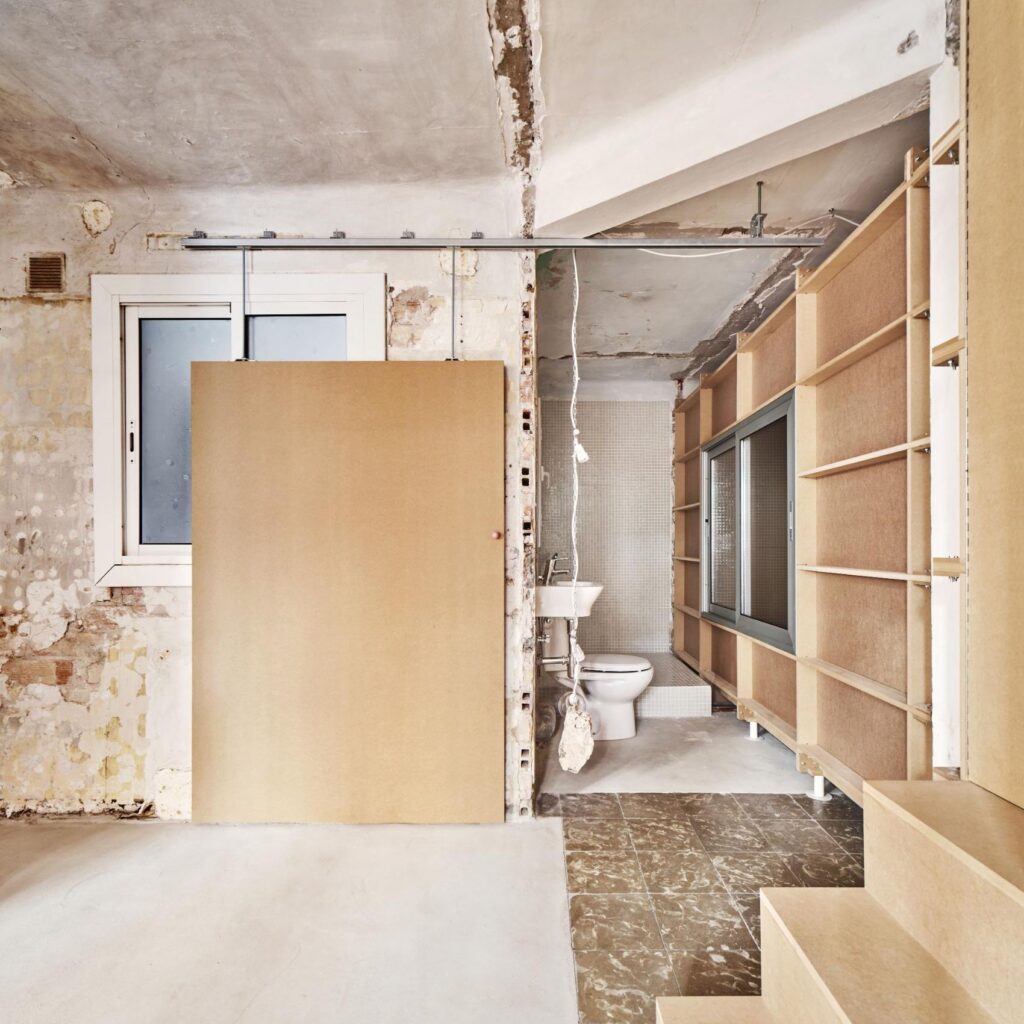
“We eliminated the budget item for new coverings (paint, plaster, tiles, etc.) after the demolitions and replaced it with a simple thorough cleaning of floors, walls, and ceilings. The marks of the previous partitions, floors, and appliances are left visible after their demolition, thus saving both on the purchase of new materials and on execution time,” TAKK told us regarding the apartment they managed to completely renovate for only 10,000 euros.
This award-winning semi-detached house by H Arquitectes is composed of "totally mineral spaces excavated within the walls." This mineral quality is achieved thanks to a particular use of what the studio calls 'poor concrete,' made on-site.
It is a mixture with very little cement and a selection of sands and gravels that, applied with a compaction technique similar to rammed earth, forms a very robust monolithic solution with high thermal inertia but, at the same time, porous enough to help regulate and stabilize the temperature, humidity, and acoustics of the spaces.
This, combined with the central height of the house, which stimulates ventilation speed and the upward exit of hot air, forms the basis of the building's energy efficiency.
The same as always, but different. That is the New Vernacular Architecture of Cantabria (NAVC), a series of projects carried out by Zooco in which the studio reinterprets lifelong materials and construction techniques through a contemporary lens, creating homes that are both contemporary and respectful of tradition.
This one is an example, and a very contemporary one: although its exterior is covered with local stone, the house's structure is composed of reinforced concrete screen walls alternated with glass panels, all of which creates a minimalist and almost industrial aesthetic.
However, wood provides great warmth and a sense of home to the whole. "It appears in partial elements of the walls and takes center stage in the exterior and interior ceilings, arranged in slats that emphasize the directionality of the house towards the sea."
This 210-square-meter semi-detached house in Sa Pobla (Mallorca) houses a very special materiality, marked by the texture of exposed thermo-clay blocks for the walls. But also by the concrete slab, the wooden flooring, and the glass galleries.
These materials, presented in their raw state, characterize this house for a young family formed by a couple and their two daughters, in which common spaces, sustainability, and frankness are the protagonists.
“The purpose of the project has always been to reflect the way of thinking and living of the future tenants. They have decided to follow a totally sincere and transparent idea of life with family and the environment. For this reason, privacy is reduced to a minimum, and simplicity and sincerity are reflected both in the layout and in the materials,” say NØRA studio.
On the walls of Panistas, in Santander, you won't see the usual photos of wheat ears. In this case, the creative process of Zooco, the studio in charge of the project, does not revolve around bread and its imagery, "so seen and used." Instead, it seeks to go to the origin of the final product, and with this idea, "create a beautiful, warm, pleasant atmosphere, a new environment for the buyer."
“We went back to the essence, to the earth, to that first step before being grain, later flour, and finally, bread. We wanted to build the space with that earth, as matter and as a chromatic range,” explain the firm.
To achieve this, the team embarked on research that resulted in the discovery of a peculiar range of products made 100% from earth. They come from Fet de Terra, an award-winning Catalan company specialized in creating architecture from this raw material, as well as in eco-innovation.
“We promote the use of local material and human resources for sustainable, ecological, and environmentally respectful construction. We use 100% recyclable materials, with low economic and energy cost, which allow the construction of healthy and efficient habitats,” explain its members.
Takk are not the only ones betting on walls that show the passage of time: in the case of Lugar Studio, the big surprise that would define the entire aesthetic of the renovation came when getting rid of the salmon-colored popcorn texture.
Source: Read the original article | Published: May 17, 2025