
Editor's Note
This editor’s note highlights the key facts and market implications behind “The Wide Range of Functions of Castellón Ceramic”, with emphasis on sourcing, product fit, fabrication, logistics, or buyer impact.
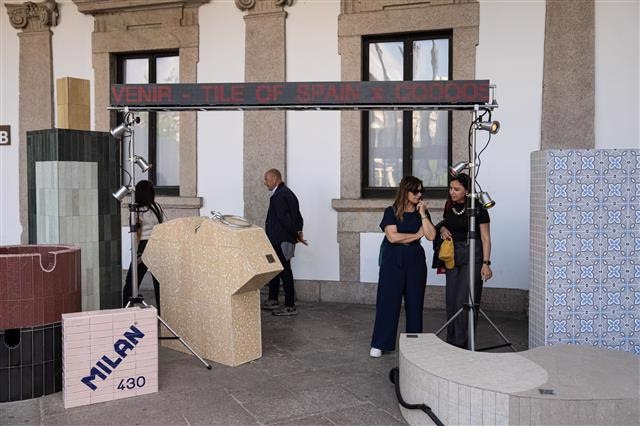
PLAZA CERÁMICA The Wide Range of Functions of Castellón Ceramics: Eleven Objects That Reinvent the Souvenir in Milan Tile of Spain presents a novel exhibition at the Fuorisalone in Milan © Tile of Spain by Alessandro Levati
CASTELLÓ. “Spanish Design as a Souvenir,” the new installation by Tile of Spain at the Fuorisalone in Milan, designed by Codoo Studio, redefines the condition of Spanish ceramics, abandoning their traditional role as cladding or flooring to assert themselves as body, volume, and autonomous design unit at the leading international event in the sector.
The space starts from a central question: Can Spanish design express the identity of a territory and become a material memory? Ceramics respond as a narrative language, shaping a still life of souvenirs on an architectural scale that reinterprets cultural icons and everyday objects of Spanish design, clad with ceramics from 15 Tile of Spain brands: Apavisa, Arcana, Argenta, Cevica, Colorker, Cristacer, Decocer, Dune, El Barco, Estudio Cerámico, Gayafores, Harmony, Tau Cerámica, Vidrepur, and Vives.
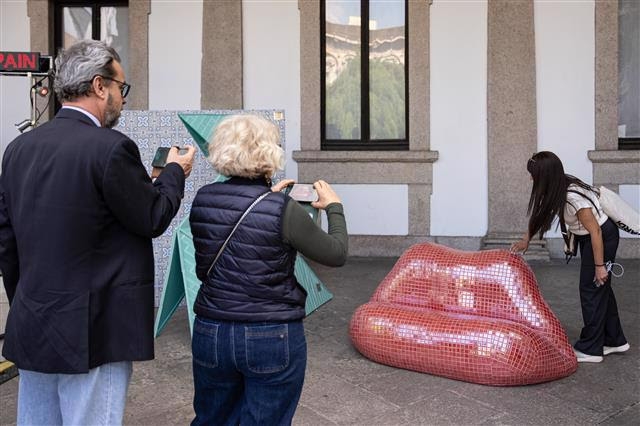
Located in the perimeter galleries of the historic cloister of La Statale, the installation configures an exhibition route where art and design converge, inviting visitors to enter the scene and explore the potential of ceramics as a contemporary material. The proposal is articulated through a walkable linear structure of 10 x 1.50 m that houses eleven reinterpreted everyday objects, whose dimensions—with weights between 44 and 247 kg and heights from 20 to 250 cm—emphasize their volumetric and sculptural condition. © Tile of Spain by Alessandro Levati Far from the tourist cliché and under the motto Materiae of Interni magazine, the installation proposes a collection of pieces conceived to endure and travel beyond the Fuorisalone, settling into the material and emotional memory of attendees. Transformed into contemporary totems, the eleven objects configure a system of references where design, culture, and production intertwine: the coaster, linked to the flamenco tablao; the castanets as an extension of the body; the plate and oil as domestic archetypes; the Copenhagen ashtray—designed in the 1960s by Jørgen Haugen Sørensen; the T-shirt as a universal souvenir; the Milan 430 as a school icon; the wine skin as a popular symbol; Miguel de Unamuno's bow tie; the magnet as a tourist memory; and the kiss, inspired by Salvador Dalí's Dailips sofa. ________
Source: Read the original article | Published: April 23, 2026