
Editor's Note
This editor’s note highlights the key facts and market implications behind “The 20 Most Outstanding Spaces at Casa Decor 202”, with emphasis on sourcing, product fit, fabrication, logistics, or buyer impact.
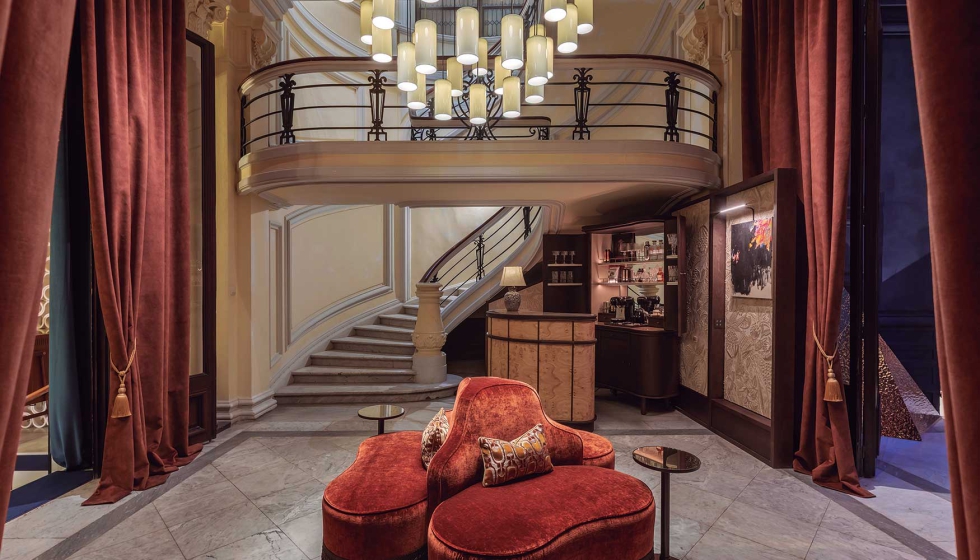
The exhibition is being held for the first time in the Las Letras neighborhood with 47 spaces that can be visited until May 24. It once again positions itself at the epicenter of contemporary design, reaffirming its role as a barometer for the trends that will define interior design in the coming years. In this edition, the dialogue between craftsmanship, technological innovation, and sustainability intensifies, resulting in 47 spaces that are not just observed but experienced. An exhibition held at the San Agustín, 11 palace-house (in the heart of Madrid's Las Letras neighborhood) which will remain open until May 24.
1. Venux Space. Kitchen ‘El Obrador: kitchen, silence and ritual’. Viruta Lab
Venux and Viruta Lab (David Puerta and María Daroz) evoke the transformation this palace underwent in the early 20th century when it became a convent. The project reinterprets a refectory and workshop with a scenography that aims to recall the memory of the place, but also becomes a space for contemplation, where silence, light, and proportion elevate daily use to a spiritual experience. The proposal by Viruta Lab transforms this palace space into a refectory, recalling its past as a convent in 1926.
2. Cosentino Space – Conceptual Space ‘Manantial’. Summumstudio
Summumstudio presents the Cosentino space at Casa Decor 2026, conceived as the Spanish launch of Éclos, the new stratified design mineral surface developed by the firm. Under the 'Manantial' (Spring) concept, the proposal articulates an architectural exploration of the origin of matter, where light, water, and space converge in a sensory experience.
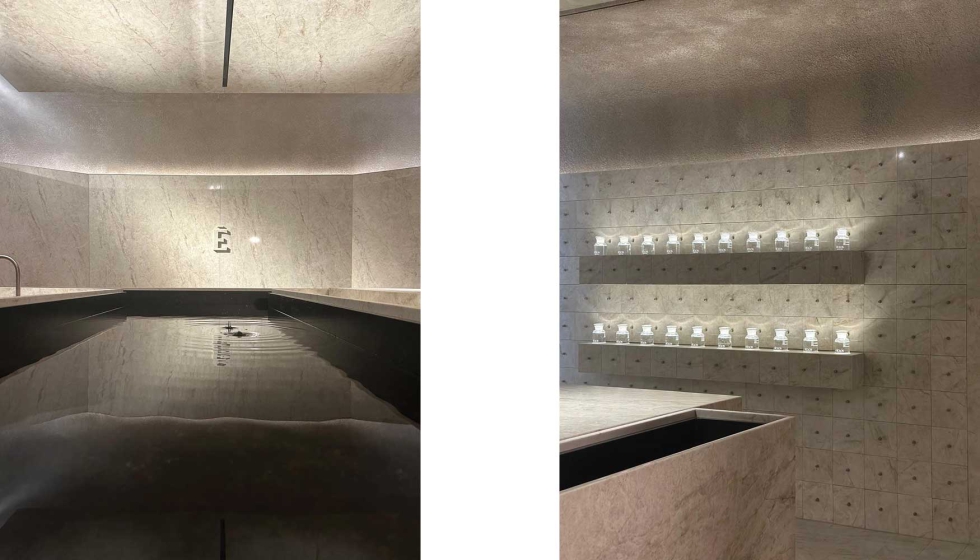
'Manantial' is the sensory experience projected by Summumstudio for Cosentino. The concept of 'Manantial' refers to the primordial, to that which arises naturally and evolves into a habitable experience. In this narrative, water acts as the common thread, flowing through the space as a metaphor for fluidity, transparency, and continuity. The very composition of the material—which integrates 88% recycled glass-origin components—reinforces this discourse. Water becomes the common thread of this space that highlights Cosentino's new Éclos system. Far from being conceived as a simple exhibition installation, the project is built with an immersive narrative around the birth of Éclos: a material that emerges, flows, and activates in dialogue with its surroundings. The intervention transforms the interior architecture into an expressive device capable of revealing processes—both physical and symbolic—linked to material genesis, underlining design's capacity to evoke emotion and meaning.
5. Technogym Space – Loft ‘Sand Stone. Architecture for the body’. Ruiz Velázquez Architecture & Design
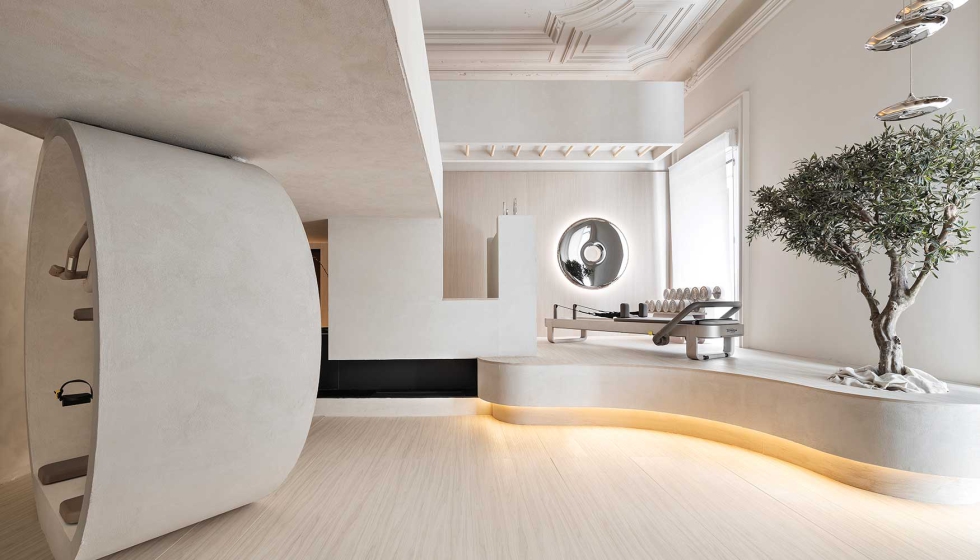
'Sand Stone' turns the house into an interior landscape. Volumes inspired by sandstone create a domestic topography that invites one to traverse, climb, and cross the space. Architecture ceases to be a static backdrop to become a physical experience that activates the body.
![[piededoto] (etiqueta desconocida) Dos imágenes que muestran con detalle los arcos y el sutil uso de la iluminación en esta divertida...](https://img.interempresas.net/fotos/5516420.jpeg)
The project explores the integration between architecture and well-being. Mineral volumes, warm textures, and Technogym's 'Sand Stone' collection build an interior where design, technology, and body care are incorporated into the home as a natural part of daily life. To achieve this, a reinterpretation of classicism is made from a contemporary perspective, through the use of curved volumes, a palette of burgundy and deep greens, natural wood, and stone that dialogue with textiles of great presence. The furniture integrates naturally, providing a contemporary accent that balances tradition and modernity. In the main access area of the exhibition is the proposal by Virginia Albuja, which plays with the nostalgia of the brand's centenary. Impar Design recreates a 19th-century smoking room where wood, mosaics, and tiles dialogue between history and contemporaneity. This room by Impar Design reinterprets tradition and trend through latticework that filters light and creates changing atmospheres. The wood, mosaics, and tiles on floors and built-in benches integrate craftsmanship, materiality, and architecture into a contemporary sensory experience.
To achieve this, sintered stone is chosen for flooring, countertops, and cladding in a glossy finish. The ceiling tracery in white retorta fabric, typical of convents and made from recycled fabrics, adds an almost divine dimension. While the warm light and invisible kitchen fuse technology, craftsmanship, and spirituality in a contemporary key. Two snapshots of this monastic space, thanks to the use of sintered stone in flooring, countertops, and cladding. In the culture of overexposure, reflection builds identity. We do not ask who we are, but how we are seen. The project reveals that everyday sanctuary where the self ceases to be to become appearance and validation.
20. Iris Ceramica Group Space – Restaurant ‘The Silent Chapel’. Raúl Martins Studio
The 20 most outstanding spaces of Casa Decor 2026.
Source: Read the original article | Published: April 20, 2026