
Editor's Note
This editor’s note highlights the key facts and market implications behind “Venux Presents ‘El Obrador’ at Casa Decor with V”, with emphasis on sourcing, product fit, fabrication, logistics, or buyer impact.
Venux, a specialist in sintered stone surfaces, is participating for the second consecutive year with its own space at Casa Decor in Madrid. The company said the space "has already generated notable interest among industry professionals, media, and visitors."
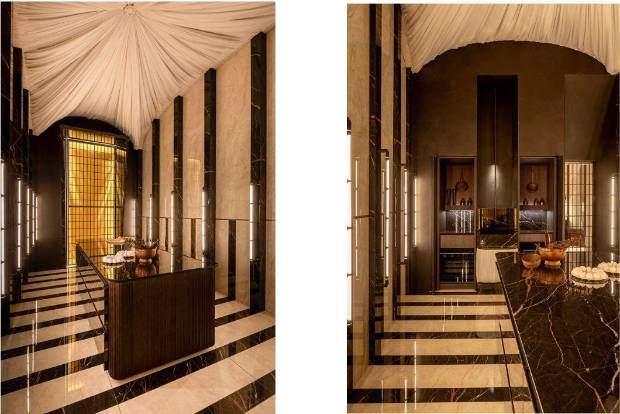
The Venux space, designed by the Valencia-based studio Viruta Lab (led by María Daroz and David Puerta), is called El Obrador and is a proposal "that connects past and present through material, light, and sensory experience." In addition to this participation, the brand is also involved in two other collaborations: the Valpaint space designed by Miguel Muñoz, and the bathroom by Ramon Soler, designed by Carmen Barasona.
El Obrador: Kitchen, Silence, and Contemporary Ritual
El Obrador was born "as an exercise in memory, contemplation, and respect for the history of the Palace of the Marquis of Los Vélez and Count of Niebla, later converted into a convent of the Congregation of the Slaves of the Sacred Heart of Jesus."
Inspired by the old refectory and the workshop where the nuns produced their culinary crafts, the space reinterprets these uses from a contemporary perspective, where silence, a slow pace, and materiality take center stage.
The Venux Taj Mahal and Laurent sintered stone surfaces “articulate the project, applied in countertops, cladding, and furniture. Their presence, enhanced by the height of the room and careful lighting design, adds an almost ethereal dimension to the whole.”
Among the most notable elements is "the large central island, conceived as the heart of the space. Its base of grooved Rekker wood, developed by Línea 3 Cocinas, introduces texture and warmth, generating a harmonious dialogue with Venux's sintered stone. This element organizes the flow and reinforces the idea of the workshop as a place for meeting, interaction, and coexistence." The finish of both the countertop and the drawers, with the interplay of wood and sintered stone, creates a material balance that "combines solidity and warmth and elevates the island to an almost sculptural piece."
In that kitchen, where bread was once kneaded, "everything is reinterpreted and works in favor of an immersive experience where the material expresses itself in its purest essence, accompanied by a careful selection of Siemens appliances—wine cellar, oven, and super-automatic coffee machine—that integrate naturally into the space, reinforcing functionality and elevating the experience towards a new balance between design, technology, and daily use."
The Opulus Auditorium, Valpaint Space, Designed by Miguel Muñoz Studio
In addition to its own space, Venux reinforces its visibility at Casa Decor 2026 with a presence in other notable proposals, such as the Auditorium, a space for the Valpaint brand designed by Miguel Muñoz.
This is the main auditorium of Casa Decor 2026, conceived as a contemporary interpretation of architectural maximalism. The designer himself defines it as the "Sanctuary of Geometric Opulence." The design is based on rhythmic repetition, where discretion is not sought, but presence is.
Venux collaborates in this space with the flooring from the Black Zimbabwe collection and with the tables in the social area, the shelving, and the pedestals from the Breccia Oniciata collection.
Ofuro, the Bathroom by Ramon Soler
In the Ofuro space by Ramon Soler, Carmen Barasona, the designer in charge of the project, "reinterprets the bathroom as a ritual of calm inspired by Japanese tradition."
In this project, Venux's participation is present in the entire bathroom furniture set, from the monolithic bathtub to the sculptural washbasin. The space is defined by "a timeless aesthetic in which material and architecture integrate naturally."
For its development, Venux sintered stone in its Urban Black model was used, a "proposal inspired by slate, a metamorphic rock of sedimentary origin, which combines the richness of its natural appearance with the technical performance characteristic of sintered stone."
Source: Read the original article | Published: April 17, 2026