
Editor's Note
This editor’s note highlights the key facts and market implications behind “Tile: 3 Major 2026 Trends for Outdoor Spaces”, with emphasis on sourcing, product fit, fabrication, logistics, or buyer impact.
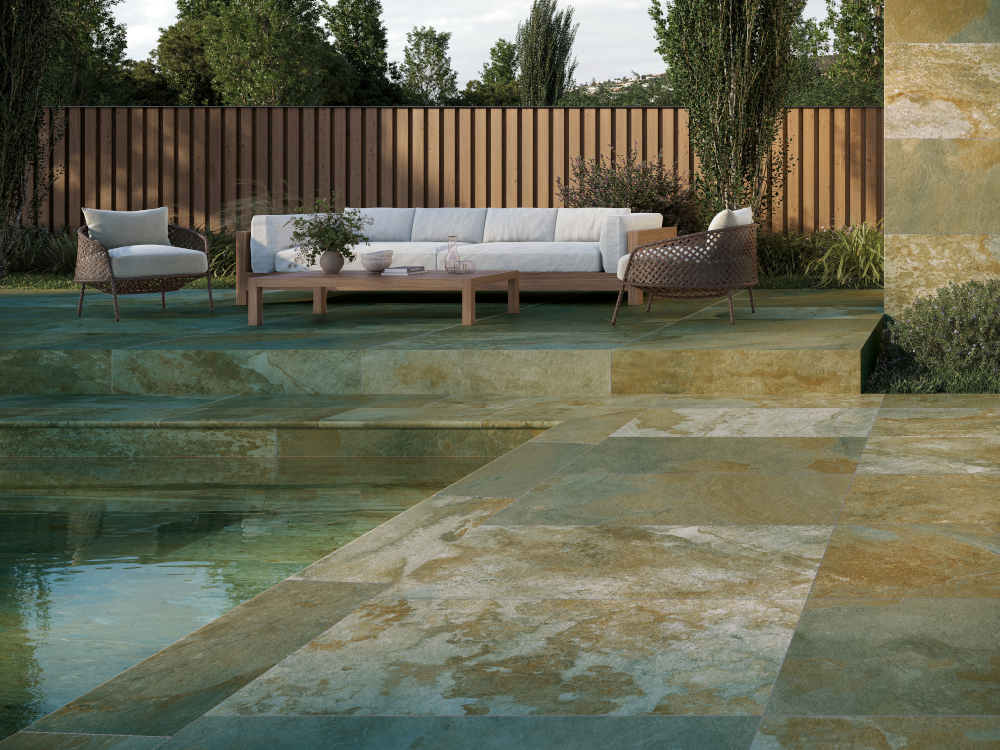
Materials After exploring the trends shaping interior spaces, the Spanish ceramic industry is now turning its attention to outdoor design. On the occasion of Time of Tile of Spain, manufacturers united under the Tile of Spain banner analyzed the major evolutions expected to define outdoor tiling in 2026. Whether for terraces, pool decks, or garden paths, outdoor ceramics are now integrating more and more naturally into their surroundings. Tiles extend the architecture of buildings, dialogue with interior finishes, and draw inspiration from natural materials to create coherent and immersive spaces. United under the umbrella brand Tile of Spain and represented by the Spanish Association of Ceramic Tile Manufacturers (Ascer), Spain's leading ceramic manufacturers gathered to identify the key 2026 trends for outdoor tiling. This initiative is part of the Time of Spain activities, which bring together several promotional actions for the Spanish tile industry, such as communication campaigns, press conferences, and award ceremonies during February and March 2026. Three Strong Directions Confirm the Gradual Disappearance of Boundaries Between Indoors and Outdoors The "In & Out" Continuity Transitions between interior and exterior spaces are becoming increasingly seamless, creating vast, open, and adaptable living areas depending on the weather. This fluidity is made possible by the development of ever-larger slabs, which have the advantage of eliminating grout lines and enhancing the sense of space. While 90 x 90 centimeter slabs were already popular, innovation is going even further with XXL formats that can reach 100 x 275 centimeters. With floors and walls dressed in this way, spaces communicate better with each other, and interior design extends outdoors without any break. Between Architecture and Landscape In this aim to erase the limits between indoors and outdoors, material effects are multiplying to offer a solution for all architectural styles, with effects mimicking natural stone, concrete, wood, or travertine. And for perfect harmony, manufacturers are expanding their ranges of complementary systems: pool coping, steps and step nosings, special pieces for corners and finishes, ventilated facade elements. This modularity allows architects and landscapers to create complete projects, perfectly matched to their environment. The Essence of Nature, Plus Performance While texture effects are diversifying to best copy nature—with high-definition digital printing, slate, and volcanic stones entering the market—technology is also being used to overcome the flaws of natural materials. The finishes thus exhibit near-zero porosity, with a water absorption rate of less than 0.5%. They are therefore insensitive to freeze-thaw cycles, grease stains, or wear over time. Furthermore, more chromatic creations, such as recycled glass mosaics, no longer lose their sheen when exposed to UV rays and cleaning products. Through these three directions, outdoor tiling continues its transformation. Far beyond a simple covering, it is becoming a central element in the design of living spaces, capable of connecting architecture, landscape, and usage. These trends, in fact, echo those already observed for interiors. The manufacturers united within Tile of Spain thus identify four major common inspirations for 2026: geology, inner calm, shared memory, and sensory sophistication. These numerous paths reflect a growing desire to create harmonious environments where interior and exterior spaces become one.
Source: Read the original article | Published: March 17, 2026