
Editor's Note
This editor’s note highlights the key facts and market implications behind “The ‘Little Bricks’ of Arabia: Driving the Centu”, with emphasis on sourcing, product fit, fabrication, logistics, or buyer impact.
After the emergence of Islamic culture, the use of ceramic tiles reached its peak. The Spanish word for tile, "Azulejo," derives from the Arabic term "Az-zylayj," meaning "little brick." Muslims quickly mastered the ceramic techniques prevalent in the Middle East and North Africa during the 7th century and developed new methods to imitate Byzantine mosaics.
From June to October 2019, the Palace Museum in Beijing and the Portuguese National Museum of Azulejos jointly hosted the exhibition "Glazed Kingdoms: 500 Years of Portuguese Azulejos" at the Yongshou Palace in the Forbidden City. The exhibition featured over 50 Portuguese azulejos from the 16th to the 21st centuries. Portuguese azulejos blend elements of Eastern and Western civilizations, serving as a microcosm of the country's history and culture. As a pioneer of the Age of Discovery, Portugal was one of the first European countries to engage in cultural exchange with China. The introduction of Chinese porcelain-making techniques and aesthetic tastes to Europe influenced local azulejos. By the 18th century, a Chinese style emerged in Portuguese azulejos, with blue-and-white forms and Chinese themes becoming fashionable. These works often reflected the elegant and understated charm of Chinese blue-and-white porcelain while retaining their inherent Western characteristics, making them a product of cultural exchange along the Maritime Silk Road.
Spain, also located on the Iberian Peninsula, boasts equally remarkable azulejos, with the Andalusia region being the most representative. These tiles are widely used for wall and floor decoration, forming a key feature of the region's art and architecture, successfully combining artistic aesthetics with practical function. This article, inspired by the "Glazed Kingdoms" exhibition, explores the origins of azulejos in Andalusia and their development in the 15th century, leading readers into a colorful world of "flower tiles."
‘Little Bricks’: The Origin and Development of Azulejos in Andalusia
Before the advent of azulejos in the West, similar products appeared in the form of ceramic tiles, with origins traceable to Mesopotamia and ancient Egypt. During the Persian dynasty, the tradition of using glazed ceramic tiles for architectural decoration continued. On the Iberian Peninsula, colored glass or mosaic decorations were used in architecture during the Roman occupation, often depicting Roman historical scenes and mythological figures. Under Roman rule from the 3rd to the 5th centuries, Andalusia retained a wealth of mosaic techniques. After the fall of the Western Roman Empire in the 5th century, the Byzantine Empire continued to use mosaic tiles extensively, forming a tradition of azulejos. Temples and palaces within the empire were adorned with magnificent azulejos, serving as tools for conveying religious and courtly messages.
After the emergence of Islamic culture, the use of ceramic tiles reached its peak. The Spanish word "Azulejo" derives from the Arabic "Az-zylayj," meaning "little brick." Muslims quickly mastered the ceramic techniques prevalent in the 7th-century Middle East and North Africa and developed new methods to imitate Byzantine mosaics. After Muslims occupied the Iberian Peninsula in the 8th century, innovative Islamic ceramic tile techniques with Byzantine influences were introduced to Andalusia. During the renovation of a mosque in the region in the 10th century, mosaic tiles made by craftsmen from Constantinople were used. These techniques reached their zenith during the Nasrid dynasty from the 13th to the 15th centuries.
Islamic Art Enters Christian Hearts: Nasrid Tiles and Mudejar Tiles
Nasrid tiles are the most representative ceramic tiles of Andalusia under Muslim rule. The technique involved cutting monochrome glazed ceramic pieces and repeatedly assembling them into patterns of varying sizes and shapes, requiring highly skilled craftsmen. The Alhambra in Granada, built by the Nasrid dynasty, was decorated in this style. Originally constructed as a fortress-palace on a hill by Muhammad I, the founder of the Nasrid dynasty (r. 1232–1273), it was expanded by successive sultans into a vast palace complex, characterized by a stark contrast between its simple exterior and luxurious interior.
The main buildings of the complex—the Mexuar, the Comares Palace, and the Patio de los Leones—were built under Ismail I (r. 1314–1325), Yusuf I (r. 1333–1354), and Muhammad V (r. 1354–1359, 1362–1391), all completed during the Nasrid dynasty's most glorious period in the 14th century. The wall tiles featured polygonal network designs forming complex geometric patterns and inscriptions praising the Creator. The most intricate designs involved different types of polygons and combinations of 8, 12, or 16-pointed star bands, all capable of infinite extension, becoming the dynasty's most famous decorative element.
Nasrid craftsmen also used fragments of different colors to create diverse visual effects, highlighting figures or floral motifs. In addition to earlier blue and green tones, the tiles incorporated purple-red and deep purple pigments. In Málaga, the dynasty's main ceramic production center, gilded ceramics were produced using relief techniques. The complexity and refinement of these techniques made them treasures of Islamic art.
From the 11th century onward, Catholic forces in the northern Iberian Peninsula expanded southward. Muslims living in communities under Catholic rule were called Mudejars, serving as conduits for the spread of Islamic art and craftsmanship, fostering a fusion of Islamic art and Catholic culture known as "Mudejar art." This was mainly expressed in architecture, reliefs, woodwork, and ceramics. The most common form was glazed facing tiles, giving rise to Mudejar tiles, often found in Muslim communities in Andalusia, particularly in Seville and Córdoba. Cities conquered by Catholic forces in the 13th century often used Mudejar-style glazed tiles in buildings constructed during the 14th and 15th centuries, preserving many geometric patterns with Islamic characteristics.
For example, the Palacio de Don Pedro, built in the second half of the 14th century within the Royal Alcázar of Seville, was originally a 10th-century Muslim stronghold controlling the region. After King Pedro I of Castile (r. 1350–1369) ascended the throne, he renovated the royal palace in the Mudejar style to show respect for local Islamic culture, with decoration carried out by Muslim craftsmen from Seville, Toledo, and Granada.
The Hall of Ambassadors in the palace served as the center of public life in the fortress, where the king held official audiences. It followed the Muslim palace layout with a square shape and a wooden hemispherical dome. The walls were covered with colored stucco reliefs and glazed tiles, with friezes inheriting Nasrid-style geometric designs, including a grid pattern with a 16-pointed star, showcasing the most luxurious decoration of the royal palace. Additionally, the main facade of the enclosure wall featured a large frieze with Arabic inscriptions in Kufic script, reading "Allah is the only victor," repeated eight times, reflecting the peaceful coexistence of Muslims and Christians at the time.
The Queen Arrives: Tiles and Polychrome Tiles in the Isabeline Period
In 1492, Catholic forces in the Spanish Reconquista defeated the last Muslim kingdom on the Iberian Peninsula, the Nasrid dynasty, marking the beginning of the widespread adoption of Catholic culture. The artistic style of this period, during the reign of Queen Isabella I of Castile (r. 1474–1504), is known as Isabeline style, characterized by a blend of Gothic, Mudejar, and Renaissance elements. In architecture, this was mainly reflected in Andalusian tiles featuring tracery, plant motifs, and patterns inspired by textiles.
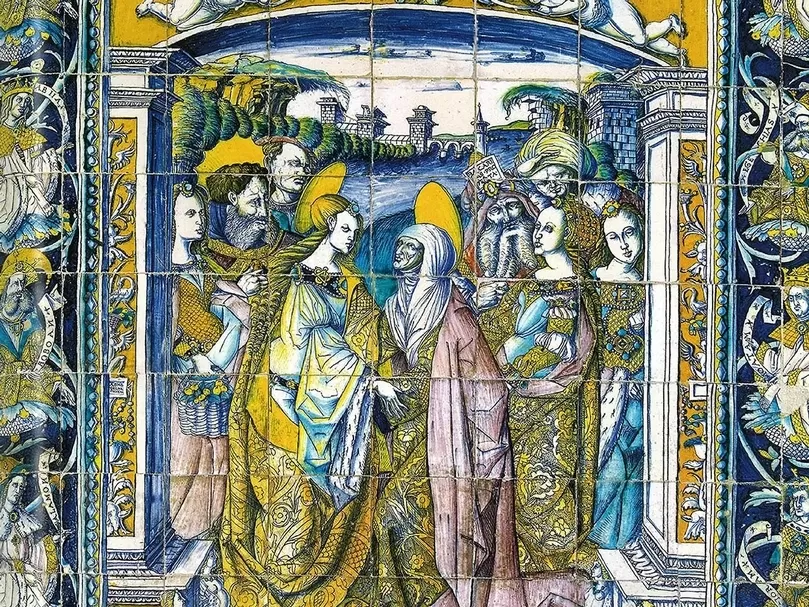
At the end of the 15th century, Italian craftsman Francesco Nicoloso Pizarro settled in Seville and developed a technique for painting directly on tile surfaces, allowing tiles to be used as large canvases with freely combined colors. This opened up many possibilities in style and subject matter, enhancing the narrative quality of the works. Subsequently, painted tile patterns included religious and mythological scenes, as well as hunting scenes, pastoral landscapes, and other themes favored by the nobility. Coats of arms also appeared frequently on tile patterns. In a society with rigid class structures, adding heraldic emblems to tiles enhanced the credibility of property owners and effectively conveyed an image of power, highlighting the importance of noble lineage. At this time, Seville, monopolizing trade between Europe and the Americas, became a major commercial center and exported such tiles to European countries and overseas colonies. Many workshops mass-produced tiles using molds to supply churches and nobles for architectural decoration.
Tiles became a fashionable architectural decoration of the era. In the gardens of the Royal Alcázar of Seville, the Pavilion of Charles V (completed in 1546) was renowned not only for its architectural layout and colonnade but also for its interior and exterior wall tiles depicting Isabeline-era flora and fauna. These patterns, inspired by contemporary tapestries, carpets, and paneled ceilings, often featured flowers within typical late Gothic or curved octagons and squares. Additionally, the Casa de Pilatos in Seville, completed in 1519, was built by the local governor in imitation of a Roman praetor's palace. Its architectural style blended Gothic, Mudejar, and Renaissance elements, with well-preserved tile decorations. The walls were covered with tiles produced in Seville workshops between 1536 and 1539, featuring over 150 different designs, all popular themes from the first half of the 16th century, including floral, geometric, and heraldic motifs. Among them, Mudejar-style tiles inherited the geometric grid forms of Muslim art, while Isabeline-style tiles featured delicate floral vines. Renaissance-style tiles were the most numerous, with more independent patterns and larger sizes, including squares, circles, diamonds, and combinations of leaves, spheres, and other elements, showing Italian influence.
A representative example is the Mosque-Cathedral of Córdoba, originally a mosque during the Muslim period (8th century) and converted into a church after the Catholic conquest in 1236. From the 13th century onward, the Catholic Church and local nobility donated many chapels of various sizes around the original mosque's prayer hall, each with an altar. Some still feature geometric-patterned glazed tiles covering tombs and walkways, blending Muslim traditions with Catholic culture. In the 16th century, the full conversion of the mosque into a Catholic cathedral reached its peak, including the construction of a new Catholic-style church within the original Islamic building and a Renaissance-style ceramic altar, completely transforming the interior space. The altar's tile patterns often depicted biblical scenes, such as the Adoration of the Magi, Jesus with the Samaritan woman, or Jesus preaching in the countryside.
Furthermore, due to economic prosperity, the Spanish monarchy accumulated great wealth and undertook costly renovations at the Royal Alcázar of Seville, with architectural decorations strongly influenced by the Italian Renaissance. In ceramic decoration, polychrome tiles were widely used, such as the ceramic altar of Queen Isabella made by Pizarro in 1504 in the Plaza del Rey, and the vaulted hall of the Gothic Palace, renovated between 1577 and 1583 under Philip II (r. 1556–1598). This hall had been the venue for the wedding of Philip II's father, Charles V (r. 1516–1556). Its polychrome ceramic panels, in Renaissance style, featured mythological figures, angels, and fruits, with a color palette of yellow, blue, green, and orange, making it a prime example of surviving ceramic panels of this type in Spain.
The Great ‘Flower’ Discovery: The Colorful Journey of Tiles
Portugal and Spain, both on the Iberian Peninsula, share the same origins and development of azulejos. From the 8th to the 9th centuries, due to exchanges in ceramic techniques between the Islamic world and China, decorative ceramic tiles were applied to architectural decoration. With the spread of Islamic culture to the Iberian Peninsula, decorative tiles in the region were deeply influenced by Islamic culture until the 15th century, presenting a hybrid form of Catholic and Islamic art. After the 16th century, with the development of painting techniques on tile surfaces, themes and styles expanded. Over time, influenced by the Renaissance, Spanish azulejos gradually developed a unique and diverse character.
With the expansion of Spain's overseas military and commercial power, these decorative tiles gradually spread abroad. They first reached Italy via Mediterranean sea routes, then spread northward along land routes to France and Belgium. Later, due to frequent wars in Europe, tile manufacturers and pattern designers took refuge in the Netherlands, producing tiles in the Delft area. These tiles gradually became popular building materials, used in domestic and religious architecture. Later, tiles such as French Faience and English Victorian tiles were inspired by them.
Interestingly, in faraway East Asia, during the Meiji Restoration's imitation of Western trends, English Victorian tiles were introduced to Japan. Due to their bright colors, beautiful patterns, and ease of cleaning, these materials were well-suited to rainy climates. They were mass-produced and exported to various parts of Asia. The traditional decorative tiles seen in Taiwan today are almost all produced in Japan.
Source: Read the original article | Published: November 04, 2019