
Editor's Note
This editor’s note highlights the key facts and market implications behind “AI Data Center Spending Is Exploding. Jobs Are N”, with emphasis on sourcing, product fit, fabrication, logistics, or buyer impact.
Hundreds of billions in corporate spending are flowing into data centers, not into wages, breaking a decades-old link between investment and hiring.
Amazon, Microsoft, Meta, and Google plan combined, unprecedented capital investments of $650 billion this year.
In any prior era, a corporate spending spree of this magnitude would have been an unambiguous jobs engine. Factories would have been built. Hiring would have followed.
This time, the money is going into a different type of infrastructure—and the labor market is not keeping up with the capital. Here’s what to know.
Where the Money Is Going
The mechanics of this capital spending cycle are distinct from all recent predecessors. Current estimates suggest 80% of the growth in final private domestic demand in the first half of 2025 came from AI data centers and related high-tech spending, according to research from S&P Global.
Without AI-related investment, U.S. business spending tells a different story. Pantheon Macroeconomics found that private fixed investment "is rising only thanks to AI-related spending," with analyst Oliver Allen showing all other categories are in decline, according to Fortune.
The composition of spending explains the disconnect. When companies build a factory, the capital investment creates demand for workers who will operate that factory for decades. When companies build a data center, the calculation is different. According to McKinsey, global data center investments are projected to reach $7 trillion by 2030, with over $4 trillion allocated to IT equipment—chips, servers, and storage, much of which is manufactured abroad. McKinsey's analysis of the value chain shows that of the total $6.7 trillion, about $4.3 trillion goes to technology developers and manufacturers (servers, semiconductors, storage), while only about $600 billion is allocated to construction labor.
The 500-to-50 Problem
Data centers are, by design, built to operate with minimal human labor. As noted by Data Center Knowledge, data center projects generate a large number of temporary jobs during construction.
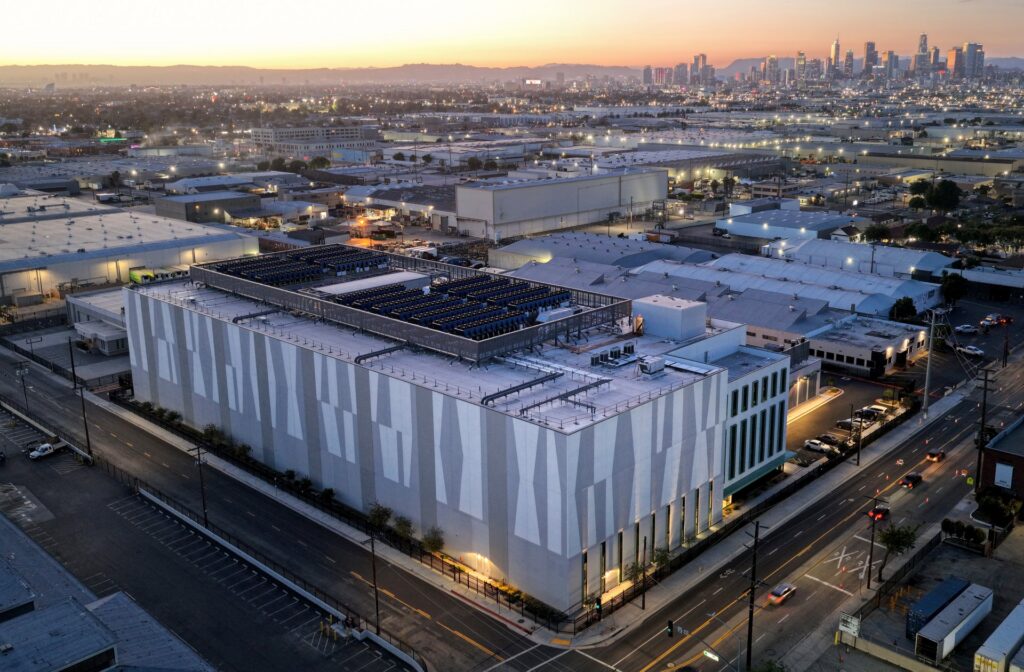
Microsoft's data center in Quincy, Washington, for example, had up to 500 workers on site during the construction process but now employs 50 full-time staff. This pattern—a construction employment peak followed by a permanent workforce that fits in a large conference room—repeats across the industry.
A standard 12-megawatt data center typically requires between 20 and 22 operational employees, according to industry staffing estimates. Compare that to a manufacturing plant of comparable capital investment, which could employ hundreds or thousands of people.
Good Jobs First, a nonprofit that tracks corporate subsidies, has documented this pattern in detail. The organization found that nearly half of state subsidies for data centers do not require job creation. Those that do typically require 50 jobs or fewer per project, compared to manufacturing projects that can create thousands. In one case, a data center in New York promised 125 jobs in exchange for $1.4 billion in public subsidies—$11 million per job. Data center employment accounts for only about 0.01% of all U.S. jobs, but the industry consumes about 4.4% of the nation's electricity.
Quartz has observed that historically, the tech industry was seen as human-capital rich with low capital expenditure impact, unlike manufacturing, which was increasingly capital-expenditure rich and low on jobs. AI is breaking down these categories.
The less optimistic interpretation is that the gains from this investment cycle are accruing to capital, not labor, in a way previous cycles did not. Many commentators and economists note that AI spending is now large enough to be visible in total GDP figures, and in some recent quarters, that growth has even outpaced contributions from consumer spending.
The question is what happens when spending peaks. Construction workers will move to the next site. The facilities themselves will run with skeleton crews. And the technology inside those buildings will continue to do what it was designed for: the work humans once did.
Source: Read the original article | Published: April 20, 2026