
Editor's Note
This editor’s note highlights the key facts and market implications behind “Silicosis Outbreak Among Engineered Stone Counte”, with emphasis on sourcing, product fit, fabrication, logistics, or buyer impact.
January 3, 2020
Overview: Silicosis Outbreak Among Engineered Stone Countertop Workers in Four States
By Katelynn Dodd, MPH; Amy Heinzerling, MD; Cecile Rose, MD; Carolyn Reeb-Whitaker, MS, CIH; and Robert Harrison, MD, MPH
Summary
Engineered stone countertops, also known as "quartz countertops," are made from quartz aggregate and resin binders. These materials, which resemble natural stone, are increasingly used in residential construction and home renovation. Between 2010 and 2018, U.S. imports of quartz slabs increased by nearly 800% (U.S. International Trade Commission). Engineered stone can contain much more crystalline silica than natural stone (>90% vs.
Data Sheet
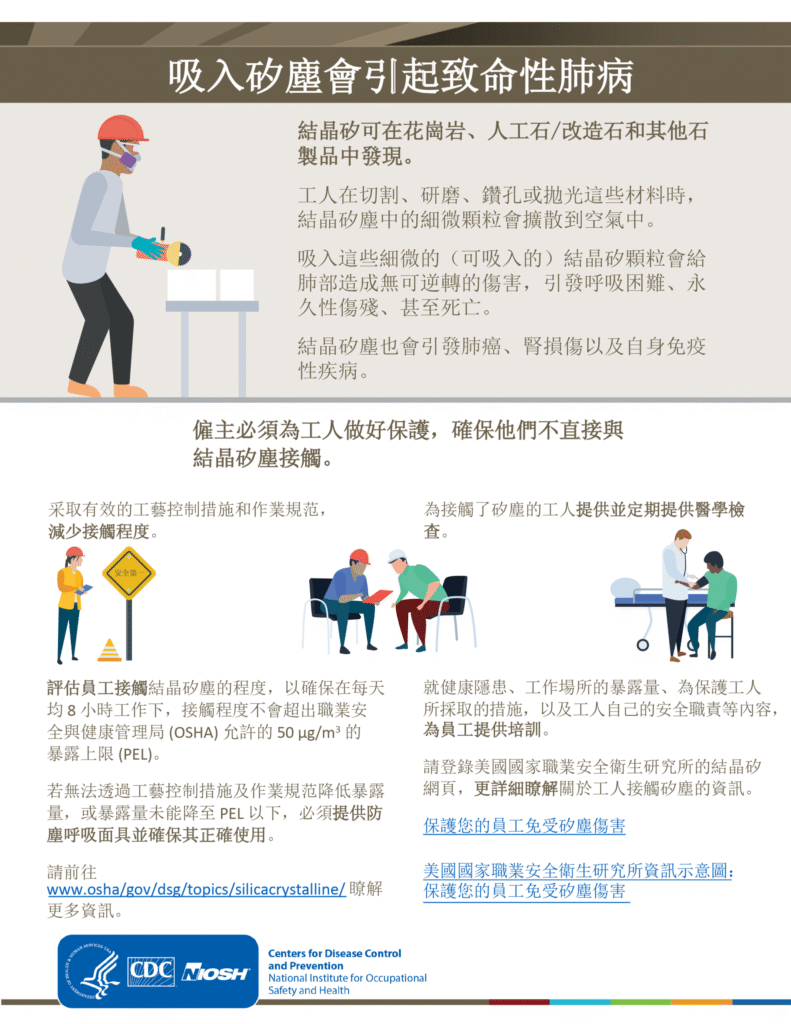
Exposure to silica dust poses health risks for workers involved in manufacturing, processing, and installing natural and engineered stone countertops. Symptoms of silicosis can include cough, fatigue, shortness of breath, or chest pain. Silicosis typically occurs after 10 or more years of exposure to respirable crystalline silica dust. However, intense exposure can lead to faster disease progression and more severe lung disease. In addition to silicosis, inhaling small ("respirable") crystalline silica particles can cause lung cancer, chronic obstructive pulmonary disease (COPD), and kidney disease, and is associated with lung infections, autoimmune diseases, and cardiovascular damage.
A previous case of silicosis linked to engineered stone processing was reported in Texas (Friedman, 2015). Recently, 18 cases of silicosis, including two deaths, were identified among stone fabrication workers in California, Colorado, Washington, and Texas (Rose and Heinzerling, 2019). Most of these workers were under 50 years old and worked with engineered stone materials. Silicosis outbreaks among engineered stone workers have also been reported in Israel, Spain, and Australia (Kramer, 2012; Perez-Alonso, 2014; Hoy, 2018; Leso, 2019). In Queensland, Australia, medical screening of all at-risk stone fabrication workers found that 12% had silicosis (Kirby, 2019). In 2018, nearly 9,000 companies and 96,000 employees were involved in stone fabrication in the U.S. (U.S. Bureau of Labor Statistics Quarterly Census of Employment and Wages). Since many of these workers likely have not been medically examined, additional silicosis cases in the U.S. likely remain undetected.
Employer Responsibilities
Employers must protect workers from exposure to crystalline silica dust. The federal Occupational Safety and Health Administration (OSHA) has issued two respirable crystalline silica standards to protect workers. The construction standard (29 CFR 1926.1153) and the general industry and maritime standard (29 CFR 1910.1053) both took effect on June 23, 2016. Similar standards have been implemented in state OSHA jurisdictions in recent years. Employers must comply with applicable federal or state OSHA standards to ensure that employee exposure to respirable crystalline silica does not exceed the permissible exposure limit (PEL) of 50 micrograms per cubic meter of air (50 µg/m³) averaged over an 8-hour workday. For more information on the final silica rule, employer requirements, and specific federal OSHA implementation dates, see here.
Prevention and Control
Silicosis can be prevented by reducing respirable silica dust exposure through effective engineering controls and work practices. Engineering controls, such as wet methods and ventilation, should be used to control silica dust exposure. Proper work practice controls, including appropriate cleaning procedures, can be used alongside engineering controls to protect employees. When silica dust levels are hazardous and as required by silica regulations, employees should be provided with NIOSH-approved respiratory protection. Respiratory protection is the least effective control measure.
Medical Surveillance
Under the OSHA silica rule, engineered stone countertop workers exposed to hazardous levels of silica must be examined by a licensed healthcare provider. This examination must include a respiratory health questionnaire, a physical exam, a chest X-ray interpreted by a NIOSH-certified B-reader, and spirometry. Healthcare providers who suspect a patient's health problems are related to work with silica-containing materials should report the case to local or state health departments. Additionally, physicians with questions about reporting silicosis can email [email protected]. In 2017, silicosis was a reportable condition in 22 states (see here for state occupational safety and health department contact information).
Additional Resources
Hazard alerts published in California, Washington, and Texas provide information on silica dust exposure, dust control requirements, and resources for workers exposed to silica. See here for a webinar describing the dangers of silica dust exposure, employer requirements under the OSHA respirable crystalline silica rule, and methods employers can use to protect employees.
The NIOSH Health Hazard Evaluation (HHE) Program offers free assistance and information on workplace silica exposure and worker health to employees, employee representatives, and employers. For more information on the NIOSH HHE Program, see the NIOSH HHE topic page. If you are interested in working with NIOSH, employees, union officials, or employers can request an evaluation of potential health hazards at their workplace here.
This blog focuses on worker exposure to high levels of silica over time. We cannot provide individual medical advice or comment on potential exposure to the public/consumers/homeowners. If you are concerned about your health, please contact your doctor.
Author Information
Katelynn Dodd, MPH, is an Associate Service Fellow (Epidemiologist) in the NIOSH Respiratory Health Division.
Amy Heinzerling, MD, MPH, is an Epidemic Intelligence Service Officer with the Centers for Disease Control and Prevention, assigned to the California Department of Public Health.
Cecile Rose, MD, MPH, is a Professor of Medicine in the Division of Environmental and Occupational Health at National Jewish Health and the Division of Pulmonary Medicine at the University of Colorado.
Carolyn Reeb-Whitaker, MS, CIH, is the Principal Investigator for Occupational Respiratory Disease Surveillance in the Safety and Health Assessment and Prevention (SHARP) Program at the Washington State Department of Labor and Industries.
Robert Harrison, MD, MPH, is the Chief of the Occupational Health Surveillance and Evaluation Program at the California Department of Public Health and a Clinical Professor of Medicine at the University of California, San Francisco.
The authors thank Ketki Patel, MD, Senior Epidemiologist, Texas Department of State Health Services.
References
Friedman GK, Harrison R, Bojes H, Worthington K, Filios M. Notes from the field: silicosis in a countertop fabricator — Texas, 2014. MMWR Morb Mortal Wkly Rep. 2015 Feb 13;64(5):129-30.
Hoy RF, Baird T, Hammerschlag G, Hart D, Johnson AR, King P, Putt M, Yates DH. Artificial stone-associated silicosis: a rapidly emerging occupational lung disease. Occup Environ Med. 2018 Jan;75(1):3-5.
Kirby T. Australia reports on audit of silicosis for stonecutters. Lancet. 2019 Mar 2;393(10174):861.
Kramer MR, Blanc PD, Fireman E, Amital A, Guber A, Rhahman NA, Shitrit D. Artificial stone silicosis: disease resurgence among artificial stone workers. Chest. 2012 Aug;142(2):419-24.
Leso V, Fontana L, Romano R, Gervetti P, Iavicoli I. Artificial stone associated silicosis: a systematic review. Int J Environ Res Public Health. 2019 Feb;16(4):E568.
Perez-Alonso A, Cordoba-Dona JA, Millares-Lorenzo JL, Figueroa-Murillo E, Garcia-Vadillo C, Romero-Morillo J. Outbreak of silicosis in Spanish quartz conglomerate workers. Int J Occup Environ Health. 2014 Mar;20(1):26-32.
Rose C, Heinzerling A, Patel K, Sack C, Wolff J, Zell-Baran L, Weissman D, Hall E, Sooriash R, McCarthy RB, Bojes H, Korotzer B, Flattery J, Weinberg J, Potocko J, Jones KD, Reeb-Whitaker CK, Reul NK, LaSee CR, Materna BL, Raghu G, Harrison R. Severe Silicosis in Engineered Stone Fabrication Workers — California, Colorado, Washington, and Texas, 2017–2019. MMWR Morb Mortal Wkly Report. September 27, 2019 / 68(38);813–818.
U.S. Occupational Safety and Health Administration; National Institute of Occupational Safety and Health, CDC. Hazard alert: worker exposure to silica during countertop manufacturing, finishing, and installation. 2015. Available from: https://www.osha.gov/Publications/OSHA3768.pdf.
United States International Trade Commission for Harmonized Tariff Schedule (HTS) code 6810.99.0010, Agglomerated quartz slabs of the type used for countertops. Available from: https://dataweb.usitc.gov/
Source: Read the original article | Published: January 03, 2020