
Editor's Note
This editor’s note highlights the key facts and market implications behind “Patina Over High-Tech! 9 Expert Tips for Finding”, with emphasis on sourcing, product fit, fabrication, logistics, or buyer impact.
It's no wonder that countertops, kitchen islands, and wall cladding made of marble are so popular – the material has had its fans for millennia. Marble is a natural material with a great variety of colors and veining, which can be further varied by how the stone is cut. White marble is particularly popular for countertops. "You won't find anything in nature as white as white marble," says Evan Nussbaum, vice president at Stone Source in New York. "This color and this type of structure don't exist in any other natural stone."
Marble and quartz countertops each have their own advantages. Quartz is known for its robustness and cost efficiency, but such engineered stone does not achieve the charm and uniqueness of natural stone. "There's a reason why marble was used for the Taj Mahal, Michelangelo's David statue, and many ancient structures – it is very durable and its patina only gets better with age," says Lauren Sullivan, founder of the interior consultancy Well x Design.
A marble countertop has a lot of charm and character – with these 9 expert tips, you'll find the right one!
Anyone planning a new kitchen has to make a ton of decisions. One of the most important: Which countertop should be installed? Even though robust high-tech materials like Dekton or fine porcelain stoneware are now available, many builders still dream of marble.
What speaks for marble?
And marble is a good choice not only because of its beauty. High-quality marbles, like the world-famous slabs from the Tuscan coastal town of Carrara, are dense and relatively pore-free, making them durable and stain-resistant.
Are marble countertops better than quartz?
What speaks against marble?
Marble also has weaknesses. For one, marble is typically more expensive than other stone countertops, for example granite. Secondly, it reacts sensitively to acids. Marble is a non-foliated metamorphic rock and consists largely of calcium carbonate or magnesium carbonate. Acidic liquids like lemon juice or vinegar can therefore attack marble and leave a dull, whitish spot where they have slightly etched the surface, even if the stone was previously sealed.
This doesn't mean you should immediately give up your dream of marble in favor of granite or quartz countertops. But it's best to keep lemons – and by the way, also turmeric – away from your marble countertop! And you should definitely carefully select the right stone and inform yourself beforehand about what to expect and how to proceed when cleaning and maintaining your countertop. Then the material – whether black or white marble – can be a beautiful and functional choice for a kitchen countertop that lasts a lifetime.
9 Expert Tips for Choosing the Perfect Marble Countertop
Below we have compiled nine expert tips and answered some frequently asked questions – this way you're sure to find the perfect marble slab for your kitchen!
1. If you fear stains, you should opt for white marble
Although many people automatically think of cream or gray-white stone when they think of marble, there are hundreds of varieties, including taupe, green, gold, red, and black types. However, Jason Cherrington, founder and managing director of the British stone company Lapicida, generally recommends sticking with white marble for kitchen countertops. This is because the whitish stains caused by contact with acids are much more noticeable on colored marble than on white marble: "We are always super skeptical when it comes to dark or non-white marble for kitchen countertops," he says, "but of course it's a personal decision."
“We are always super skeptical when it comes to dark or non-white marble for kitchen countertops, but of course it’s a personal decision.”
The classic among light marbles is, as is well known, Italian Carrara marble. It can be further subdivided into cloudy Bianco di Carrara, Arabescato, Calacatta, and the almost pure white Statuario, which Michelangelo and Donatello already used for their statues. Carrara marble is generally of excellent quality and a great idea for the kitchen. Another point in its favor is that it doesn't have to be shipped across continents like more exotic types, making it a more sustainable choice.
2. Make sure the different marble slabs match
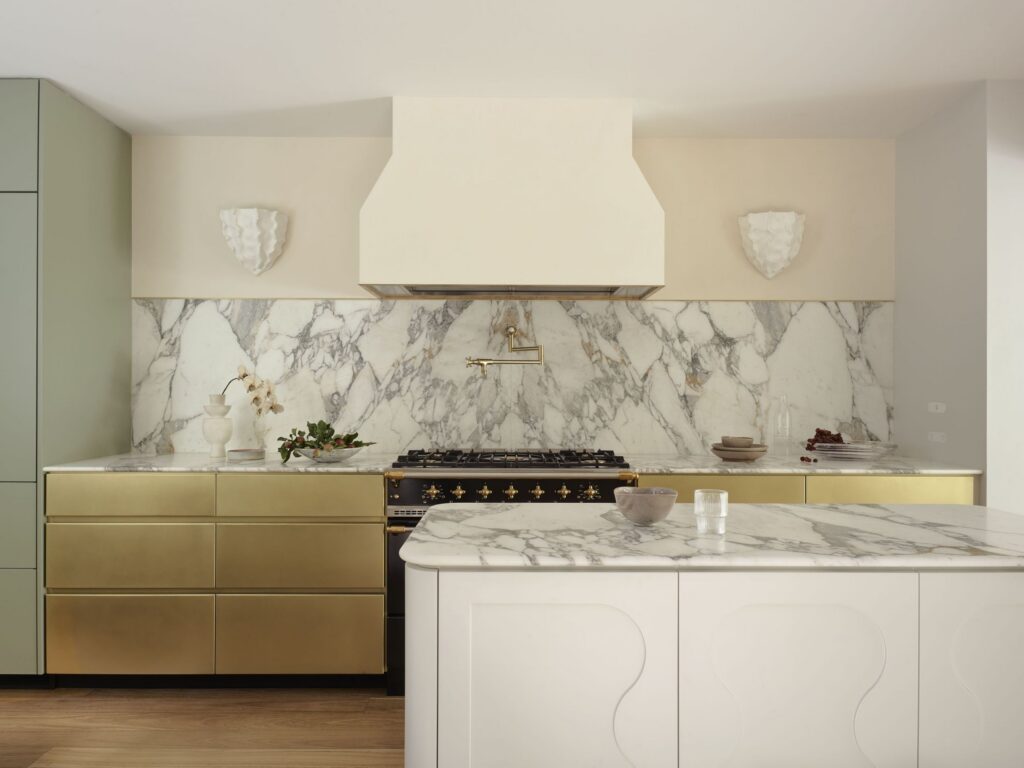
Each stone slab is slightly different, so ideally you should select the exact pieces to be used for your countertop at the dealer or directly at the stoneworks or quarry. Depending on the length of the planned countertop and the size of the slabs, you may need several pieces. In this case, you should ensure that the veining of adjacent slabs harmonizes and that there is a beautiful transition at the seams. A special effect is achieved with so-called bookmatching: a slab is split and the two resulting surfaces are arranged mirror-image, which visually resembles a Rorschach test or an open book. This technique is particularly recommended for the backsplash or other vertical surfaces. It can also be applied to the countertop, but the effect doesn't come across as well there.
3. Consider the cutting direction
Source: Read the original article | Published: February 02, 2024