
Editor's Note
This editor’s note highlights the key facts and market implications behind “Vietnam Tungsten Material Upgrade Reshapes Taiwa”, with emphasis on sourcing, product fit, fabrication, logistics, or buyer impact.
Vietnam Tungsten Material Upgrade Reshapes Taiwanese Tool Supply Chain
The next decade of the world looks to ASEAN. The index news "ASEAN Business" carefully selects the most critical financial headlines from Vietnam, Malaysia, Thailand, Indonesia, and the Philippines daily, covering government policies, industry landscapes, and investment layouts, allowing you to grasp key information before trends rise and lock in the next growth hub ahead of the market.
Core Insight: Tungsten Deep Processing Takes Center Stage
Reporter’s Observation: Three Accounts for Taiwanese Cemented Carbide Tools
Vietnam Analysis Report | Reporter Huang Zhengang 2025-12-27 According to a report on the Vietnamese government website, on the 27th, General Secretary of the Communist Party of Vietnam Central Committee To Lam and Prime Minister Pham Minh Chinh visited the exhibition area of Masan High-Tech Materials (which owns and operates the Núi Pháo polymetallic tungsten mine in Thai Nguyen Province) during the "11th National Patriotic Emulation Congress." They affirmed its deep processing and core technology mastery, calling for expansion of high-tech materials and increased added value. For Taiwanese businesses, this means: a more significant "non-China tungsten material" node emerges in ASEAN, but geopolitical and policy risks also rise simultaneously.
Key Points at a Glance
Vietnam's top leadership publicly endorses "tungsten deep processing" and high-tech material routes.
The most directly affected are manufacturing links such as cemented carbide tools/wear parts (CNC, molds, mining, and engineering processing).
Short-term priority for Taiwanese businesses: incorporate "tungsten powder/tungsten carbide" as a second supply source and into contract terms (delivery time, source, ESG).
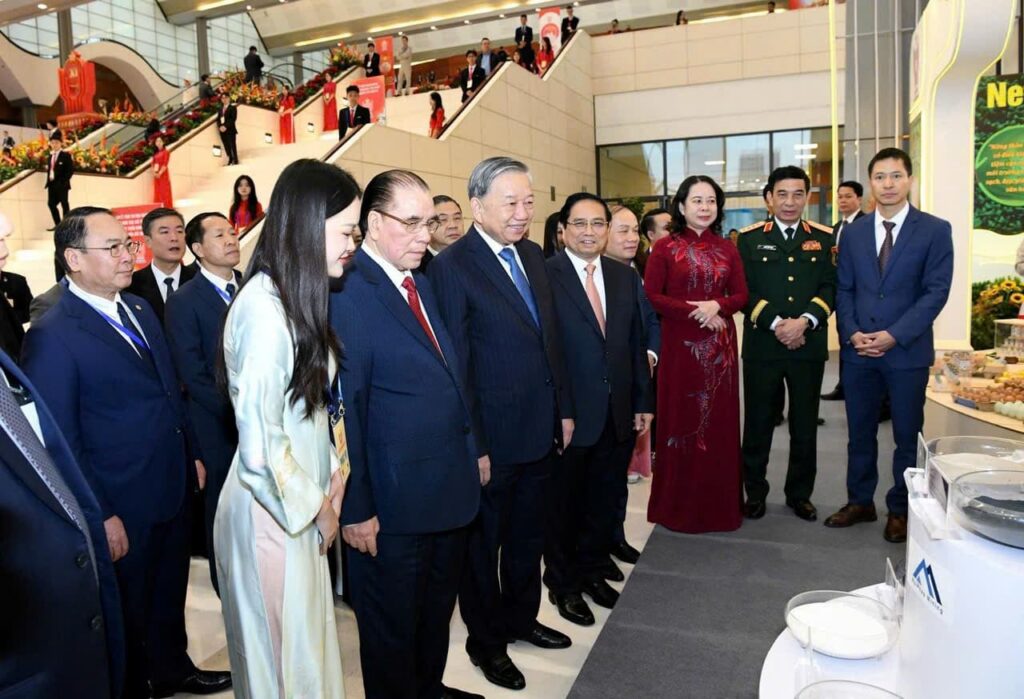
Vietnamese senior leaders visited the high-tech materials exhibition area at the "National Patriotic Emulation Congress" to learn about deep-processed products like tungsten. (Photo/Reprinted from Vietnam Government E-Newspaper)
Core Insight: Tungsten Deep Processing Takes Center Stage
Vietnam wants to sell "technological content," not just ore.
The report highlighted exhibits of tungsten crystals, copper concentrate, fluorite, bismuth, and "deep-processed products," emphasizing that the enterprise controls a complete chain from mining, beneficiation to deep processing. Vietnam also pointed out that tungsten materials can supply key industries such as electronics, aerospace, automotive, renewable energy, and defense.

Núi Pháo makes Vietnam more than a supporting role in global tungsten supply.
The U.S. Geological Survey (USGS) 2025 Mineral Commodity Summaries estimates: global tungsten mine production in 2024 was about 81,000 tons (tungsten content), with China at about 67,000 tons and Vietnam at about 3,400 tons; Vietnam's tungsten reserves are estimated at about 140,000 tons. This means that while Vietnam's volume is far smaller than China's, it holds scarcity in the "non-China" supply chain.
The public "endorsement" itself is a signal.
In Vietnam's political context, top leaders publicly pausing at a national congress to affirm an enterprise for "doing deep processing and mastering core technology" is usually more than just praise—it is a message to the market: the government wants to expand and deepen key minerals toward "materials and high added value."
Reporter’s Observation: Three Accounts for Taiwanese Cemented Carbide Tools
Tools are not "small consumables" but "yield levers."
One of tungsten's main uses is in cemented carbide for cutting and wear-resistant applications. Once tungsten powder/tungsten carbide supply tightens, prices fluctuate, or delivery times lengthen, the impact is not just material cost but also processing tempo, tool life, yield, and delivery default risk.
Vietnam becomes a candidate for a "second source," but also more sensitive.
Europe is promoting supply chain resilience and diversification through the Critical Raw Materials Act (targeting increased domestic mining/processing/recycling ratios by 2030), making "non-China" tungsten materials more likely to command premiums and long-term contract discussions. For Taiwanese businesses, this could lead to two directions: If you are a tool/wear parts supplier, you can use the "Vietnam material node" to tap into European and American customers' risk diversification needs (but prepare traceability and ESG documents). If you are an end processing plant (machinery/auto parts/electronic components), you can use a second source to reduce supply disruptions, but factor in compliance and negotiation costs.
The biggest risk is not in the mine, but in "control."
Reuters has reported Western government concerns that Chinese forces might influence important "non-China" tungsten supply points like Núi Pháo through acquisitions/equity stakes, mentioning diplomatic and policy-level tugs-of-war. Such geopolitical variables directly reflect on long-term contracts, export flows, and financing costs.
Sources: Vietnam Government E-Newspaper, U.S. Geological Survey, Reuters
Source: Read the original article | Published: December 27, 2025