
Editor's Note
This editor’s note highlights the key facts and market implications behind “Mapuche Ceramic Crafts and the Art of Preserving”, with emphasis on sourcing, product fit, fabrication, logistics, or buyer impact.
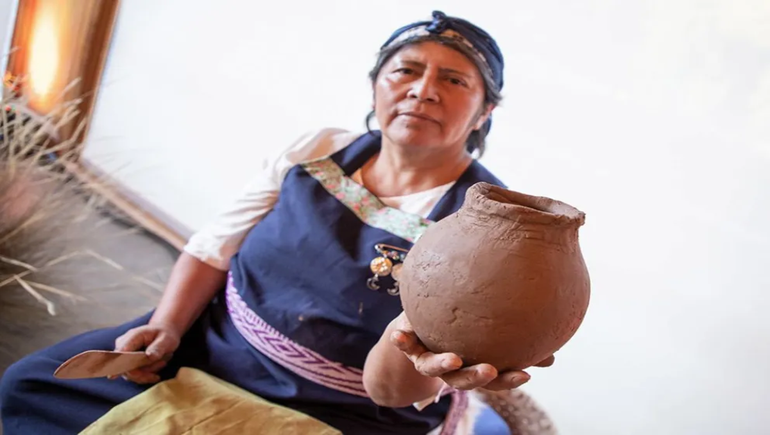
Berta Catricura seeks to recover ancestral techniques and strengthen cultural belonging. An activity that transcends generations of indigenous peoples.
Among corridors, mountains, and landscapes of southern Neuquén, there was a space that invited one to slow down and look closely at another kind of resistance: that of the hands that work the clay, hold memory, and transmit a culture.
As part of an activity organized for runners of Patagonia Run at the Chapelco Golf Club in San Martín de los Andes, Artesanías Neuquinas participated with a live demonstration of traditional crafts from different localities in the province.
One of them was Berta Catricura, a Mapuche ceramist born in the Lafquenche area, near Las Coloradas, although she has lived in Junín de los Andes for years. Her story is deeply linked to the Painefilú community, where she began working with ceramics alongside children, seeking to recover ancestral techniques and strengthen Mapuche cultural identity.
Berta Catricura also participates in the Intercultural Center of Lof Painefilú and the Commission of the Mapuche Cultural Center.
Art, Memory, and Identity
“We started working with clay with the pichikeche, with the children, so that through that art they could know and value Mapuche culture,” she said.
Although she did not learn the technique within her family, as happens in many cases, Berta sought that knowledge personally, sharing knowledge with other women in the community and recovering practices that come from previous generations.
The technique she uses is based on traditional methods of Mapuche ceramics. The first step is finding the right clay.
“We call it rag. We always teach that you have to ask permission from the place before taking it, because we are part of this mapu, this land, we are not owners,” she explained.
Then begins a long process of cleaning and preparing the material. The pieces are shaped by hand, using pinch or coil techniques, and later smoothed and burnished to waterproof them, without the need for glazes. Firing is done with wood, in kilns built within the community itself with the participation of families, teachers, and students.
A Site of Living Culture
The Painefilú community is located in the Pampa del Malleo area, north of Junín de los Andes, and is one of the territories where Mapuche culture remains alive through community work, language, crafts, and the relationship with the land. There, intercultural spaces operate where art, weaving, Mapuzungun, and ceramics are taught.
For Berta, the goal is not only to produce pieces but to transmit an identity.
“Those who do not know their culture do not value it. We want the children to feel proud of being Mapuche, not to be ashamed. For a long time there was discrimination, but today the new generations come with another strength,” she noted.
Artesanías Neuquinas has been working for more than 50 years in preserving and promoting the province's artisanal tradition, supporting hundreds of artisans from Mapuche communities and localities throughout Neuquén. The provincial company promotes workshops, fairs, marketing spaces, and activities that allow these crafts to become known and generate genuine income for those who sustain them.
“Artesanías Neuquinas helps to spread what we do, to make it known in other places, and also to be an income for the artisans,” expressed Berta.
In each piece she shapes, there is clay, fire, and time. But there is also something deeper: a way of understanding the world, of relating to the land, and of keeping alive a history that continues to beat in every community of southern Neuquén.
Source: Read the original article | Published: April 19, 2026