
Editor's Note
This editor’s note highlights the key facts and market implications behind “Chengjilu: China’s Import Bargaining Power and E”, with emphasis on sourcing, product fit, fabrication, logistics, or buyer impact.
◎Author|Chengjilu (Freelance Writer)
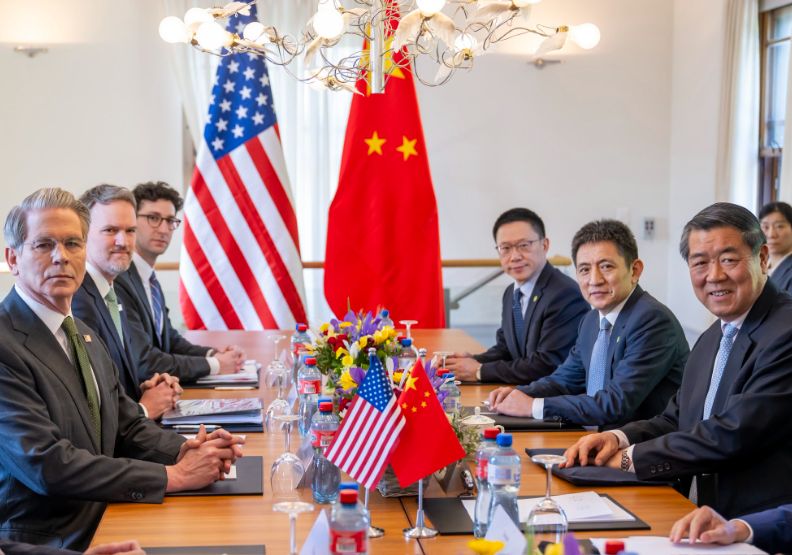
China-US Geneva Economic and Trade Talks. Chinese representative: Chinese State Council Vice Premier He Lifeng (first from right); two US representatives: Treasury Secretary Bessent (first from left) and US Trade Representative Greer (second from left). Source: Taken from "X" @USTradeRep
After joining the WTO, China became the world's factory and an industrial powerhouse. However, the West manipulates the prices of bulk commodities, deliberately causing sharp price increases for everything China needs to buy, such as agricultural products, iron ore, copper, aluminum, and energy. On the other hand, for any industrial product that China has developed and captured the market through R&D, due to fierce internal competition, it can only be sold abroad at rock-bottom prices, such as electric vehicles, photovoltaic and wind power components, earning meager profits while facing tariff exclusion and policy obstruction.
Australia's three major mining companies—BHP, Rio Tinto, and FMG—control over 50% of global iron ore production. China, the world's largest steel producer, is highly dependent on imported iron ore, with 65% coming from Australia, giving Australia a position to demand whatever it wants. Over the past decade or more, Australian miners have repeatedly and maliciously raised prices by controlling market supply. Between 2005 and 2008, they drove up prices by over 100%. After 2010, they refused long-term price negotiations with China, switching to quarterly and monthly spot pricing, making it easier to push prices higher. In 2019, the Brumadinho mine disaster in Brazil reduced production capacity by about 10%, and Australian miners took the opportunity to raise quotes. During the pandemic in 2020-2021, they cited transportation constraints and strong demand to drive prices up. After 2023, they used environmental protection and carbon reduction as excuses, claiming the need for large-scale investment in green mining and clean energy, to push prices higher again. As the largest buyer, China should have strong bargaining power, but under oligopoly, it has been exploited.
China's exploitation by Australia is mainly due to domestic steel mills purchasing iron ore individually, competing and bidding against each other, giving Australia leverage for extortion. Over the past decade, China has attempted to unify the negotiation and procurement of iron ore imports for domestic steel enterprises to counter the monopoly pricing of the three Australian miners. From 2003 to 2009, the China Iron and Steel Association (CISA) represented over 70 domestic steel mills as the world's largest iron ore importer in annual long-term price negotiations with the three Australian miners. China, due to its large procurement volume, demanded prices lower than Japan's, which Australia rejected. After negotiations broke down in 2009, Australian miners switched to market spot pricing. Since then, Chinese steel mills have procured separately, passively accepting quoted prices, and CISA has completely lost its bargaining power. China's iron ore import costs once soared to sky-high levels in 2021, compressing steel enterprise profits, creating industrial losses and national security risks.
At the finished product warehouse of the Tinplate Division of Shougang Jingtang United Iron & Steel Co., Ltd., lifting equipment loads tinplate sheets onto trucks (photo taken on July 22, 2023, drone photo). Source: Xinhua News Agency, photo by Zhu Xudong
The Chinese government realized the need to diversify iron ore imports and actively expanded importing countries during this period. For example, it increased iron ore imports from Brazil's Vale, reaching 25% of total imports. It developed the Simandou super iron ore mine in Guinea, Africa, investing not only in the mine but also in surrounding railways, ports, and other infrastructure for future iron ore transportation, with production expected to start in 2026, supplying up to millions of tons of iron ore to China annually. Iron ore imports from Russia are also rapidly increasing. Combined with imports from South Africa, India, Peru, Canada, Ukraine, Iran, Mauritania, Mongolia, and others, the total has approached 20%. Import diversification is changing Australia's long-standing dominant position.
The Chinese government also recognized that the China Iron and Steel Association was unable to consolidate iron ore imports, so it actively integrated the domestic iron ore industry and resource reserves. In 2022, China established the China Mineral Resources Group (CMRG), integrating the procurement of state-owned steel enterprises, representing about 40% of China's iron ore imports, approximately 1.1 billion tons annually, to import iron ore uniformly and negotiate prices collectively. It can also over-import iron ore at low prices to build reserves, enhancing national industrial security and bargaining resilience. Although Australia's share of China's iron ore imports has dropped from 70% in 2023 to an estimated 60% in 2025, in September 2025, China signaled a potential halt in purchasing Australian iron ore while proposing payment in RMB. This was just a small test to put psychological pressure on Australian miners, lowering prices in future negotiations and leveraging the buyer's bargaining power. After the news broke, senior executives from the three Australian miners immediately came to China. To retain the Chinese market, they initially planned a 15% price increase with USD payment, but now they are offering an 18% price reduction, and BHP has agreed to accept RMB payment. Australian Prime Minister Albanese quickly called for maintaining China-Australia economic and trade relations. This all reveals China's bargaining power as the largest buyer, no longer being exploited.
The "Power of Siberia 2" natural gas pipeline is a strategic China-Russia energy cooperation project, initiated in 2015, planning to transport natural gas from Russia's Siberian gas fields through Mongolia to China, with an annual supply of 50 billion cubic meters over a 30-year contract period. The negotiation process has been extremely complex: from China's opposition to the pipeline passing through politically unreliable Mongolia, but rerouting would add 2,000 kilometers of pipeline; Mongolia's reserved attitude and demand for a high transit fee of $1 billion, with no contribution to the 950-kilometer pipeline within its territory; Russia's willingness to build but requiring Chinese investment; Russia's unexpected entanglement in the Russia-Ukraine war in 2022, urgently needing foreign exchange; and the preferential price China should receive for the 30-year contract. After 10 years of negotiations, in September 2025, with the agreement of the leaders of China, Russia, and Mongolia, the pipeline will pass through Mongolia, with payments settled 50% in RMB and 50% in rubles. Gazprom and China National Petroleum Corporation finally signed a legal memorandum.
The "Power of Siberia 2" is expected to run from the Yamal Peninsula through Mongolia to northeastern China. Source: Gazprom
Although the Power of Siberia 2 pipeline has been finalized for construction, the natural gas price is still under negotiation. Russia, referencing European prices, demands $260 per thousand cubic meters, while China, based on the 30-year long-term contract, demands $130 per thousand cubic meters. Compared to the painful experience with the "Power of Siberia 1" pipeline in 2012, when Japan intervened, Russia became arrogant, and China was betrayed and disrespected, this time China has exerted the bargaining power it deserves as a buyer.
The development of China's rare earth industry is a history from early chaos, indiscriminate mining, environmental pollution, rock-bottom prices, resource depletion, and exploitation as a marginal resource, to becoming a globally focused strategic resource. It encompasses policy adjustments, technological breakthroughs, resource control, and the mental journey of the China-US game.
In 2011, China began merging and integrating the rare earth industry. In 2015, six companies—Aluminum Corporation of China, China Minmetals Corporation, Northern Rare Earth, Xiamen Tungsten, Guangdong Rare Earth, and Southern Rare Earth—merged surrounding small companies to form six major rare earth groups. In 2021, further consolidation occurred: Aluminum Corporation of China, China Minmetals Corporation, and Ganzhou Rare Earth merged to form China Rare Earth Group, becoming the world's largest rare earth supplier. Currently, the actual control of China's rare earth industry is concentrated in the hands of two state-owned enterprises: China Rare Earth Group and Northern Rare Earth. This centralized structure helps the Chinese government implement rare earth export controls, price regulation, and industrial upgrading, giving it the capability to impose rare earth export restrictions as a bargaining chip.
On December 23, 2021, China Rare Earth Group Co., Ltd. was established in Ganzhou, Jiangxi Province. Image source: Xinhua News Agency
Since 2023, China has imposed export controls on gallium and germanium-related items. By 2024, the list of restricted rare earth elements for export was expanded to include seven more, and by 2025, it was further expanded to a total of 14. The control scope includes the metal elements themselves, rare earth-containing alloys, oxides and other compounds, targets and magnetic materials, and rare earth-related technologies and equipment.
In 2024, the Chinese government announced and implemented the "Rare Earth Management Regulations," stipulating that rare earth mineral resources belong to the state and cannot be mined without special permission. This is a rallying call for China's rare earth industry, laying the legal foundation for China's rare earth resources, operations, and management. Strict controls are imposed on high-performance magnet manufacturing technology, mining separation, purification processes, and scientific researchers with key technical backgrounds, strictly managing the outflow of rare earths, technology, and talent.
China-US tariff negotiations have been repeatedly postponed, with four rounds of talks so far. During this period, the US has continuously introduced new sanctions against China, such as imposing huge port fees of over a million dollars on Chinese-made ships starting October 14; export controls on key software that could be used for military or high-tech fields; adding more Chinese companies and their invested subsidiaries to the sanctions entity list; and on September 30, 2025, the US pressured the Dutch government to freeze control of Nexperia, a Dutch chip company under China's Wingtech Technology, and remove its CEO Zhang Xuezheng from his position, akin to robbery.
Since the US is attacking China during tariff negotiations without sincerity, in October 2025, China announced a comprehensive upgrade of rare earth export controls, though not explicitly stated, targeting the US and Europe. It fully restricts the export of rare earth technology, equipment, raw materials, and products containing Chinese components, targeting military uses, advanced semiconductor processes, and high-tech fields like artificial intelligence, with the control scope extending beyond the original military industry. For the first time, it implements the principle of long-arm jurisdiction: any country, when trading with a third country, involving Chinese rare earth components and technology, even if only 0.1%, must report to China and apply for approval. Strictly speaking, for example, ASML's lithography machines in the Netherlands contain Chinese rare earth components and technology in three main parts: lasers, magnets, and optics. In the future, ASML must obtain Chinese approval to sell lithography machines, and TSMC as well. Such a major development has caused concern in the US high-tech industry, leading to a sharp drop in Wall Street stocks last week. It makes Trump understand that unless he shows sincerity in negotiations, China has plenty of trump cards and will see it through.
Global rare earth production comparison chart. Estimated in rare earth oxide (REO) equivalents. Data includes lanthanides and yttrium, but excludes most scandium. Source: US Geological Survey
The US's sweeping tariffs, sanctions, and long-arm jurisdiction, and China's latest restrictions on rare earth exports and long-arm jurisdiction, whether both governments can implement them effectively is a question, including corporate deception, domestic corruption, and black market smuggling. However, compared to 2018 when Trump 1.0 launched tariff sanctions, China sent Vice Premier Liu He to lead the response, hastily and under duress. Now, with Trump 2.0 launching tariff sanctions again, China responds calmly and adeptly. Instead, Trump faces problems both domestically and internationally, overwhelmed and irate, such as claiming that from November 1, all Chinese exports to the US will face an additional 100% punitive tariff, an absurd overreaction that would essentially halt all trade between the two countries. China's import bargaining power and export control capabilities have both made significant progress, with strategic stability, worthy of admiration.
◎Author|Chengjilu (Freelance Writer)
◎Editor|Shanna Bian
Source: Read the original article | Published: October 29, 2025