
Editor's Note
This editor’s note highlights the key facts and market implications behind “Taoyuan Metro Green Line Accused of Using Chines”, with emphasis on sourcing, product fit, fabrication, logistics, or buyer impact.
Recently, a weekly magazine reported that the Taoyuan Metro Green Line has used Chinese-made products, suspended contractors from participating in subcontracting, failed to follow construction drawings, had excessive budgets for backfill, and experienced leaks in the control center. The Metro Engineering Office (MEO) strongly refuted these claims on the 27th, stating that the report was a malicious misinterpretation and not factual. The Taoyuan Metro Engineering Office strongly refuted the weekly magazine's report, calling it a malicious misinterpretation and not factual. Photo / File photo The MEO stated that the flooring in the middle of the station areas is "granite tile," with "stone" only used for the perimeter edging of the public areas. The weekly magazine reported that the GC03 section of the Green Line used Chinese stone. In reality, the originally approved stone supplier was Xiamen Qiancheng Company, but the main contractor discovered that the products were Chinese-made and proactively replaced them with a domestic supplier on June 5 of this year. No materials from Xiamen Qiancheng Company were used. Stone will only be used for the perimeter edging of the public areas in the future, and it will be supplied by another company, Jinbida. Photo / Provided by MEO
The photo cited in the weekly magazine shows the "granite tile" already laid in the middle of the station, not "stone." The supplier of the granite tile is Taiwan's Jingong Ceramics Company, not a Chinese manufacturer. Stone for the perimeter edging will be supplied by Jinbida, imported from India, and is scheduled to be installed this Wednesday. Additionally, the flooring in the restrooms is ceramic tile, not stone. Therefore, the claim that the Taoyuan Metro Green Line has already used Chinese stone is false.
Furthermore, in June, the project supervisor discovered that a material supplier had been suspended by the Public Construction Commission on April 23, 2024. This was immediately reported to the MEO. After consulting with the Shanshui Qianting International Law Firm, which provided a legal opinion on June 19, and reviewing the Executive Yuan's Public Construction Commission's interpretations, it was confirmed that contracts signed before the suspension could continue without retroactive effect. The supplier's continued delivery complies with the Government Procurement Act, and the process was reviewed by the Ethics Office. Regarding the weekly magazine's report that the tile joint width of 10mm did not meet the specification of 6mm, allegedly involving favoritism worth NT$10 million, the MEO explained that the construction specification for tile joints on the Taoyuan Metro allows a width of no more than 10mm. The actual construction was 10mm, which complies with the contract. This practice is consistent with other metro systems in Taipei, New Taipei, Taichung, and Kaohsiung, as well as the Taoyuan Railway Station. The claim of favoritism is unfounded.
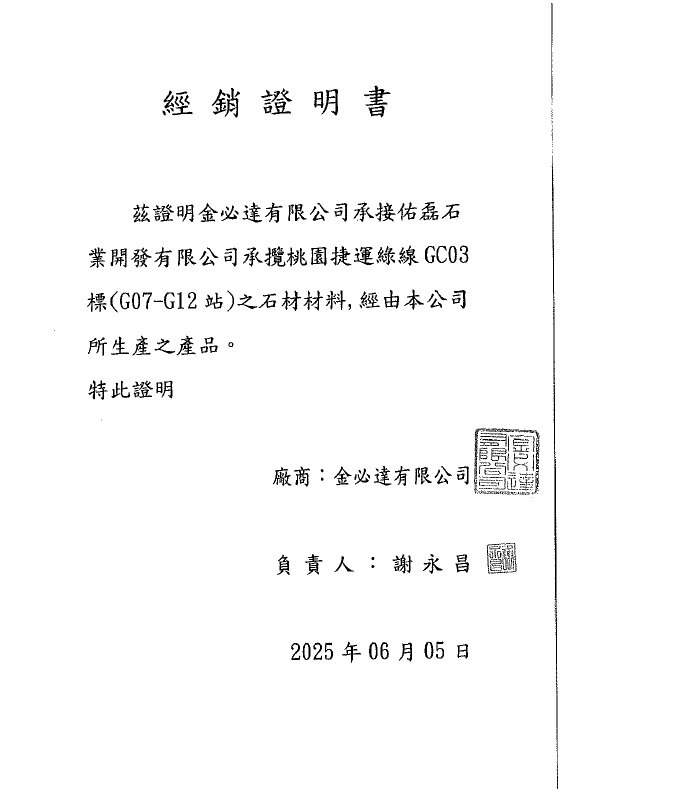
The MEO further emphasized that regarding the ground improvement backfill at the North Depot of the Green Line, the original budget was over NT$100 million, but the city government increased it to nearly NT$600 million. Before Mayor Chang San-cheng took office, the North Depot project had gone through 20 meetings without a decision. After Chang and current MEO Director Liu Ching-feng took office in 2023, they pushed for progress. The architectural style was approved in January 2023, the first construction drawing in March 2023, and site leveling began in April 2023. While a typical metro depot takes 6 to 6.5 years, the MEO aimed for an external control schedule of 4 years and an internal target of 3 years and 8 months. Within 1 year and 3 months, the North Depot Management Center was topped out; within 1 year and 5 months, the four core buildings were structurally complete; within 1 year and 6 months, the main substation was energized; and within 1 year and 8 months, the first train entered the depot. Major milestones were achieved in less than 2 years. The claim of NT$100 million for soil improvement refers to the remediation of contaminated soil at Shenmeipi, which could not be removed. The NT$100 million was allocated by the Environmental Protection Bureau to treat the contaminated land by mixing in clean soil for dilution. This was solely for pollution remediation of the original Shenmeipi area, where the soil was loose and unsuitable for construction. The cement mixing method was used to strengthen the soft pond soil, not for structural purposes. As early as April 2019, the Green Line project management consultant recommended an additional NT$720 million for ground improvement using cement treatment. However, the MEO calculated that only NT$599 million was needed. Due to delays by the previous director, it was not until Chang San-cheng and Liu Ching-feng took office that the consultant recommended incorporating the soil remediation into the contract change for relocating the North Depot to Shenmeipi. To ensure transparency, the MEO convened a clean government platform meeting with the Agency Against Corruption, the District Prosecutors Office, the Investigation Bureau, and the Ethics Office. External experts were also invited. After comparing various methods, the experts unanimously agreed that the cement mixing method would save time and money while improving ground strength. All parties confirmed that proceeding with a contract change was appropriate, and the process was complete, leading to the current construction progress at the North Depot. Regarding the control center leak in May due to poor construction quality, the MEO explained that the roof was still under construction at that time. The waterproof layer, insulation board, and concrete screed were not yet finished, so it could not be waterproof. This was not a quality issue. Before the permanent waterproof layer was completed, temporary waterproof paint was applied to seepage areas, and water-swelling materials were injected. The MEO also addressed media inquiries about Director Liu's trip to Germany to visit Siemens, which included stops in Nordic countries, suggesting it was a disguised vacation. In reality, the MEO had submitted a plan in 2024, approved by the city government, to "inspect cultural assets in Finland and Sweden and the world's longest public art subway corridor." This was a joint trip with the Cultural Affairs Bureau to study public art installation and cultural asset revitalization. Since the northern section of the Green Line (7 stations) is scheduled to open in 2026, signal system integration needed to be expedited. On May 13 of this year, Director Liu reported to Mayor Chang that a visit to Siemens headquarters in Germany was necessary. On June 3, Chang approved combining Liu's trip to Germany for signal progress discussions with the existing Nordic plan, adding 3 days to the original itinerary to save travel time and public funds. On September 3, German time, Liu successfully met with Siemens senior management, who pledged full cooperation. After Liu's return, Siemens began full-scale signal installation on September 26, demonstrating the effectiveness of the trip. The MEO further clarified that the Taoyuan Metro Green Line is a large-scale design-build project. The city government specifies functional requirements for trains and stations, and contractors complete preliminary designs for approval before construction. The review process involves nationally renowned engineering consulting firms as project managers, with key items also subject to external third-party review. Unlike traditional projects requiring complete design before bidding, design-build emphasizes functionality. Otherwise, completing detailed designs for all 21 stations before bidding would take at least 3 years. The claim that the MEO allowed construction without design review to expedite the schedule is false. Regarding reports that the Taoyuan Audit Office had concerns and referred the case to the Taoyuan District Prosecutors Office, the prosecutors denied receiving any information about construction material irregularities. Director Liu noted that large metro projects inevitably involve disputes between contractors and subcontractors. The city government maintains that all metro construction is legal and compliant. Even if some individuals spread false claims to the media, the city government will continue its original schedule toward the goal of opening the first phase of 7 stations in 2026.
Source: Read the original article | Published: October 28, 2025