
Editor's Note
This editor’s note highlights the key facts and market implications behind “Taoyuan MRT Engineering Bureau Refutes Allegatio”, with emphasis on sourcing, product fit, fabrication, logistics, or buyer impact.
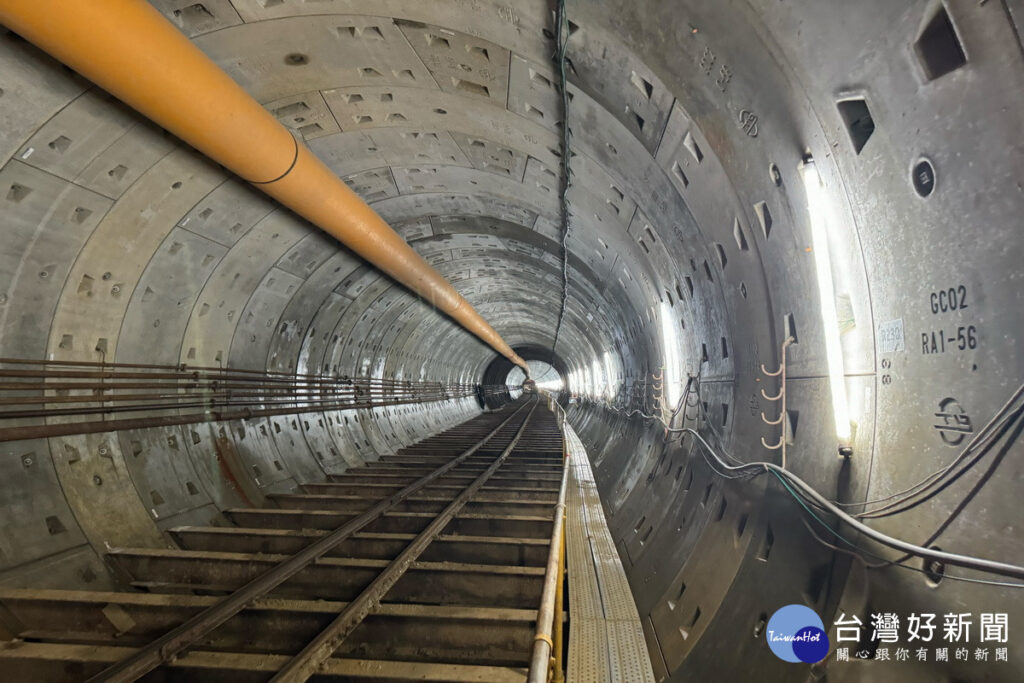
Taoyuan MRT Green Line tunnel boring machine breakthrough (file photo). The Taoyuan MRT Green Line project has been accused of using Chinese stone, allowing a suspended supplier to participate in procurement, failing to follow construction drawings, and having an excessive budget for backfill soil improvement. City Councilor Huang Qionghui also strongly criticized the project. On September 27, the Taoyuan City Government MRT Engineering Bureau issued a seven-point rebuttal to the allegations, emphasizing that all work is "legal and compliant," denouncing the reports as "malicious misinterpretation, not the truth," and reiterating the goal of opening seven stations in the northern section by 2026.
Stone Material Clarification
In response to a weekly magazine's allegation that the Green Line station stone materials were made in China, the MRT Engineering Bureau clarified that the central floor area of the stations is paved with "sintered stone tiles" from Taiwan's Jing Gong Ceramics Company, not "stone" as reported. As for the "stone" used for the border trim in the station public areas, the originally approved supplier was Xiamen Qiancheng Company. However, after the main contractor discovered on June 5, 2025, that the product was made in China, it proactively switched to a domestic supplier. The stone is now provided by another supplier, Jinbida Company, and will be imported from India. Installation is expected to begin this Wednesday.
The bureau emphasized that the photos cited in the report show the already-laid "sintered stone tiles," not "stone," and the stone work has not yet started. Therefore, the claim that "the Taoyuan MRT Green Line project has already used Chinese stone" is absolutely false.
Supplier Suspension Issue
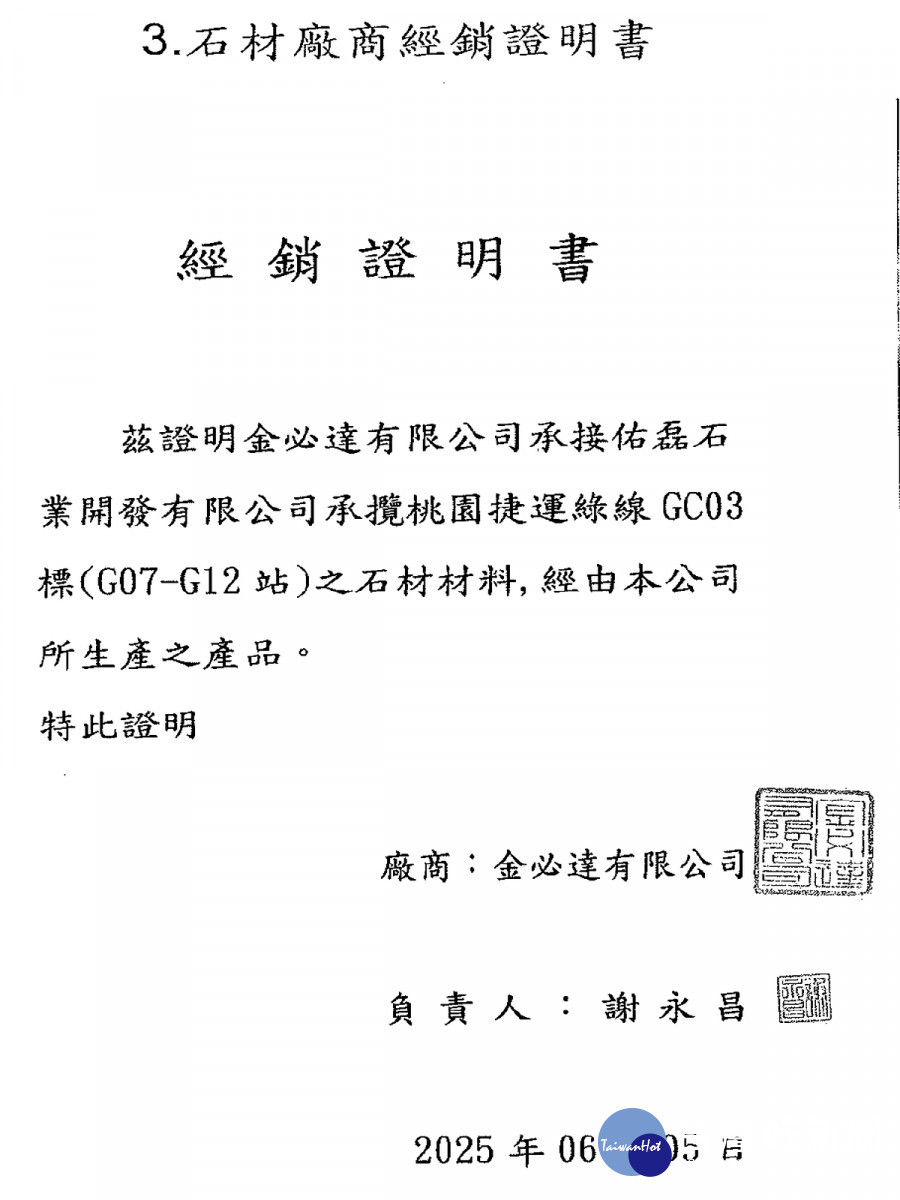
Regarding the allegation that a material supplier, despite being suspended by the Public Construction Commission, continued to supply materials, the MRT Engineering Bureau stated that after the supervising unit discovered the supplier was suspended on April 23, 2024, it immediately reported to the bureau. After consulting with a law firm and the Public Construction Commission, it was confirmed that if the suspended supplier had signed a contract before the suspension, it could continue to perform the contract without retroactive effect. The bureau stressed that the supplier's continued supply complies with the Government Procurement Act, and the process was reviewed by the Ethics Office, ensuring all procedures were complete. The bureau provided a distribution certificate showing that the stone is supplied by another company, Jinbida.
Tile Joint Width Controversy
Allegations that the tile joint width of 10mm does not meet the standard of 6mm, potentially involving favoritism worth NT$10 million, were refuted by the bureau. The bureau stated that the construction specification for Taoyuan MRT floor tiles requires a joint width of "not greater than 10mm," and the 10mm width used on site fully complies with the contract. The bureau further noted that MRT stations in Taipei, New Taipei, Taichung, Kaohsiung, and the Taoyuan Railway Station all use a 10mm joint width as standard practice, making the claim of "favoritism" baseless.
Budget Increase for Soil Improvement
Regarding the controversy over the budget for backfill soil improvement at the North Depot, which increased from the originally allocated NT$100 million to nearly NT$600 million, the bureau explained that before Mayor Chang San-cheng took office, the North Depot project had been unresolved after 20 meetings. After Mayor Chang and current Bureau Director Liu Qingfeng took office in 2023, they worked hard to accelerate progress, aiming to shorten the typical 6-6.5 year depot construction period to 3 years and 8 months. Director Liu explained that the original NT$100 million was allocated by the Environmental Protection Bureau for pollution remediation of the contaminated "Shenmeipi" land, using imported soil for dilution, not for constructing structural works. As early as April 2019, the project management consultant recommended an additional NT$720 million for soil improvement using a "cement treatment method," but the previous director delayed the decision. After Mayor Chang took office, an integrity platform and external review meeting with experts and scholars unanimously agreed that the "cement mixing method" would best save time and costs while improving ground strength. Therefore, a contract change of NT$599 million was approved, with complete procedures, leading to the current construction results. Liu emphasized that the budget increase was necessary to "catch up on the delays caused by the previous administration's inaction."
Water Leakage at Control Center
In response to water leakage at the control center during rain in May this year, the bureau stated that the roof was still under construction at the time, with permanent waterproofing, insulation boards, and concrete screed not yet completed, so it could not be waterproof. This was not due to poor construction quality. Temporary waterproof paint and water-stop expansion materials have been applied to the leaking areas.
Director’s Germany Trip
Regarding allegations that Director Liu Qingfeng's trip to Germany to visit Siemens was a "fake inspection, real vacation," the bureau responded that Director Liu added three days to an already-approved trip to Northern Europe to negotiate signaling progress with Siemens, saving public funds. After Liu returned, Siemens, responsible for the signaling system, began full construction on September 26, demonstrating the trip's significant benefits.
Design and Construction Process
In response to the accusation that the "construction team is designing while building," the bureau clarified that the Taoyuan MRT Green Line is a large-scale project using a "turnkey model." In this model, the city government specifies functional requirements, and the contractor completes preliminary design, which, after city government approval, allows construction to proceed. This differs from traditional projects requiring complete, detailed designs before construction, emphasizing functional completeness. The bureau stressed that all design reviews are conducted by nationally renowned engineering consulting firms as project management contractors, and key items are also subject to external review by third-party impartial entities. This is not, as reported, "construction without design review." Director Liu stated that in the face of malicious slander against the MRT project, the city government will adhere to the principle of legality and compliance, follow the established acceleration schedule, and firmly advance toward the goal of opening the first phase of seven stations by 2026.
Source: Read the original article | Published: October 27, 2025