
Editor's Note
This editor’s note highlights the key facts and market implications behind “ITC Director Yolanda Reig: “For us, electrificat”, with emphasis on sourcing, product fit, fabrication, logistics, or buyer impact.
The latest milestone, and probably the most important, is to advance the change in the organization's culture. The environment changes rapidly, the sector does too, and the needs of the industry are constantly evolving. We must respond without losing the essence of being a knowledge-generating center and a non-profit entity, but by implementing a vision of efficiency closer to the needs of a company. Among my objectives has also been to implement a corporate governance system that integrates principles of transparency, regulatory compliance, and sustainability. For this, in 2025 we have continued with our corporate sustainability system, the renewal of the register of socially responsible entities, the calculation of social impact (SROI), and the start of the certification process according to ISO 45001.
In 2025, we carried out a total of 119 private R&D&I projects and services with 92 companies and 10 entities and institutions, amounting to €1,969,834.38, while we developed 58 projects with public funding from regional, national, and European administrations, reaching €4,345,314.64. In addition to this, we performed a number of advanced services for companies, reaching 16,913.
In the Chemical Engineering degree, there was indeed a certain orientation towards ceramic technology in the final years. We currently have the UJI's Bachelor's Degree in Chemical Engineering, which provides essential knowledge to work in any industrial sector, including ceramics. But, furthermore, since 2021 we have had the UJI's Master's in Permanent Training in Ceramic Technology, in which a significant number of ITC teaching staff participate. In the last five years, 166 people have taken it. It is an excellent master's program that is helping both companies and students to grow and to have quality training to work in the ceramic sector.
Interview
ITC Director Yolanda Reig: "For us, electrification is the ideal solution for ceramic tile manufacturing"
A native of Alicante and a graduate in Chemical Sciences and a PhD in Food Science from the University of Valencia, she has led the flagship of research in the ceramic sector since 2024. She argues that "innovation has ceased to be an option to become a key tool for adaptation and resilience," and on that path, the ITC works with the cluster to develop projects and activities serving the needs of companies. With €9.1 million in revenue and 132 workers in 2025, the center faces a 2026 of major challenges.
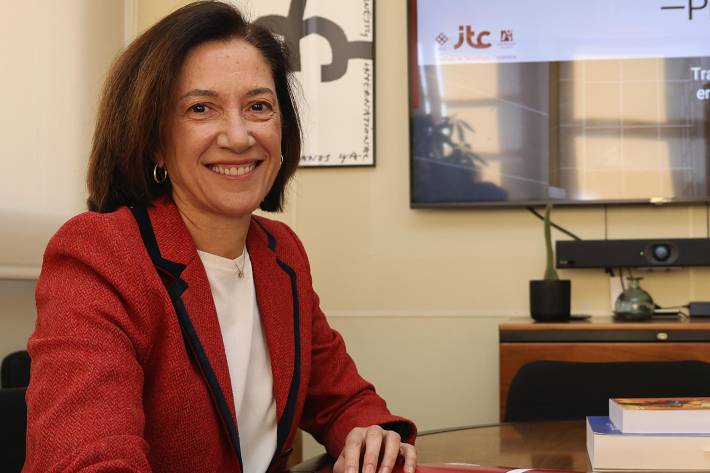
Yolanda Reig is the director of ITC-AICE.
(EUGENIO TORRES)
What assessment can you make of the 2025 financial year for the ITC? What milestones would you highlight?
The assessment of 2025 has been positive. I want to highlight the great effort made by the entire team to, at the same time, grow in knowledge, transfer research results from the laboratory to industry, and drive innovation in companies. All with a clear goal: to research with real impact.
During 2025, I would highlight several milestones, although it is worth remembering that our main work focuses on supporting a sector fundamental to our province in its innovation processes. This year, 69% of our activity has focused on this area, working not only with companies in the ceramic cluster but also with the business associations and entities that support it.
The first milestone is linked to the policy of promoting technology transfer from the center. In September 2025, AICE's participation in TEKINN was made public, establishing the first spin-off of our center, based at Espaitec, at the UJI. It is a major challenge for the ITC because it changes our vision of innovation, but it is also a way for R&D results that, due to their high risk or being considered not yet mature, do not find business investment, to reach the market. Thanks to the REDIT Ventures investment initiative, it has been possible to take this step.
The second milestone has been adapting knowledge to the current and real needs of the industry. Our priority research lines in 2025 have been three: decarbonization, artificial intelligence, and chemical technologies.
“Our priority lines in 2025 have been three: decarbonization, artificial intelligence, and chemical technologies”
In the field of decarbonization, we have continued working on the electric kiln for firing ceramic tiles to verify consumption and performance, analyze emission profiles, and evaluate the scalability of the technology. We are also working on CO2 capture technologies thanks to the development of a capture prototype simulating these emissions at real industrial concentrations. In the green hydrogen line, we have conducted combustion tests with H2 that was generated using a prototype electrolyzer located in our facilities, developed by an engineering firm and another R&D center. Finally, the performance of burners has been evaluated and redesign proposals have been made to improve their efficiency.
Regarding the use of Artificial Intelligence…
Source: Read the original article | Published: April 19, 2026