
Editor's Note
This editor’s note highlights the key facts and market implications behind “Tile Industry Estimates 300 Million Euros Annual”, with emphasis on sourcing, product fit, fabrication, logistics, or buyer impact.
The Spanish ceramic tile industry is entering the second quarter of the year with maximum uncertainty over the publication of free CO2 emission allowances for gas-intensive industries for the period 2026-2030, a step by the European Commission within the Emissions Trading System (ETS) that the sector expected this April. Expectations are at their peak, as if Brussels gives the green light to the initial 34% cut compared to the 2021-2025 period, the tile sector's direct CO2 costs would rise to between 109 and 163 million euros.
Business leaders go further and fear the impact the ceramic industry would suffer if Brussels continues with its decarbonization timeline – for 2040 it has set a target of reducing emissions by 90% – and decides to completely withdraw the free emission allowance concessions.
Industry sources indicate that "the worst is the future, as EU policy is to reduce free allocations until they disappear completely, which could mean an additional cost for the sector, in this case, of more than 300 million euros, with the uncertainty of whether it will be possible to continue buying emission rights, what their price will be, or if in any case nothing can be emitted."
“the worst is the future, as EU policy is to reduce free allocations until they disappear completely, which could mean an additional cost for the sector, in this case, of more than 300 million euros, with the uncertainty of whether it will be possible to continue buying emission rights, what their price will be, or if in any case nothing can be emitted.”
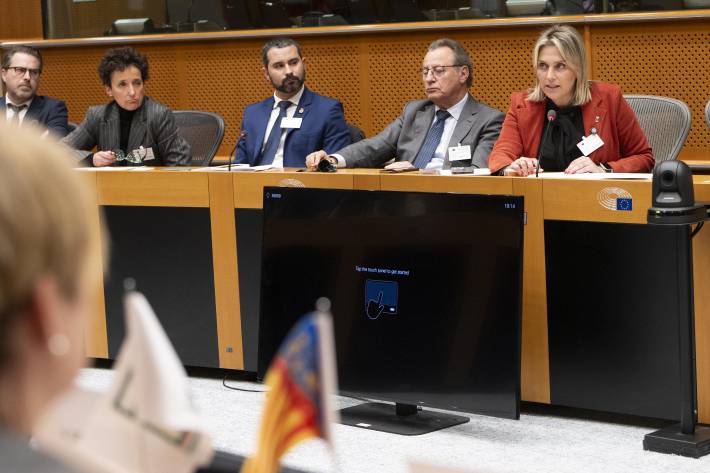
The additional cost exceeding 300 million euros would double the 'blow' from the 34% cut, which has kept the industry on edge since last November and has motivated an intense pressure campaign that led the Spanish (Ascer) and Italian (Confindustria Ceramica) trade associations, as well as the regional governments of the Valencian Community and Emilia-Romagna, and several political representatives from the province and European deputies, to sign a manifesto in defense of the industry last March.
For the moment, the European Commission has not yet published the new benchmark criteria, a procedure that, if carried out according to initial forecasts, would give rise to the aforementioned 34% adjustment. Industry pressure remains at its peak, and even the central government, through the Ministry of Industry, has recently sent a letter to the European Commission urging it to assess the technological reality of gas-intensive industries such as ceramics – which have no alternative energy source to gas – and to halt the aforementioned cut through a mechanism for separating sub-installations.
It should be recalled that the additional cost exceeding 160 million euros – and 300 million if free allocations disappear – comes from a double path. On the one hand, the foreseeable need to resort to the market to buy free emission allowances in order to maintain stable production. On the other hand, the ton of CO2 will become more expensive, because as free emission allowances are reduced, demand in the private market will increase.
The business leaders consulted insist that non-EU countries against which the sector competes emit more CO2 in their processes. "We must take into account that the Spanish ceramic sector exports more than 70% of its production to countries where there are other producers not subject to emissions trading. This difference of 30 to 40 cents in an average export price that Spain has of just over 10 euros means a lot compared to products manufactured in India or China, where not only are they not subject to emissions trading, but they also have energy, in many cases, much cheaper than in Europe," reiterates a veteran tile manufacturer.
Source: Read the original article | Published: April 26, 2026