
Editor's Note
This editor’s note highlights the key facts and market implications behind “Tile Anti-Dumping Investigation Could Lead to 6,”, with emphasis on sourcing, product fit, fabrication, logistics, or buyer impact.
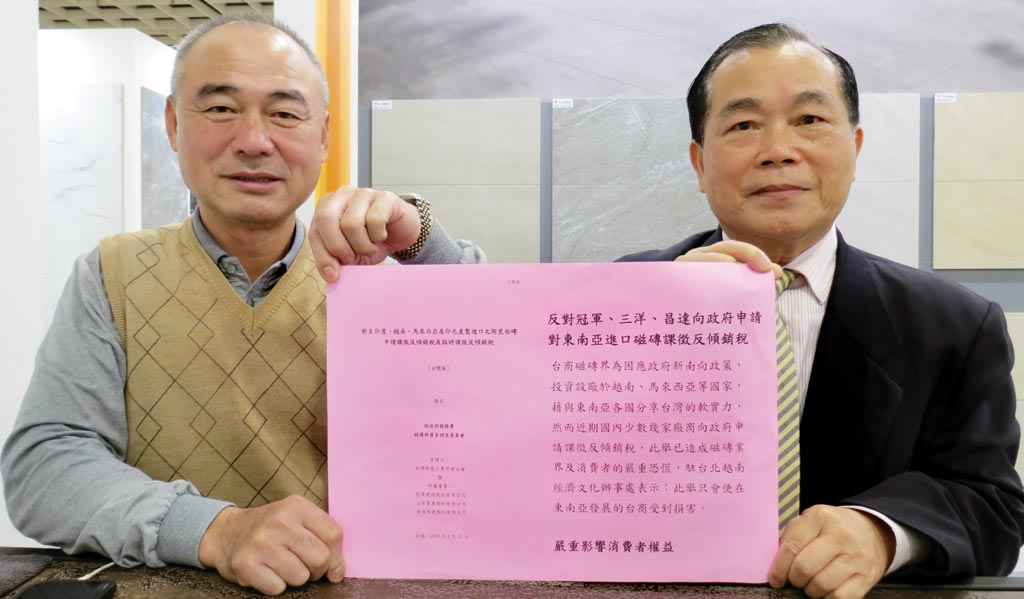
Chen Yu-kai (left), Chairman of the Taiwan Tile Development Association, and Lai Fu-yuan (right), Secretary-General, urge the government to halt the anti-dumping investigation into tiles from four Southeast Asian countries. Photo by Fu Bing-xiang.
In response to the government's plan to launch an anti-dumping investigation into tiles from four Southeast Asian countries (India, Indonesia, Malaysia, and Vietnam), Chen Yu-kai, Chairman of the Taiwan Tile Development Association (TTDA), strongly urged and proposed three demands: opposition to tile anti-dumping, opposition to tile price increases, and opposition to unreasonable policy protection. He stated that if the investigation proceeds solely based on a petition from three companies in the Taiwan Ceramic Industry Association, and heavy tariffs are imposed on these four countries, the consequence would force more than half of the nearly 200 importers to close. With an average of 60 employees per importer (ranging from over 20 to 100), this would conservatively result in 6,000 job losses. The reporter conducted an exclusive interview with Chairman Chen.
Q: Why is the government imposing anti-dumping measures on tiles from Southeast Asian countries and India, with tariffs of 50% or even higher?
A: The main reason is that domestic manufacturers have not sought breakthroughs in fundamental industry issues or product enhancement. Instead, they have taken advantage of administrative measures to suppress competition. When these measures proved ineffective, they resorted to filing for anti-dumping duties on tiles, attempting to block foreign tiles with high tariffs. This action is highly questionable and has broad implications. Currently, not only tile importers oppose it, but also the construction investment industry, the construction industry, and professionals. Secondly, I want to express my opposition to the imposition of anti-dumping duties and provisional anti-dumping duties on imported tiles. Consider that the current import tariff on tiles in Taiwan is 10%. If anti-dumping duties are imposed, the total tariff rate on imported tiles is estimated to rise to between 30% and 100%. This would harm not only importers who rely on this business but also domestic manufacturers that import tiles from India and Southeast Asia. If imposed, some may take the opportunity to inflate tile prices, leading to higher housing costs, which would be detrimental to consumers and the construction industry. Additionally, ceramic raw materials such as clay, gas, glaze auxiliaries, and foreign labor are all imported. Coupled with expensive advanced equipment, low willingness among manufacturers to invest in equipment, process pollution, labor costs under the Labor Standards Act, and pollution control costs under environmental regulations, it is clear that the high-pollution, high-energy-consumption tile manufacturing industry is no longer suitable for production in Taiwan. The government should stop protecting it.
Q: If domestic tile production is no longer suitable for local manufacturing, how should manufacturers adapt?
A: Currently, the Taiwanese tile market is fully open to imports from all countries except mainland China. Taiwan's production value is low, and export value is even lower. Transformation and international trade are the best principles for sustaining the industry. Moreover, domestic tile kilns are aging. Most Taiwanese kilns are short, at most over 100 meters. In contrast, foreign kiln lines I have seen are mostly 250 meters or 400 meters, with high output, stable quality, diverse and beautiful patterns, and low costs. Taiwan simply cannot compete. Foreign countries use more advanced equipment such as the SYSTEM or SACMI "roller-pressed tile" systems, while domestic manufacturers still largely use traditional "mold-pressed tile" equipment. It is truly difficult to compete with foreign counterparts. Left with no other options, they resort to slander, insults, and erecting trade barriers.
Chen Yu-kai emphasized that imposing anti-dumping duties and provisional anti-dumping duties on tiles from the four countries involved would inevitably face severe challenges at the WTO. Other industrial products from Taiwan would likely face retaliation, severely impacting relations with New Southbound countries. Joining the Regional Comprehensive Economic Partnership (RCEP), the Comprehensive and Progressive Agreement for Trans-Pacific Partnership (CPTPP), or bilateral trade agreements would become even more difficult.
Source: Read the original article | Published: December 19, 2020